How successive govts enabled land grabs in the name of religion
December 5, 2025
  • Read Ecopy
  • Circulation
  • Advertise
  • Careers
  • About Us
  • Contact Us
Android AppiPhone AppArattai
Organiser
  • ‌
  • Bharat
    • Assam
    • Bihar
    • Chhattisgarh
    • Jharkhand
    • Maharashtra
    • View All States
  • World
    • Asia
    • Europe
    • North America
    • South America
    • Africa
    • Australia
  • Editorial
  • International
  • Opinion
  • RSS @ 100
  • More
    • Op Sindoor
    • Analysis
    • Sports
    • Defence
    • Politics
    • Business
    • Economy
    • Culture
    • Special Report
    • Sci & Tech
    • Entertainment
    • G20
    • Azadi Ka Amrit Mahotsav
    • Vocal4Local
    • Web Stories
    • Education
    • Employment
    • Books
    • Interviews
    • Travel
    • Law
    • Health
    • Obituary
  • Subscribe
    • Subscribe Print Edition
    • Subscribe Ecopy
    • Read Ecopy
  • ‌
  • Bharat
    • Assam
    • Bihar
    • Chhattisgarh
    • Jharkhand
    • Maharashtra
    • View All States
  • World
    • Asia
    • Europe
    • North America
    • South America
    • Africa
    • Australia
  • Editorial
  • International
  • Opinion
  • RSS @ 100
  • More
    • Op Sindoor
    • Analysis
    • Sports
    • Defence
    • Politics
    • Business
    • Economy
    • Culture
    • Special Report
    • Sci & Tech
    • Entertainment
    • G20
    • Azadi Ka Amrit Mahotsav
    • Vocal4Local
    • Web Stories
    • Education
    • Employment
    • Books
    • Interviews
    • Travel
    • Law
    • Health
    • Obituary
  • Subscribe
    • Subscribe Print Edition
    • Subscribe Ecopy
    • Read Ecopy
Organiser
  • Home
  • Bharat
  • World
  • Operation Sindoor
  • Editorial
  • Analysis
  • Opinion
  • Culture
  • Defence
  • International Edition
  • RSS @ 100
  • Magazine
  • Read Ecopy
Home Bharat

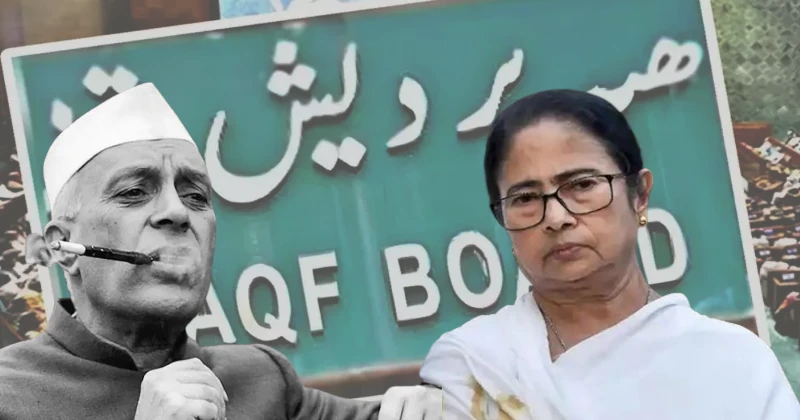
Nehru’s ‘Waqf by user’ to Mamata’s Islamist Appeasement: How successive govts enabled land grabs in name of religion

Nehru's 1954 Waqf Act, especially the 'Waqf by User' clause, laid the foundation for institutionalised land grabs under the guise of religious charity, privileging Islamic bodies while marginalising others. Successive leaders like Mamata Banerjee have amplified this legacy through aggressive minority appeasement at the cost of national unity and justice

WEBDESKWEBDESK
Apr 17, 2025, 05:00 pm IST
in Bharat
Follow on Google News
FacebookTwitterWhatsAppTelegramEmail

When Jawaharlal Nehru signed the Waqf Act of 1954 into law, he did more than just introduce legislation for managing Islamic religious endowments he carved out a separate, preferential legal ecosystem for Islamists, directly undermining the secular fabric of the nation he claimed to uphold. Hidden within this Act was a dangerous and insidious clause that continues to wreak havoc on property rights across India: ‘Waqf by User’.

This provision allowed Islamic bodies to claim any land as Waqf property based solely on evidence of historical use for religious or charitable purposes even in the absence of a formal Waqf deed. In simple terms, if a piece of land had once seen a namaz offered under a tree or a charity meal served to a handful, it could now be claimed permanently as Islamic property. No ownership title. No transfer documents. No registration needed.

Nehru’s obsession with appeasement of Islamists and his desperation to be seen as a secular icon abroad blinded him to the devastating consequences his decisions would have on India’s future. His so-called secularism was a deeply flawed, one-sided arrangement where the state aggressively controlled Hindu religious institutions and their wealth, while empowering Islamic bodies with unchecked autonomy and property rights.

Even as temples across Bharat were being taken over by state governments, Waqf Boards were being handed the legal means to expand their property portfolios without opposition. Nehru gave birth to a parallel system where Muslims, through the Waqf mechanism, could claim land without proof, while Hindus faced government control, audits, and bureaucracy in their temple management.

‘Waqf by User’ is a draconian concept introduced by the Nehru government in 1954, just seven years after he permitted the creation of Pakistan in the name of religion. This move was yet another law that enabled Muslims to claim land parcels owned by Hindus in India. Nehru was a… pic.twitter.com/6tVPn4cQYv

— Amit Malviya (@amitmalviya) April 17, 2025

The 1954 Act was not born out of any pressing social need; it was a calculated political move. Seven years after agreeing to the creation of Pakistan — the greatest partition based on religion in modern history — Nehru decided to reward the same ideology within India by empowering Islamic institutions and legitimising religious land grabs.

The Central Waqf Council, created under this Act, would later oversee an empire of unimaginable scale. Today, Waqf Boards are one of the largest non-governmental landowners in India, holding over 6 lakh acres of land. And thanks to Nehru’s ‘Waqf by User’ clause, a vast chunk of this land was acquired not through purchase or donation, but by exploiting a legal loophole that would never be permitted for any other religion.

In contrast, Hindu religious institutions — whose existence predates Islamic arrival in Bharat by millennia — are heavily regulated, audited, and even looted by the state, with no equivalent legal route to protect or reclaim their lands from encroachment.

If Nehru planted the seed, successive Congress and secular governments nurtured the tree. The 1995 amendment to the Waqf Act created Waqf Boards in every state and union territory, giving them the power to survey, list, and claim land across Bharat — often without notice to current landholders. These Boards operate with quasi-judicial authority, functioning beyond the scrutiny that other public bodies face.

Perhaps the most outrageous example of this overreach came when the Uttar Pradesh Sunni Waqf Board claimed the Taj Mahal as its property — a UNESCO heritage monument built by Mughal royalty using state resources of that time. The absurdity of this claim underscores the unchecked audacity given to Waqf Boards under Nehru’s framework.

Nehru’s 1954 decision was not a one-off miscalculation — it was part of a consistent pattern of minority appeasement that would continue for decades. From Haj subsidies funded by Hindu taxpayers, to the Shah Bano U-turn in 1985, to Manmohan Singh’s infamous declaration in 2006 and again in 2009 that “Muslims must have the first claim on national resources” — every government walking Nehru’s path has continued to favour one community in the name of secularism.

While Hindus fought legal battles to protect their temples, ancestral homes, and pilgrimage sites, Waqf Boards expanded without restraint, often bulldozing over local records, municipal objections, or public sentiment.

Fast forward to present-day West Bengal, and we see Mamata Banerjee walking in Nehru’s footsteps — with added zeal. Under her tenure, allegations of illegal land grabs in the name of Waqf have surged. Local reports have emerged of Hindu families being driven out, lands quietly marked as Waqf without notice, and government silence in the face of mounting grievances.

Islamic appeasement has become the bedrock of her political strategy. From stipends for imams to unofficial ‘Waqfisation’ of village lands, Mamata’s governance model echoes and amplifies Nehru’s vision: securing minority votes at the cost of civilisational justice and national integrity.

Jawaharlal Nehru’s Waqf Act was not a secular policy — it was a betrayal of the majority. It created a second-tier legal framework that disadvantages Hindus and other communities while privileging Islamic religious institutions with unchecked powers.

Topics: Jawaharlal Nehrunehru governmentWaqf ActMamata GovernmentWaqf Act 1954Waqf Amendment actWaqf by User
ShareTweetSendShareSend
✮ Subscribe Organiser YouTube Channel. ✮
✮ Join Organiser's WhatsApp channel for Nationalist views beyond the news. ✮
Previous News

Uttar Pradesh: Outrage in Aligarh after Khwaja hotel uses napkins featuring Hindu deities; Owner Salim arrested

Next News

“Judges acting as super parliament, and have no accountability”: VP Jagdeep Dhankhar’s stern remarks on judiciary

Related News

Defence Minister Rajnath Singh(File Photo)

‘Nehru wanted Babri Masjid built with public funds, Patel opposed it’: Rajnath Singh at Unity March in Gujarat

SIR in West Bengal: Voter list cleanup flags 10 lakh invalid entries; Massive rot of Mamata-led TMC government exposed

SIR In West Bengal: Krishnaganj exodus exposes illicit vote bank of TMC

‘Vande Mataram’ Betrayed: How Nehru’s appeasement politics silenced Bharat’s national song

Maniben: Devoted daughter who nursed Sardar Patel for 41 years from 1909 to 1950 after her mother Javerbha’s death

Jawaharlal Nehru (Left) and Sardar Vallabhbhai Patel (Right)

Major Conflicts Between Sardar Patel and Nehru: How Nehru’s policies undermined Sardar Patel’s united Bharat vision

Load More

Comments

The comments posted here/below/in the given space are not on behalf of Organiser. The person posting the comment will be in sole ownership of its responsibility. According to the central government's IT rules, obscene or offensive statement made against a person, religion, community or nation is a punishable offense, and legal action would be taken against people who indulge in such activities.

Latest News

BJYM leader Shyamraj with Janaki

Kerala: Widow of BJP worker murdered in 1995 steps into electoral battle after three decades at Valancherry

Russian Sber bank has unveiled access to its retail investors to the Indian stock market by etching its mutual fund to Nifty50

Scripting economic bonhomie: Russian investors gain access to Indian stocks, Sber unveils Nifty50 pegged mutual funds

Petitioner S Vignesh Shishir speaking to the reporters about the Rahul Gandhi UK citizenship case outside the Raebareli court

Rahul Gandhi UK Citizenship Case: Congress supporters create ruckus in court; Foreign visit details shared with judge

(L) Kerala High Court (R) Bouncers in Trippoonithura temple

Kerala: HC slams CPM-controlled Kochi Devaswom Board for deploying bouncers for crowd management during festival

Fact Check: Rahul Gandhi false claim about govt blocking his meet with Russian President Putin exposed; MEA clears air

Union Minister for Road Transport and Highways Nitin Gadkari (Right)

India set for highway overhaul as Union Minister Nitin Gadkari unveils nationwide shift to MLFF electronic tolling

RSS Akhil Bharatiya Prachar Pramukh Shri Sunil Ambekar

When Narrative Wars result in bloodshed, countering them becomes imperative: Sunil Ambekar

Ministry of Civil Aviation mandates emergency action: IndiGo ordered to stabilise flight operations by midnight

Chhattisgarh CM Vishnu Deo Sai at Panchjanya Conclave, Nava Raipur, Image Courtesy - Chhattisgarh govt

Panchjanya Conclave: Chhattisgarh CM Sai shares views on development projects in Maoist hotbed, women empowerment

Union Finance Minister Nirmala Sitharaman

‘TMC is holding Bengal back’: Sitharaman slams Mamata govt over industrial & healthcare setbacks

Load More
  • Privacy
  • Terms
  • Cookie Policy
  • Refund and Cancellation
  • Delivery and Shipping

© Bharat Prakashan (Delhi) Limited.
Tech-enabled by Ananthapuri Technologies

  • Home
  • Search Organiser
  • Bharat
    • Assam
    • Bihar
    • Chhattisgarh
    • Jharkhand
    • Maharashtra
    • View All States
  • World
    • Asia
    • Africa
    • North America
    • South America
    • Europe
    • Australia
  • Editorial
  • Operation Sindoor
  • Opinion
  • Analysis
  • Defence
  • Culture
  • Sports
  • Business
  • RSS @ 100
  • Entertainment
  • More ..
    • Sci & Tech
    • Vocal4Local
    • Special Report
    • Education
    • Employment
    • Books
    • Interviews
    • Travel
    • Health
    • Politics
    • Law
    • Economy
    • Obituary
  • Subscribe Magazine
  • Read Ecopy
  • Advertise
  • Circulation
  • Careers
  • About Us
  • Contact Us
  • Policies & Terms
    • Privacy Policy
    • Cookie Policy
    • Refund and Cancellation
    • Terms of Use

© Bharat Prakashan (Delhi) Limited.
Tech-enabled by Ananthapuri Technologies