





This would be a good time to jog your memory about what our school history textbooks vaguely covered in a few paragraphs. For, the significance of the Amritsar massacre would not become evident unless you gauge what the conglomeration was protesting against at Jallianwala Bagh on April 13, 1919, on the auspicious eve of Baisakhi. The British colonial government had passed the Anarchical and Revolutionary Crimes Act on March 18, 1919. The purpose of the Act, named after Sir Sidney Rowlatt, was to curb the growing nationalist upsurge in the country. The unpopular legislation provided for stricter control of the press, arrests without warrant, indefinite detention without trial, and juryless trials for proscribed political acts. The accused were denied the right to know the accusers and the evidence used in the trial. Those convicted were required to deposit securities upon release, and were prohibited from taking part in any political, educational, or religious activities. Two bills, called Black Bills, were introduced and they gave enormous powers to the police to search a place and arrest any person they disapproved of without a warrant.
It was to raise their voices against this draconian act that the crowd had gathered in Jallianwala Bagh. They were not armed and, as per the directions of Mohandas Karamchand Gandhi, who had wanted Indians to stage a satyagraha against Rowlatt Act, this was ordained to be a peaceful protest. Or else why would women and little children be present at the ground that in a matter of a few minutes turned into a bloodied hellhole for the innocents who had gathered there. Karan Singh Tyagi’s Kesari Chapter 2, without dilly dallying, hurls you at this moment in April 1919. And, just like how in ten minutes Jalianwala Bagh became a point from where Indian history never stayed the same, Debojeet Ray’s camera brilliantly captures in a series of tight shots the threadbare reality of the brutal hatred unleashed by the Butcher of Amritsar, Brigadier-General Reginald Dyer, over unsuspecting men, women and worst of all, children.
If the last one hour of the 2021 biopic Sardar Udham had director Shoojit Sircar present a realistic portrayal of the massacre through an extended and graphic sequence that justified why Udham Singh (one of Vicky Kaushal’s best performances till date) ardently desired revenge from Michael O’Dwyer, the Lieutenant-Governor of Punjab at that time, consider the opening sequence of Tyagi’s work a substantiated continuation of it. This will prepare you abundantly for the riveting courtroom drama that follows. It will also reveal incriminating evidence that never really was out in public domain about how Dyer would go scotfree if one Sir Chettur Sankaran Nair wouldn’t sue the ‘Crown for genocide’.
It is while watching such cinema that the realisation dawns on the mind incessantly how Bharat’s academic historical literature has been presented through a severe colonial prism. Because, not only was the conspiracy not dwelled upon in detail but also because the brutality received just a passing mention in our school text books. While the highlight stayed on how Rabindranath Tagore and Gandhi condemned the massacre, we were never told about the perseverance of luminaries like Sir Nair who refused to grovel before the Imperial Crown when it truly mattered. At this juncture, one must also understand how though Gandhi launched the non-cooperation movement following the Amritsar massacre, the leader also forgave Dyer for it.
In 1938, Gandhi wrote: “General Dyer himself surely believed that English men and women were in danger of losing their lives if he did not take the measures he did. We, who know better, call it an act of cruelty and vengeance. But from General Dyer’s own standpoint, he is justified (sic).” As preposterous as this rationale may read, it also sets the stage for why people like Sir Nair ought to be brought into mainstream discussion even more. These are people who deserve respect and acclaim much more than a leader who allowed a nation to ignore the monstrosity of what Dyer did with weak and hypocritical justifications.
The narrative dealt with in the film clearly deduces how the massacre wasn’t a spur of the moment decision. It was a careful, pre-planned conspiracy by the representatives of the British crown channeled by hatred for Indians, shocking racism and a diabolical penchant to treat us as slaves if not animals. The extent of what Dyer had planned is even more heartless once you go through the nitty gritty of the case. Even if we discount that some portions were dramatized using artistic license, the editing is sharp enough to not let the mind wander off. The writing by Karan Singh Tyagi and Amritpal Singh Bindra is scrisp, keeping the attention engaged on the procedures employed by Sir Nair to bring Dyer down. Ray’s lens tautly displays the emotions on each of the character’s faces minutely, which was needed in a drama of this stature.
This is a story that our youth must discover. They ought to comprehend that India’s struggle for freedom wasn’t bloodless. Our countrymen and revolutionaries have spilled blood so that our motherland would get back her honour. They gave their all so that we live respectful, free lives. Yes, there is innocent blood smeared on every page of the chapters of our enslaved past tainted by the unwarranted cruelty of the colonisers. Kesari Chapter 2 is an effort to redeem the respect for sacrifices of our brave martyrs and instill pride in all those people who shook up the Crown by holding them accountable. Sumit Saxena’s fiery dialogues bring the pages of The Case That Shook The Empire by Raghu Palat and Pushpa Palat alive. A worthy screen adaptation for sure.
This is not the first time that the Jallianwala Bagh massacre is being depicted on celluloid. You have had the movie Jallian Wala Bagh in 1977 written, produced and directed by Balraj Tah, where the screenplay was done by Gulzar. But more than delving on the details of the incident, the film went on to show the aftermath centering on Udham Singh, played by Parikshat Shani. The Academy Award winning Gandhi by Richard Attenborough, hardly spent much time on it considering the script was more about the leader. Interesting, the film even shied away from showing how Gandhi later exonerated Dyer. Anshai Lal’s romantic comedy Phillauri delivers a poignant take on lovers getting separated when the boy gets shot during the Jallianwala Bagh massacre.
Hence, it is Sardar Udham, directed by Shoojit Sircar that is laudable for bravely showing the Jallianwala Bagh massacre for what it was. And how it galvanized the entire nation to rise against its colonial master and set India’s struggle for independence in motion. But if are to probe further into what led General Dyer to march into Jallianwala Bagh and execute such a heinous crime, what did the riots that had torn through Amritsar three days earlier on April 10th have to do with the massacre and what role did Michael O’Dwyer play all through this tragic episode, Kesari Chapter 2 is a good point to begin with. It might just ignite your inquisition in gauging whether Dyer was singularly responsible for the massacre, or was he acting maliciously on specific orders?
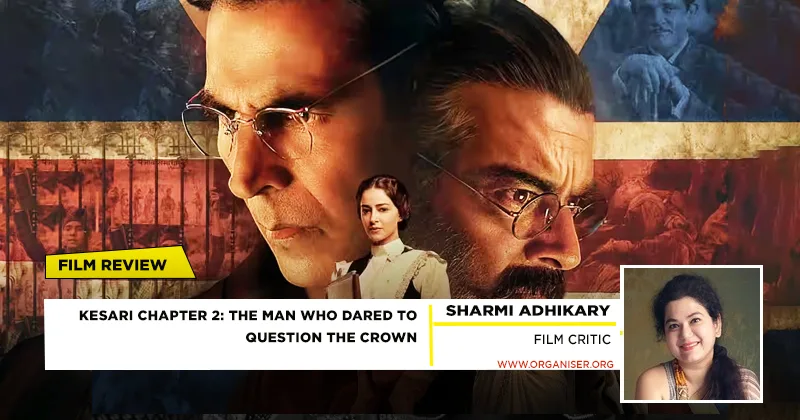
Putting the events surrounding the massacre under a microscope, the movie uncovers a deep conspiracy rooted in the colonial notion of white superiority. The show reimagines history based on the data found from the Hunter Commission’s inquiry, and deals with issues like racism, prejudice, whitewashing, half-truths and the redaction of history. Akshay Kumar who brings the action to the fore as Sir Sankaran Nair does not let his stardom take away from the importance of the matter and R Madhavan who plays Adv Neville McKinley makes it easy to understand what goes on in the minds of Indians who till date are brown sepoys psychologically. He is as he always is. Superb. Ananya Pandey is a surprise I would say. She is adequate as Dilreet Gill, a hardworking and passionate young lawyer who eggs Sir Nair to rise to the occasion when the need arises. If you are too used to Pandey’s glam-laden avatar, this would be a good chance to witness her stand strong in a part that gives her ample scope to emote.
The stage however belongs to Kumar, who after Anurag Singh’s Kesari (based on the battle of Saragarhi) shows how to take out a forgotten chapter from India’s colonial past and present it mindfully before an audience starved of good cinema. If Kesari had whetted your appetite for acknowledging what lesser known bravehearts of Bharat did against Islamic invaders, Kesari Chapter 2 is a full frontal war cry against the colonizers from the perspective of an Indian who deserves much more than an honorary title from the machiavellian imperialists.















Comments