





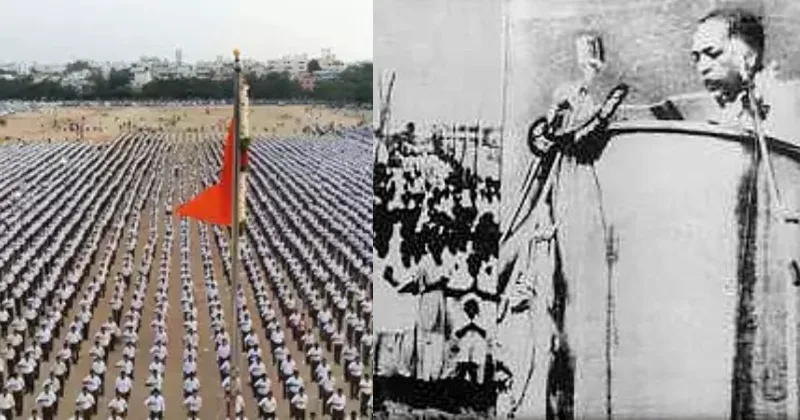
Dr Ambedkar’s idea is closely similar to RSS’s idea of Samrasta, in which love, affection and brotherhood towards all is a necessary element. RSS’s concept of Samrasta derives from Indian values, which believe that God is reflected everywhere in nature. Dr Ambedkar chose Gautam Buddha in 1956. He was under pressure from two Abrahamic religions – Christianity and Islam – for a long time. Socialism or Marxism was also one of the possible options before Dr Ambedkar, which denies the existence of religion. However, Dr Ambedkar chose India born Buddhism after a prolonged and deep study for almost two decades. Eternal values in ancient Indian philosophy greatly influenced Dr Ambedkar. His idea of equality was not superficial like western philosophies but was deeply rooted in India soil.
This is the same idea, for which RSS has been working for years. Equality is necessarily a psychological state of mind, which is a manifestation of intelligence and emotions. Mere proclamation of equality or legal provision of equality cannot bring about equality in its true spirit. India has a number of laws, which were enacted to promote equality but the inequality or discrimination continues as no efforts were taken to educate and awaken the people to bring it into practice. This is the precise area, where RSS has been working for years and the result can be seen. RSS believes that discrimination has no space in Hindu organisation and that equality was a fundamental qualification for organizing Hindus. The basic difference between equality sought by RSS and other organizations is very simple. For RSS, equality is `Swabhav’ while other organizations and ideologies look at it superficially.
This fundamental difference was never understood by Marxists in India and they engaged themselves in a poor attempt to portray Dr Ambedkar in a particular manner for their own political considerations. In an essay on Buddha and Marx, Dr Ambedkar says, “If the Marxists keep back their prejudices and study the Buddha and understand what he stood for I feel sure that they will change their attitude. It is of course too much to expect that having been determined to scoff at the Buddha they will remain to pray. But this much can be said that they will realise that there is something in the Buddha’s teachings which is worth their while to take note of.”
Similarity between equality expected by Dr Ambedkar and RSS can be drawn easily. Dr Ambedkar’s quest for equality originated from the philosophy of Buddha, which was based on human values like love, affection, empathy and brotherhood. RSS’s concept of `Samrasta’ has its origin in the same human values. Buddha and Dr Ambedkar emphasized on transforming a human being by changing his/her moral disposition and to follow the past voluntarily. The concept of `Samrasta’ underlines the same principle as it expects dissolution of all discriminatory grounds from one’s intelligence and emotions. Samrasta is not the principle to be mentioned in the books or speeches but to be practiced in real life for which intellectual and emotional transformation is required. At an intellectual level, almost everybody supports the principle of equality but that is not reflected in the social transactions. The reason is human values like love, affection, empathy and brotherhood are not allowed to blossom at an emotional level.
Dr Ambedkar was a staunch democratic and had deep commitment for freedom. He would have never followed Marx’s philosophy, which speaks of dictatorship. Communists believe in the dictatorship of the proletariat. No one can expect Dr Ambedkar to support any form of dictatorship even though it speaks for upliftment of deprived communities. Dr Ambedkar’s thrust was freedom from all the enslavements. He always insisted upon social and economic freedom along with political freedom. Dr Ambedkar had even warned that political freedom would be in danger if it was not accompanied by social and economic freedom. Communist model can never ensure any kind of freedom as Marx had specifically mentioned about dictatorship. Being a strong democratic, Dr Ambedkar would have never supported Communism. Dr Ambedkar’s commitment to democracy is reflected in the Indian Constitution, which is based on democratic principles.
The most remarkable milestone in Dr Ambedkar’s journey was the dissolution of All India Scheduled Caste Federation and formation of Republican Party of India. His political journey is strong evidence of his intellectual honesty, openness and strong commitment to equality and upliftment of deprived communities. After having a brief experience in the form of the Independent Labour Party (1937), Dr Ambedkar floated the All India Scheduled Caste Federation in July 1942. This was the first political experiment in India, which exclusively spoke for deprived communities. The first convention of SCF, which was held in Nagpur, passed nine resolutions and all of them were directly related with the interests of Scheduled Caste.
The Scheduled Caste Federation worked for 14 years and was dissolved in 1956 to form the Republican Party of India. In the same year, Dr Ambedkar embraced Buddhism in Nagpur. Dr Ambedkar announced the formation of the Republican Party of India but died in December in the same year before he could formally launch the party. Dr Ambedkar was well aware of the reality that the social base of Scheduled Caste Federation was bound to be restricted because of inbuilt social compulsions of the caste element. Dr Ambedkar never wanted to have a split in the society on any ground. He wanted to accommodate all the social groups in his political party but the name – Scheduled Caste Federation – was proving to be a big obstacle in his vision. Therefore, he chose a bigger and significant name, which was more accommodative. By launching the Republican Party of India, Dr Ambedkar made his intention clear that he was willing to take into confidence all the social groups and did not want to restrict himself to Scheduled Caste people. Dr Ambedkar was anti-Congress by nature. The Republican Party of India was willing to contest the election along with other anti-Congress parties. Unfortunately, Dr Ambedkar died before the official formation of the Republican Party of India. His colleagues, later, formed the party but the political party would have been different if Dr Ambedkar was alive.
Dr Ambedkar was necessarily a religious/spiritual person. This is the reason why he opted for Buddhism, which believes in peace and eternal human values. He had deep faith in Buddhism, which was born on Indian soil. He did not opt for any alien choice like two Abrahamic religions – Islam or Christianity. He was never attracted towards foreign ideologies like Socialism and Communism. He believed that peace in individual and social life can be brought through Buddhism, which stands for human transformation and eternal peace.
`Samrasta’ walks on the same line. `Samrasta” stands for eradication of any kind of discrimination. `Samrasta’ is neither a strategy nor policy but it is a matter of faith, belief and conviction. Like Dr Ambedkar, `Samrasta’ takes all the social trends and groups along with it. No scope for any separate identity as all of them are dissolved into Hindutva. `Samrasta’ stands for the theory of Adwait in which all the identities are mixed with each other in a natural process. Thoughts and actions of Dr Ambedkar suggest that equality is necessarily a state of mind and the concept of `Samrasta’ speaks the same.
















Comments