





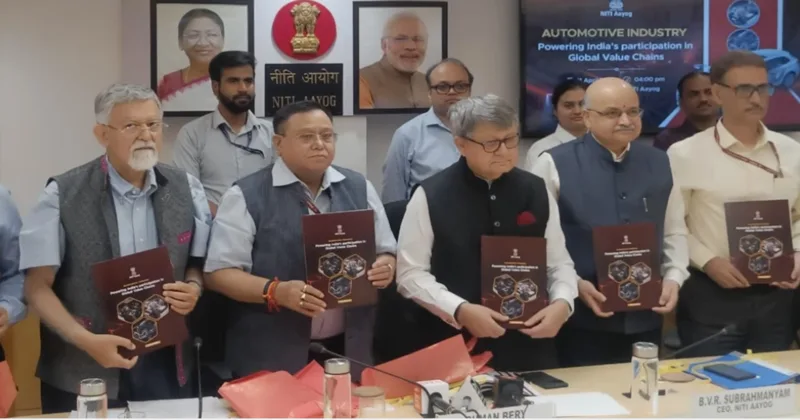
In a move to reposition India’s automotive sector on the global stage, NITI Aayog launched a comprehensive report titled “Automotive Industry: Powering India’s Participation in Global Value Chains” on April 11. The report was unveiled by NITI Aayog Vice Chairman Suman Bery in the presence of Members Dr. V.K. Saraswat and Dr. Arvind Virmani, along with CEO Shri B.V.R. Subrahmanyam.
The report presents a roadmap to accelerate India’s transition from being a domestic manufacturing hub to a major global automotive powerhouse, with an ambitious goal of raising India’s share in the global value chain (GVC) from 3 per cent to 8 per cent by 2030.
India’s Automotive Aspiration
With a clear vision for the future, the report sets forth a target of increasing auto component production to USD 145 billion by 2030. Currently valued at around USD 20 billion, India’s automotive exports are expected to triple to USD 60 billion, contributing to a projected trade surplus of USD 25 billion.
Furthermore, this growth is anticipated to generate 2 to 2.5 million new employment opportunities, bringing the sector’s total direct employment to an estimated 3 to 4 million workers by 2030.
From Factory Floors to Global Headlines
In 2023, global automobile production touched approximately 94 million units. The global automotive component market was valued at USD 2 trillion, with around USD 700 billion in exports. India, now the fourth-largest vehicle producer globally—after China, the US, and Japan—manufactures nearly 6 million vehicles annually. Notably, India has carved out a niche in small car and utility vehicle segments, supported by the cost competitiveness of its workforce and initiatives such as ‘Make in India’.
Key Challenges
Despite its manufacturing strength, India’s participation in high-precision automotive component segments—such as engine parts, transmissions, and steering systems—remains low at 2–4 per cent. Challenges such as high operational costs, infrastructural deficits, insufficient R&D expenditure, and moderate GVC integration continue to hinder India’s competitiveness.
Emerging Global Trends Shaping the Sector
The automotive sector globally is undergoing rapid transformation driven by:
• Electric Vehicles (EVs): Soaring demand, regulatory push for decarbonisation, and advances in battery technology are redefining vehicle manufacturing.
• Battery Ecosystem: The rise of battery manufacturing hubs in Europe and the U.S. is reshaping the supply chain for key minerals like lithium and cobalt.
• Industry 4.0: Technologies like AI, IoT, robotics, and ML are enabling smarter factories and data-driven production, enhancing efficiency and enabling new business models.
Strategic Interventions Proposed by NITI Aayog
To strengthen India’s position in the GVC, the report lays out a series of strategic interventions, classified under four component categories based on complexity and maturity:
Fiscal Measures
• Opex Support & Capex Boost: Support for manufacturing capabilities and essential infrastructure including tooling and dies.
• Skill Development: Creating a talent pipeline aligned with future needs.
• R&D and Branding: Incentives for innovation, branding, and government-facilitated IP transfer, especially for MSMEs.
• Cluster Development: Shared R&D and testing centers to promote collaboration.
Non-Fiscal Measures
• Industry 4.0 Adoption: Emphasis on automation, digitisation, and flexible manufacturing.
• International Partnerships: Promoting foreign collaborations, JVs, and FTAs.
• Ease of Doing Business: Streamlining regulatory processes, enhancing supplier discovery, and encouraging labor flexibility.
Vision 2030: A Roadmap to Leadership
By 2030, India aims to become a globally competitive automotive manufacturing hub, with increased integration into global value chains, technological advancement, and job creation. The proposed strategy aims to not only boost output but also elevate the country’s profile as a preferred destination for high-tech and sustainable automotive solutions.
With the automotive sector being a critical pillar of India’s economic development, NITI Aayog’s report emphasises that realising this vision requires concerted efforts from both government and industry. The roadmap offers a comprehensive plan to address existing bottlenecks, enhance global competitiveness, and usher in a new era where Indian vehicles and components play a central role on the global automotive stage.















Comments