





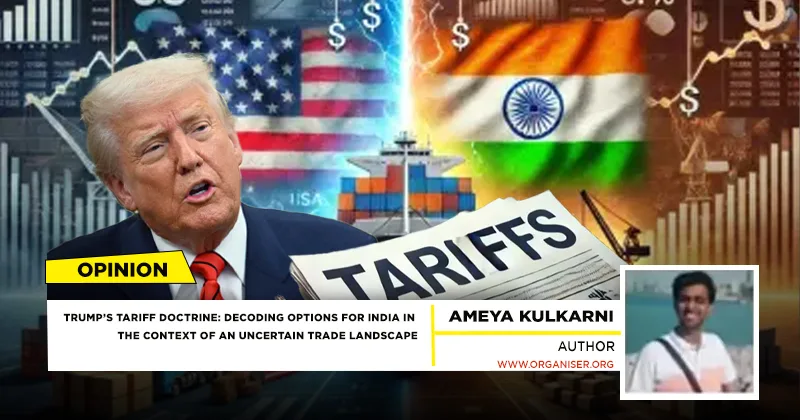
Liberation Day” has delivered what is arguably the greatest shock to the global trading system in recent times with US President Donald Trump unveiling his policy of reciprocal tariffs. Comparisons are being drawn with the Smoot-Hawley Tariff Act of 1930 that had then led to the collapse of global trade. Trump has spared neither friend nor foe, with countries across the board — from allies like the UK and EU to China and even Madagascar — facing the spectre of significantly higher tariffs. For now, predicting how this ends is beset with difficulties.
US President Donald Trump has announced sweeping reciprocal tariffs on all trade partners in addition to the existing tariffs on steel and aluminium. The stated goals: Reshore manufacturing — especially of cars, electronics, and chips — and reduce bilateral trade deficits. Whether those aims can be met remains uncertain. But two things are clear.
First, this is a seismic shock to the global trade order. The scale of the tariffs is unprecedented, by some estimates greater than those under the infamous Smoot-Hawley legislation. A baseline tariff of 10 per cent applies to all countries, with higher rates for nations running trade surpluses with the US. China, the primary target, faces a 54 per cent tariff (34 per cent newly announced, on top of the existing 20 per cent). Surprisingly, even close US allies, like the European Union, Japan, South Korea, and Vietnam have not been not spared — despite the fact that the US has free trade agreements (FTAs) with the latter three. These partners will face tariffs of 20 per cent or more, justified by the US on grounds of alleged currency manipulation and non-tariff barriers. The tariffs are broad and indiscriminate, applied across products rather than sector-specific lines. This new regime will likely shrink global trade opportunities as substantial cost and price increases dampen demand.
Second, we now face deep trade policy uncertainty. The announcement lacked clarity on key details. For instance, the US has cited “implied protection” levels that far exceed applied MFN (Most Favoured Nation) rates — India’s MFN rate is 17 per cent, but the US claims India’s overall protection is 52 per cent due to non-tariff barriers. Moreover, it’s unclear if the tariffs are dynamic. If India reduces its own tariffs, will the US reciprocate? Finally, retaliatory measures by other countries could spiral into a full-blown trade war or set in motion a protracted process of negotiation and bargaining, leaving the trade regime fundamentally unstable: Decision-making for firms and governments will be extremely difficult.
All that said, India may have gained a window of opportunity. India’s relative advantage stems from the fact that the reciprocal tariffs it faces are lower than those imposed on many of its competitors. Consider two sectors: Low-skill goods like apparel and footwear and higher-tech products like electronics.
Start with apparel. These are not products the US is likely to reshore because American wages are too high to be globally competitive. India has an edge. Tariffs on exports to the US will be 27 per cent for India, compared to 54 per cent for China, 46 per cent for Vietnam, 37 per cent for Bangladesh, and 32 per cent for Indonesia. As long as the US continues to import apparel, Indian exporters will experience a competitive advantage. This will be true for other unskilled labour-intensive exports.
In electronics, the picture is more nuanced. The US aims to reshore this sector, and the political will to do so is strong. But India is still well-positioned. Among key exporters, Vietnam, Thailand, and Taiwan all face higher tariffs than India. Japan and South Korea are the exceptions, with marginally lower tariffs of 24 per cent and 26 per cent respectively. While some firms may relocate to the US, the current uncertainty makes fully reshoring production risky. Apple, for instance, benefits from manufacturing in India, which allows it to serve global markets more efficiently and avoid punitive tariffs elsewhere.
To be sure, countries in Latin America and Turkey face the lowest 10 per cent baseline tariff — but among large Asian exporters, which are the closest competitors, India has clearly fared better. For now, pharmaceuticals have been exempted, adding to India’s advantage.
In short, despite a murky policy environment and likely weaker global export demand, this is a boost to the “China-plus-one,” “Vietnam-plus-one,” and “Bangladesh-plus-one” strategies that global firms are pursuing. If one looks closely, the impact of the new tariffs will be to undermine the China-centred global value chain in Asia because the countries hit hardest are an integral part of it.
How should India respond?
India’s priority should be to grow its global market share — regardless of whether global trade itself is expanding. To that end, India must aim to improve its competitiveness by reversing current trade policy trends. While the US may be using reciprocal tariffs as a pressure tactic to bring countries to the negotiating table, India should liberalise trade policy not reactively, but as part of a long-term strategy. This reform agenda should rest on three pillars.
First, tariffs must be lowered and rationalised. A uniform tariff of 5-10 per cent or a two-tiered structure (for example, five per cent on inputs and 10 per cent on final goods) would simplify the system. This would reduce inefficiencies, delays, and rent-seeking at the border.
Second, eliminate non-tariff barriers like quality control orders that act as disguised protectionism rather than ensuring standards. Combined with lower tariffs, this would help make India a low-cost destination for investors.
Third, and most critically, ensure policy stability. India must avoid the urge to frequently revise tariffs or impose retrospective duties, like those levied on Volkswagen and Samsung for decade-old imports. In today’s volatile global environment, stability is a key competitive advantage.
The main exception to this liberalisation agenda is agriculture, particularly food crops. In the current geopolitical climate, India must maintain domestic production to ensure food security. Trade policy here requires more caution. Still, there is scope to lower tariffs on non-food crops — or those not widely consumed in India — such as soybeans and maize meant for poultry feed, which are major US exports.
Counterintuitive as it may seem, the winners in this uncertain trade landscape will not be those who raise barriers but those who offer predictability and openness. Global firms will seek production hubs and export platforms that are cost-effective, policy-stable, can provide labour and capital at scale, and are insulated from retaliatory action. India can — and should — be that safe haven.
The imposition of tariffs will result in a significant macroeconomic shock. As per a note by JP Morgan, if these policies are sustained, they “could push the US and global economy into recession this year”. Trump has, however, indicated that the duties imposed could be decreased or limited in scope if countries undertake significant steps to address US concerns. India and the US are currently negotiating a trade deal. A few days ago, India agreed to the terms of reference for the agreement. It has also taken steps in therecent past — from cutting tariffs on high-end cars and high-capacity motorcycles to doing away with the equalisation levy — showing an accommodative stance. But, along with negotiating with the Trump administration and pushing ahead with the trade deal, Delhi must also pursue a more ambitious and broader agenda for trade reform.
This means resisting protectionism and doubling down on trade reform. This will not only secure India’s place in shifting supply chains but also send a strong signal to investors: India is open for business regardless of what other countries do.















Comments