





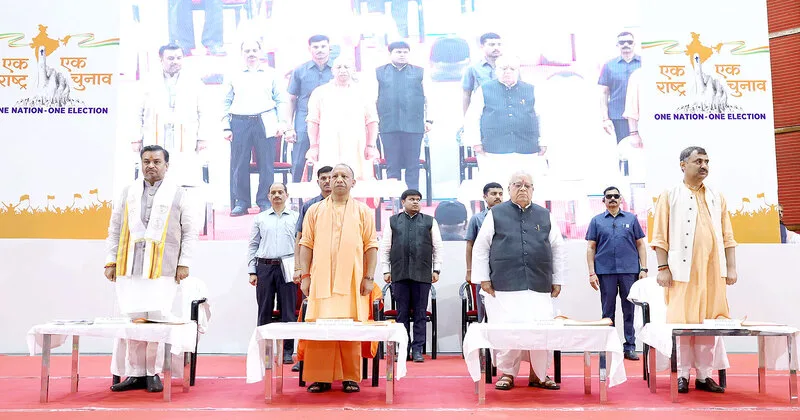
Uttar Pradesh Chief Minister Yogi Adityanath made a strong pitch for the implementation of the One Nation, One Election (ONOE) policy, emphasizing that frequent elections hamper political stability, derail developmental work, and place a heavy burden on the country’s economy and administrative machinery. Addressing a special convention on the subject at the Indira Gandhi Pratishthan, organised by the Uttar Pradesh unit of the Bharatiya Janata Party (BJP), the CM said the time had come for the nation to move towards a more stable and synchronised electoral system.
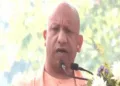
The event, chaired by senior BJP leader and former Rajasthan Governor Kalraj Mishra, saw a focused discussion on the necessity of simultaneous elections for the Lok Sabha and state assemblies. Chief Minister Yogi Adityanath, in his keynote address, said, “Political instability cannot lead to the development of a sovereign nation. Repeated elections only serve to weaken the system and fuel corruption, ultimately affecting the common man.”
हर भारतवासी One Nation, One Election का समर्थन करेगा क्योंकि वह भी नहीं चाहता है कि बार-बार इलेक्शन से उसका विकास बाधित हो… pic.twitter.com/udRenkKJkb
— Yogi Adityanath (@myogiadityanath) April 7, 2025
The Chief Minister highlighted how continuous electoral activity creates administrative hurdles and brings development work to a standstill due to the repeated imposition of the model code of conduct. “Every election cycle hands over administrative control to the Election Commission. The government’s grip on governance weakens and its capacity to deliver is minimized,” he said. He questioned the logic of expecting meaningful results from a government that is left with barely six months of effective working time between elections.
Yogi further pointed out that each cycle of elections disrupts not only governance but also causes financial strain. “Conducting separate elections for the Centre and states costs the economy heavily. According to estimates, such a practice affects the GDP by nearly 1.5%, translating to a loss of over Rs 3 lakh crore. This is money that could otherwise be used to develop infrastructure, education, and health,” he stated.
In a compelling comparison, the CM brought attention to the political situation in Uttar Pradesh before 2017, when, according to him, governance was paralyzed by criminal elements. “Back then, mafias operated parallel governments in districts. The law of the land had collapsed, and looting state resources was treated like a right. That period created an identity crisis among the people,” he recalled.
He credited political stability post-2017 for the transformation of Uttar Pradesh into an economic powerhouse. “Without a stable government, it would have been impossible to rid the state of riots and mafias. Today, the state is witnessing growth, security, and infrastructure development, all thanks to political continuity,” Yogi asserted.
Referring to the situation at the national level, he said the instability prior to 2014 had tarnished India’s global image. “The absence of a strong and stable government affected not just domestic development but also the country’s stature in the world. Our economy struggled, and our infrastructure suffered,” he noted.
Taking a historical perspective, the Chief Minister said that even the experienced and respected former Prime Minister Atal Bihari Vajpayee had to lead a coalition government that lacked complete stability. This, he argued, hampered long-term planning and implementation. “But things have changed now. Under Prime Minister Narendra Modi’s leadership, India has moved from being the world’s seventh-largest economy to the third. This could only happen because of sustained political stability,” he said.
He reminded the audience that the idea of One Nation, One Election had first been strongly advocated by Prime Minister Modi during the inauguration of Sardar Vallabhbhai Patel’s statue in 2019. “The call was not just about elections- it was about nation-building,” he said. CM Yogi proposed that a clear road map must be drawn up to implement the policy by 2034. To synchronize election cycles, the tenure of certain state governments may need to be extended or shortened. “This adjustment is necessary if we are serious about saving resources and driving development in a systematic manner,” he said.
He also touched upon India’s history with simultaneous elections. “Before 1966, India used to hold Lok Sabha and state assembly elections at the same time. But internal strife within the Congress party disturbed this system. Over the years, instability spread to the rest of the country through arbitrary dismissals of state governments and imposition of President’s Rule,” he alleged. Acknowledging that the idea of ONOE is bound to face resistance from opposition parties, the Chief Minister urged the public to counter any misinformation. “Opposition forces may spread false narratives. But we must stay focused and respond by asserting that this country belongs to all of us, and so does its development. Political stability is in everyone’s interest,” he stated.
He also appealed to BJP workers and citizens alike to engage more actively on social media platforms to increase awareness about ONOE. “People need to be educated about how this system can bring positive change. The message should reach every household,” he said.










Comments