





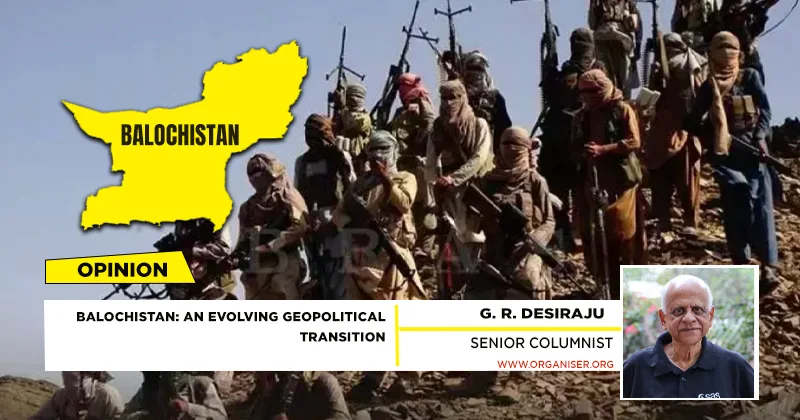
The recent hijacking of the Jaffar Express by insurgents in a remote part of western Pakistan was a watershed moment in a whole sequence of events that have sought secession for the troubled province of Balochistan over the last 80 years. Many defence and security analysts have opined on the history and mechanisms of this insurgency.
Simultaneously, the flare ups in the Pashtun regions of Pakistan are also of note, given the supposed assertions of the security analysts regarding the linking up of the Baloch and Pashtun insurgent groups. In both these peripheral areas of Pakistan, centrifugal forces have been on the rise as this artificial nation-state collapses in front of our eyes.
However, rather than dwell on specific incidents, it might be more worthwhile to analyze them in the context of bigger geopolitical tectonic shifts that have been taking place consequent upon the weakening of the nation-state idea and of the post-WW2 rules-based order with its attendant institutional set-up and organizations. The arrangements whereby the USA has been subsidizing the economies of its vassals and allies have been demolished literally overnight by Donald Trump hastening the demise of the nation-state idea itself. Essentially, the primary architect of this disruption is America seeking to ingest what it created out of the ashes of Mittel Europa like a proverbial Bhasmāsur.
In this context, let us take up the example of Balochistan as a case study. This region might be one of the first to unyoke itself from the burden of the rules-based order, something it has been wanting to do since 1950. Attempting a crystal-ball gaze into the near future one sees how the intermezzo period between the collapse of the post WW2 order on the one hand and a multipolar world on the other might actually play itself out in reality. Specifically, how would naturally organic states like Balochistan, Bhutan or Rakhine morph themselves during the intermediate period between the rules-based order of the past and a future based on multipolarity? How do these evolving nations adjust themselves to the new equilibrium that is now unfolding?
The transition from the Metternich nation state to the post-WW1 dispensation to a stable civilisational state a century later has been and will be a messy affair. In the current interim period, a country like Balochistan spanning two different countries and three different states within Pakistan could well be morphing into a friendly vassal that surrounds the Indian rajya, in the extended domains of Bhāratvarsha. It is noteworthy to point out that what is happening in Balochistan might well have happened in Kurdistan except for the timing; the Kurdish movement peaked at a time when the rules-based order and the nation-state concept were too strong. For Balochistan, the timing is right—the world is ready to see the artificiality of the nation-states that were carved out from the Ottoman Empire after WW1—and recognise the inevitability of a reversal to an older condition where the entire region from the Mediterranean Sea to the Sindhu River consisted of a number of domains separated by soft borders and a free flow of people, trade, commerce and cultural traditions.

Civilizational states are very different from nation states. Bhārat is the dominant civilizational state—one could even call it an empire—in this part of the world. It will have fuzzy borders in the medium term, say by 2035. Balochistan will be one of the nations that buffers the new Bhārat from West Asia and located in one of the fuzzy regions. The Baloch nation today covers all of the Pakistani province of the same name, and also regions of eastern Iran, south western Punjab, southern Khyber Pakhtunkhwa and parts of western Sindh. Hard political boundaries have done little justice to the aspirations of the Baloch people who have felt separated by artificial boundaries that are required in a political model that is far removed from the culture and daily life of essentially migratory communities who travelled for reasons of trade and commerce.
It is pertinent to note the unfortunate history of Balochistan post-1947. The Sultan of Kalat, who was suzerain of this region had no wish to join Pakistan at the time of partition. Balochistan was an independent entity for almost a year after which it was forcibly annexed by Pakistan. The province is sparsely populated but of very large area—it accounts for 44% of Pakistan’s land mass. It has, however, only 12-15 million people, just 5-7% of Pakistan’s population. Most of it is rugged land and yet it is blessed with an enormous number and variety of mineral wealth that includes copper, gold, silver, coal, iron, chromite, limestone, marble and precious stones like rubies, emeralds, and topaz among others—a veritable treasury.
When stable and ordered domains and structures undergo deep rooted changes to new, very different but also stable and ordered domains and structures, the interfacial periods or phases are characterized by disorder, ambiguity, amorphicity and chaos—whether these changes are physical, political or economic. The more different the initial and final states, the more unpredictable and fluxional the intermediate periods. This is precisely where we see Balochistan today. The Baloch people are dispersed in different countries or provinces within these countries. They aspire to a situation where the Baloch nation is also graced with a political identity as an independent country, which would mostly comprise the present province in Pakistan but could also include some adjoining areas in Iran, Khyber Pakhtunkhwa, Punjab and Sindh.
The day-to-day manifestations of this geopolitical disorder are manifested in the form of armed disturbances, attacks on the Pakistani army, civilian killings, sabotage, and general mayhem. Detailed analyses of these events, in terms of troop movements or possible alignments of ethnic groups may be accurate in the immediate temporal context but fail to capture the big picture of the Baloch nation undergoing huge birthing pains as it moves towards a stable political condition as a small country at the periphery of Bhārat, linked to the mother country through economic and cultural ties, blessed by iconic associations such as Hinglaj Mata, one of our hallowed shakti peethas.
While Balochistan might achieve political independence by reverting to its natural boundaries, a similar harking to its cultural roots might take somewhat longer. Both Khyber Pakhtunkhwa and Balochistan have been largely stripped of their cultural markers and moorings because of the root and stem destruction of the Buddhist and Sanātani culture that used to lie at the intersection of the trade routes between Central Asia, Indian subcontinent, Persia and Western Asia.
There will undoubtedly be a new type of economic order in civilizational states and empires and concomitantly a period of uncertainty and flux in the intermediate period of the transition state between the nation-state of Pakistan and an independent Balochistan. Globalization via trade was the economic bedrock of the rules-based order and the nation-state. However, recent events have shown that even this paradigm is now under threat. What would the enabling condition of sovereignty be, of a new Baloch nation? Sovereignty is determined not by the presence of barbed wires and soldiers guarding borders but the ability to control seigniorage profits as well as enforce the acceptance of one’s currency within (and possibly outside) one’s borders. This is not a new phenomenon but has been true of human civilization since the republican city states of Bhārat and Greece at least 2500 years ago. However, for intermezzo states like Balochistan with fluid borders, this economic condition may not be easy to achieve given the lack of trust in a new currency by the local population as well as limited confidence of cross border investors for fund raising. In such a scenario, these states might default to using a basket of currencies of trading partners that could also include certain cryptocurrencies (instead of over-dependence on a single currency like the US dollar) to determine the value of the local currency. Natural resources or associated goods and services could guarantee the value of the currency to ensure stability. Balochistan might well be the first example of a new global economic paradigm that unfolds in front of our eyes over the next decade. For in the end, it is economics that directs politics.














Comments