





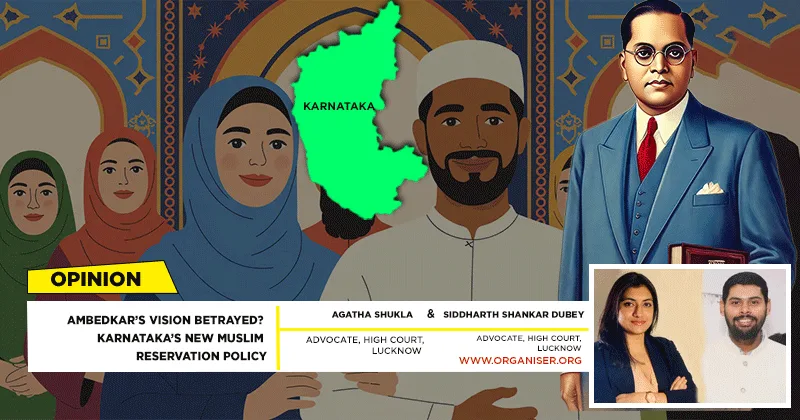
Karnataka’s Chief Minister Siddaramaiah presented the state’s budget for 2025-26 on March 7, 2025, announcing an amendment to the Karnataka Transparency in Public Procurements (KTPP) Act. Approved by the state Cabinet, this amendment mandates a 4 per cent reservation for Muslims, categorised under 2B of the Other Backward Classes (OBC) list in government tenders. The policy applies specifically to civil works contracts valued up to ₹2 crore and procurement contracts up to Rs 1 crore. The state government justifies this move as a measure to address socio-economic disadvantages rather than a religion-based benefit. However, it contradicts constitutional principles, threatens national unity, and conflicts with the vision of Dr. B.R. Ambedkar.
The concept of reservation policies in Bharat, historically, can be traced back to the British colonial era, where the framework of group-based affirmative action first emerged. The Morley-Minto Reforms of 1909 introduced separate electorates for Muslims, treating them as a distinct political entity. This approach was reinforced by the Montague-Chelmsford Reforms of 1919 and, later by the Communal Award of 1932, which extended separate representation to other religious minorities. As claimed by colonial rulers, these measures aimed to ensure equitable political participation. However, it inadvertently deepened communal divisions, playing a role in the eventual partition of Bharat in 1947.
As evidenced from the constitutional assembly debates’ archives, the makers of the Bhartiya Constitution consciously chose to move away from religion-based reservations, opting instead for caste-based affirmative action. With the adoption of the Constitution in 1950, provisions such as Articles 15(4) and 16(4) were introduced to enable special measures for Scheduled Castes (SCs), Scheduled Tribes (STs), and other socially and educationally backward classes (SEBCs). Notably, these provisions were designed to be neutral concerning religion, focusing solely on social and educational disadvantage.
Dr BR Ambedkar, the chief architect of the Constitution, was a vocal critic of religion-based quotas, cautioning that such policies could create a society driven by entitlements rather than merit. Similarly, Sardar Vallabhbhai Patel firmly opposed communal representation, believing it would sustain societal divisions rather than foster national unity. These perspectives significantly shaped Bharat’s reservation framework, reinforcing the principle that affirmative action should be based on caste and tribal identity rather than religious affiliation.
A pivotal moment in Bharat’s reservation history came with the Mandal Commission Report (1979), which was implemented in 1990. This report recommended a 27 per cent reservation for Other Backward Classes (OBCs), including certain Muslim communities classified as socially and educationally disadvantaged. However, the classification remained religion-neutral, with non- Hindu groups being assessed on socio-economic criteria rather than religious identity. Over time, states such as Kerala, Tamil Nadu, Andhra Pradesh, and Karnataka incorporated specific Muslim sub-groups into their OBC lists, setting the stage for continued debates on the nature and scope of affirmative action in India.
The incumbent government in 2005 formed a committee to ascertain the social, economic and educational condition of Muslims in India. The Sachar committee had so many pitfalls that multiple recommendations made by it were sidelined, for the simple reason that it went against the constitutional spirits. Moreover, the intent to form this committee itself was discriminatory, politically appeasing and in contravention with the idea of secular Bharat.
The Bhartiya Constitution expressly prohibits discrimination based on religion, as outlined in Articles 15(1) and 16(2). At the same time, Articles 15(4) and 16(4) allow for affirmative action in favour of socially and educationally backward classes (SEBCs), Scheduled Castes (SCs), and Scheduled Tribes (STs). However, these provisions require that reservations be grounded in objective assessments of social and educational backwardness rather than religious identity.
Karnataka’s justification for introducing a 4 per cent reservation for Muslims under Category 2B is based on the findings of the Reddy Commission (1994), which identified backwardness among this group. Since Category 2B provides a blanket cover to the whole religion, the policy effectively functions as a religion-based quota, raising concerns about its constitutionality.
Judicial rulings have consistently emphasized that reservations must be based on social and educational disadvantage rather than religious affiliation. In Indra Sawhney v. Union of India AIR 1993 SC 477, the Supreme Court upheld the legitimacy of quotas for Other Backward Classes (OBCs) but clarified that they must be backed by empirical evidence of backwardness. The judgment also imposed a 50 per cent cap on total reservations and required the exclusion of the “creamy layer”—those who are economically advanced within backward groups. Similarly, in
M.R. Balaji v. State of Mysore AIR 1963 SC 649, the Court held that exceeding the 50 per cent limit required exceptional circumstances, which Karnataka lacks in the present case.
A similar case arose in Andhra Pradesh when a 5 per cent Muslim reservation introduced in 2004 was struck down by the High Court due to a lack of sufficient data establishing backwardness. In contrast, a proposal in West Bengal was made to reserve government tenders for Muslims which was later invalidated by the High Court, reinforcing the principles that affirmative action cannot be based solely on religious identity.
Karnataka’s policy faces legal scrutiny due to the absence of updated empirical data demonstrating the continued backwardness of Category 2B irrespective of religion. Without concrete justification to the religion-based reservation, the courts may find the measure unconstitutional. Additionally, with total reservations in the state currently at 50 per cent, 4 per cent for Category-1, 15 per cent for Category-2A, and the newly added 4 per cent for Category-2B—any further expansion would push the state beyond the Supreme Court’s 50 per cent ceiling and may rise it up to 57 per cent which would be contrary to the established principles. Unless Karnataka provides exceptional justification, such as the presence of tribal-dominated regions, any attempt to exceed this limit could be deemed legally untenable.
Several states have implemented reservations for Muslim communities within the broader OBC framework, which is constitutionally flawed while interpreting the principles of reservation. In Kerala, around 12 per cent of the OBC quota is allocated to Muslim sub-groups like Mappilas and Rowthers. Since these groups are classified as OBCs rather than receiving a separate religious quota, it does not totally turnout to be unconstitutional because it is not religion based. Tamil Nadu follows a similar approach, reserving 3.5 per cent of its OBC quota for Muslim communities such as Labbais and Marakkayars. Andhra Pradesh also introduced OBC Category E, which includes communities like Dudekulas and Ansaris. The policy was adjusted to align with the principles laid down in Indra Sawhney, ultimately failing to stand on test of “social backwardness” with 11 indicators to ascertain backwardness, religion not being one. This precedent indicates that Karnataka’s reservation has failed the constitutional test for its implementation. It lacks a religion-neutral classification backed by clear empirical data.
Critics argue that policies favoring religious identity over national unity risk fostering division, akin to the historical “balkanisation” of regions into fragmented, antagonistic groups. Allocating reservations and resources based on religion could set a precedent for similar demands from other religions, escalating social tensions. Dr. Ambedkar had foreseen such risks, stressing the need for unity with his resolute declaration: “We must be determined to defend our independence with the last drop of our blood.” Similarly, Karnataka’s ₹1,000 crore allocation for “minority localities” raises concerns about “ghettoization”, where segregated communities may emerge instead of fostering broader social integration. Public resources should be distributed based on economic need rather than religious identity to prevent deepening communal divides.
Ambedkar firmly opposed religion-based reservations, recognizing how pre-independence communal electorates had fuelled Bharat’s partition. His vision for affirmative action was to uplift historically disadvantaged groups such as SCs and STs—not to create faith-based entitlements. By reserving government contracts exclusively for Muslims under Category 2B, Karnataka’s policy diverges from this principle, challenging the very essence of Bharat’s secular framework.
While the government justifies the 4 per cent Muslim reservation in public procurement on the grounds of socio-economic backwardness, the policy stands on fragile legal ground. It risks violating Articles 15(1) and 16(2) by prioritizing religion, contradicts Indra Sawhney due to the lack of updated empirical data, and could eventually push reservations beyond the Supreme Court’s 50% ceiling. Rather than adopting communal quotas, a more constitutionally sound approach would be to implement policies based on objective socio-economic indicators, benefiting all disadvantaged groups regardless of religion. Upholding a transparent, merit- driven system is essential to preserving both social harmony and Bhartiya values. As the harbinger of Sardar Patel urged, “Let us sink all differences and work as one team.” Karnataka must embrace this wisdom to ensure justice without undermining national unity.












Comments