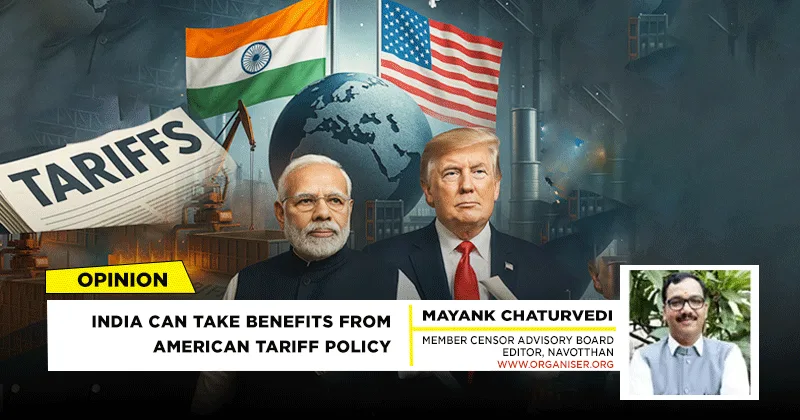
India can take benefits from American tariff policy
September 13, 2026
  • Read Ecopy
  • Circulation
  • Advertise
  • Careers
  • About Us
  • Contact Us
Android AppiPhone AppArattai
Organiser
  • ‌
  • Bharat
    • Assam
    • Bihar
    • Chhattisgarh
    • Jharkhand
    • Maharashtra
    • View All States
  • World
    • Asia
    • Europe
    • North America
    • South America
    • Africa
    • Australia
  • Editorial
  • International
  • Opinion
  • RSS @ 100
  • More
    • World Hindu Congress 2026
    • Op Sindoor
    • Analysis
    • Sports
    • Defence
    • Politics
    • Business
    • Economy
    • Culture
    • Special Report
    • Sci & Tech
    • Entertainment
    • G20
    • Azadi Ka Amrit Mahotsav
    • Vocal4Local
    • Web Stories
    • Education
    • Employment
    • Books
    • Interviews
    • Travel
    • Law
    • Health
    • Obituary
  • Subscribe
    • Subscribe Print Edition
    • Subscribe Ecopy
    • Read Ecopy
  • ‌
  • Bharat
    • Assam
    • Bihar
    • Chhattisgarh
    • Jharkhand
    • Maharashtra
    • View All States
  • World
    • Asia
    • Europe
    • North America
    • South America
    • Africa
    • Australia
  • Editorial
  • International
  • Opinion
  • RSS @ 100
  • More
    • World Hindu Congress 2026
    • Op Sindoor
    • Analysis
    • Sports
    • Defence
    • Politics
    • Business
    • Economy
    • Culture
    • Special Report
    • Sci & Tech
    • Entertainment
    • G20
    • Azadi Ka Amrit Mahotsav
    • Vocal4Local
    • Web Stories
    • Education
    • Employment
    • Books
    • Interviews
    • Travel
    • Law
    • Health
    • Obituary
  • Subscribe
    • Subscribe Print Edition
    • Subscribe Ecopy
    • Read Ecopy
Organiser
  • Home
  • Bharat
  • World
  • Operation Sindoor
  • Editorial
  • Analysis
  • Opinion
  • Culture
  • Defence
  • International Edition
  • RSS @ 100
  • Magazine
  • Read Ecopy
Home World North America USA

India can take benefits from American tariff policy

Recent changes in the United States’ tariff policy have opened up new avenues for India to strengthen its trade position and expand its export footprint. As the U.S. looks to reduce dependence on specific markets by imposing higher tariffs on certain imports, India has the potential to step in as a reliable alternative supplier across various sectors

Mayank ChaturvediMayank Chaturvedi
Apr 7, 2025, 08:00 pm IST
inUSA, Bharat, World, Opinion
Follow on Google News
Facebook
Twitter
WhatsAppTelegramEmail

The new ‘Reciprocal Tariff’ implemented by US President Donald Trump is sure to have a deep impact on the world economy. But the concern being expressed about this tariff is not really that much for Bharat at least. You can now consider it as President Donald Trump’s inclination towards Prime Minister Narendra Modi or the positive attitude of the current US government towards the NRIs who are driving the American economy, whatever it may be; overall India’s interests do not seem to be affected in this, rather on the contrary, this tariff policy has certainly opened up new opportunities for India in many areas.

If seen, more than 60 countries are being affected by America’s tariff war. America’s trade deficit with China is very high. Therefore, it has imposed the highest tariff on China. America has announced to impose 54% tariff on all Chinese imports. In fact, Trump’s announcement has added a 34 per cent so-called “reciprocal tariff” to the existing 20 per cent tariff on all goods imported from China to the US. The US has imposed tariffs of 49 per cent on Cambodian goods, 46 per cent on Vietnam, 44 per cent on Sri Lanka, 37 per cent on Bangladesh, 31 per cent  on Switzerland, 30 per cent on South Africa, 36 per cent on Thailand, 32 per cent on Indonesia and Taiwan, 29% on Pakistan, 26% on India, 25% on South Korea, 24 per cent on Malaysia and a minimum of 10 percent on other countries. Along with this, there are many products which the US has kept away from its new tariff policy and has left the opportunity open for many countries to earn full profit.

If the goods are getting affected by the tariff, then it is because their demand is high in the US, most of which is currently met by China and other countries. Now many new opportunities have opened up for India in these very areas. If we study a little back in the context of India, India has had a huge trade deficit with China, which was about $52 billion in 2018-19. There was a lot of pressure on the Indian government to reduce it, so it was seen that the Modi government started promoting indigenous manufacturing to reduce its import dependence. Work was started simultaneously in many areas, including the Atmanirbhar Bharat Abhiyan, promotion of indigenous production in areas like electronics, pharmaceuticals and medical equipment, efforts in mobile phones, automobiles and solar panels. The results of which are now visible on a large scale.

If we look at the new opportunities, India can bring a large stock of US dollars to itself by increasing its manufacturing capacity in electronics and machinery. India’s electronics exporters also benefit because after high tariffs were imposed on countries like Vietnam, India is a big hope for traders. Similarly, the impact on machinery, auto parts and toys imported from China and Thailand is seen to be benefiting India. The increase in tariff on Chinese clothes in the US has given the Indian textile industry a new opportunity to increase its share in the US market. With the US imposing higher tariffs on clothes imported from China and Bangladesh, Indian clothes will naturally become cheaper, which will increase the demand for Indian products.

It is a good thing that the tariffs do not seem to have a direct impact on the IT sector. Although it is certain that the slowdown and inflation in the American market will affect it, but this effect does not seem to be very high, because the IT professionals of India are economic than those of any other country, which also has the best quality in itself. So even in the future, Americans will continue to trust India in the IT sector. Apart from this, India has a golden opportunity to import cheap agricultural products to America and it can increase its agricultural exports (such as rice, spices, and tea) much more than at present, because due to the increased tariffs on China, American companies will want to get cheap goods, which is not possible for India to fulfill in today’s time.

Indian pharma industry is already performing well in chemicals and pharmaceuticals. Every year, about nine billion dollars worth of medicines are exported from India to America, which is the largest industrial export sector of the country. In such a situation, this new policy of America is providing it an opportunity to become more global. Along with this, the countries on which America has set high tariff rates are also going to impose heavy tariffs on American goods in return, some have even started announcing their increased tariff policy. Naturally, in such a situation it has become easier for India to create favourable markets for its goods in these countries as well. After China, many countries of Europe are affected the most. China has openly come out against America. China’s Commerce Ministry has clearly said that China will take firm counter-measures to protect its rights and interests. The United States has prepared the so-called ‘reciprocal tariffs’ on the basis of unilateral assessment, which is not in accordance with international trade rules. It has asked America to cancel this new tariff.

Canadian Prime Minister Mark Carney has announced a 25% tariff on vehicles from America, it is going to impose heavy tariffs on many other American goods. French President Emmanuel Macron has asked his country’s companies to postpone investments in the US. Brazilian President Luiz Inacio Lula da Silva has already said that he has started taking all necessary measures keeping in mind the interests of his country. In such a situation, it is natural that India can increase the export of its goods in all these countries and other Asian countries. However, India is also seeing losses in some sectors such as jewellery, dairy, auto parts etc. Because India exports jewellery worth about 11 billion dollars to the US every year, which is 30% of exports. In the new tariff, the US has increased the duty on jewellery by an additional 18 to 20 percent.

The 2.4 percent duty that was earlier levied on the goods of auto ancillary companies is likely to increase to 25 percent. But even after this, what is clearly visible is that this tariff war started by America has provided India with new economic opportunities in many areas and in many countries. In fact, now we should take full advantage of the new opportunities that we have got by diverting our exports to other countries instead of depending only on American markets.
Topics: IndiaDonald TrumpPM Narendra ModiUS Tariff PolicyManufacturingAtmanirbhar Bharat Abhiyan
Share
Tweet
SendShareSend
✮ Subscribe Organiser YouTube Channel. ✮
✮ Join Organiser's WhatsApp channel for Nationalist views beyond the news. ✮
Previous News

Pakistan: BYC decries state crackdown on Baloch Long March

Next News

L2: Empuraan controversy: A dangerous trend

Related News

Prime Minister Narendra Modi, along with Chinese President Xi Jinping, Russian President Vladimir Putin and other world leaders, poses for a picture at a joint tree plantation initiative during the BRICS Summit

BRICS Summit 2026: India as the voice of Global South, shared responsibilities & scripting inclusive world order

Chinese President Xi Jinping and Prime Minister Narendra Modi

BRICS Summit 2026: PM Modi hold talks with President Xi; Stresses border peace & tranquility as key to India-China ties

(From Left to Right): Russian President Vladimir Putin, PM Modi & Chinese President Xi Jinping

BRICS New Delhi Declaration | Key Takeaways: Cross-border payment, counter-terrorism to tech ties & supply resilience

BRICS Summit 2026: New Delhi Declaration to be issued today; India seals diplomatic win amid West Asia crisis

PM Modi holds series of bilateral meetings;(From Left to Right): Malaysia PM Anwar Ibrahim, Ethiopian PM Abiy Ahmed Ali and Iran President Masoud Pezeshkian

BRICS Summit: PM Modi flags maritime security, seafarers safety with Iran President; Holds series of bilateral talks

Speaking at the BRICS Business Forum, Putin took a sharp swipe at G7

BRICS Summit 2026: President Putin takes swipe at G7; BRICS drives 40% of Global GDP while west contributes only 18%

Load More

Latest News

Exterior of the Lokayukta Building

Karnataka Lokayukta records 1,248 cases in four years, 887 linked to bribery

RSS Akhil Bharatiya Karyakarini Sadasya Dr Manmohan Vaidya at a Pramukh Jan Samvad Sangosthi organised by Kashi Mahanagar on the occasion of the RSS Centenary Year,

Entire society must unite with a sense of oneness; This Is the spirit of Sangh Work: Dr Manmohan Vaidya

‘Samuel Could Never Do This’: Mother Rejects Blasphemy Allegations Against Son in Lahore

Pakistan Blasphemy Case: Mother of Christian man Samuel Arif claims false implication, seeks justice

Prime Minister Narendra Modi, along with Chinese President Xi Jinping, Russian President Vladimir Putin and other world leaders, poses for a picture at a joint tree plantation initiative during the BRICS Summit

BRICS Summit 2026: India as the voice of Global South, shared responsibilities & scripting inclusive world order

Chinese President Xi Jinping and Prime Minister Narendra Modi

BRICS Summit 2026: PM Modi hold talks with President Xi; Stresses border peace & tranquility as key to India-China ties

Tamil Nadu: Hindu Munnani flags TVK govt’s restrictions on Vinayaka pandals, barring women, children from processions

Lashkar-e-Toiba founder Hafiz Saeed. (File image)

J&K Terror Case: Hafiz Saeed gets second NBW; NIA says he operates from Pakistan

Pakistan’s push for a place in the expanding BRICS bloc faces a difficult diplomatic road ahead, despite backing from key partners.

Pakistan knocking BRICS Door: Why Islamabad’s 2023 membership bid remains elusive despite Chinese and Russian support

BRICS Bazaar

BRICS Bazaar: Global traditions and cultural diplomacy take center stage at New Delhi’s National Crafts Museum

(From Left to Right): Russian President Vladimir Putin, PM Modi & Chinese President Xi Jinping

BRICS New Delhi Declaration | Key Takeaways: Cross-border payment, counter-terrorism to tech ties & supply resilience

Load More
  • Privacy
  • Terms
  • Cookie Policy
  • Refund and Cancellation
  • Delivery and Shipping

© Bharat Prakashan (Delhi) Limited.
Tech-enabled by Ananthapuri Technologies

  • Home
  • Search Organiser
  • Bharat
    • Assam
    • Bihar
    • Chhattisgarh
    • Jharkhand
    • Maharashtra
    • View All States
  • World
    • Asia
    • Africa
    • North America
    • South America
    • Europe
    • Australia
  • Editorial
  • Operation Sindoor
  • Opinion
  • Analysis
  • Defence
  • Culture
  • Sports
  • Business
  • RSS @ 100
  • Entertainment
  • More ..
    • Sci & Tech
    • Vocal4Local
    • Special Report
    • Education
    • Employment
    • Books
    • Interviews
    • Travel
    • Health
    • Politics
    • Law
    • Economy
    • Obituary
  • Subscribe Magazine
  • Read Ecopy
  • Advertise
  • Circulation
  • Careers
  • About Us
  • Contact Us
  • Policies & Terms
    • Privacy Policy
    • Cookie Policy
    • Refund and Cancellation
    • Terms of Use

© Bharat Prakashan (Delhi) Limited.
Tech-enabled by Ananthapuri Technologies