





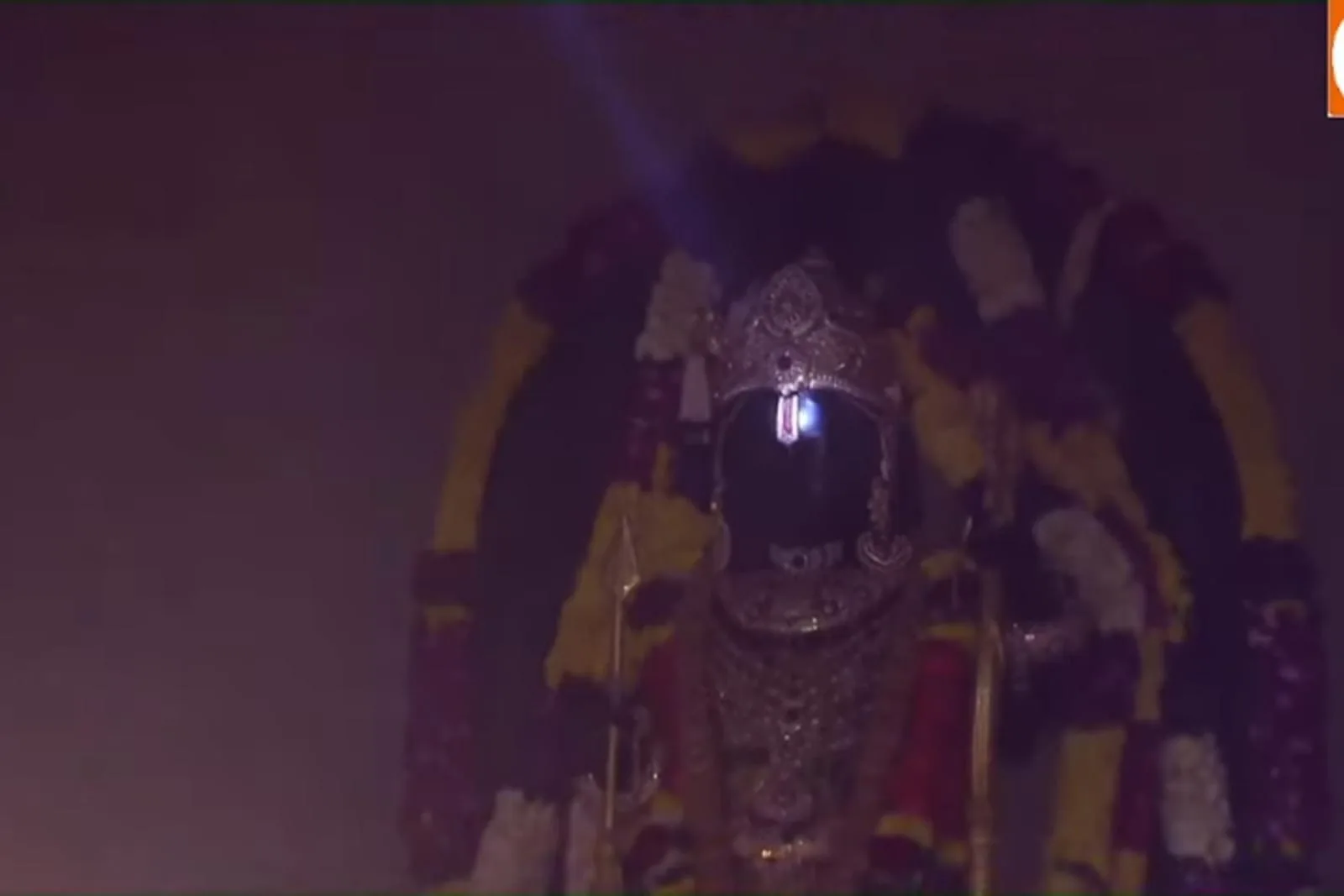
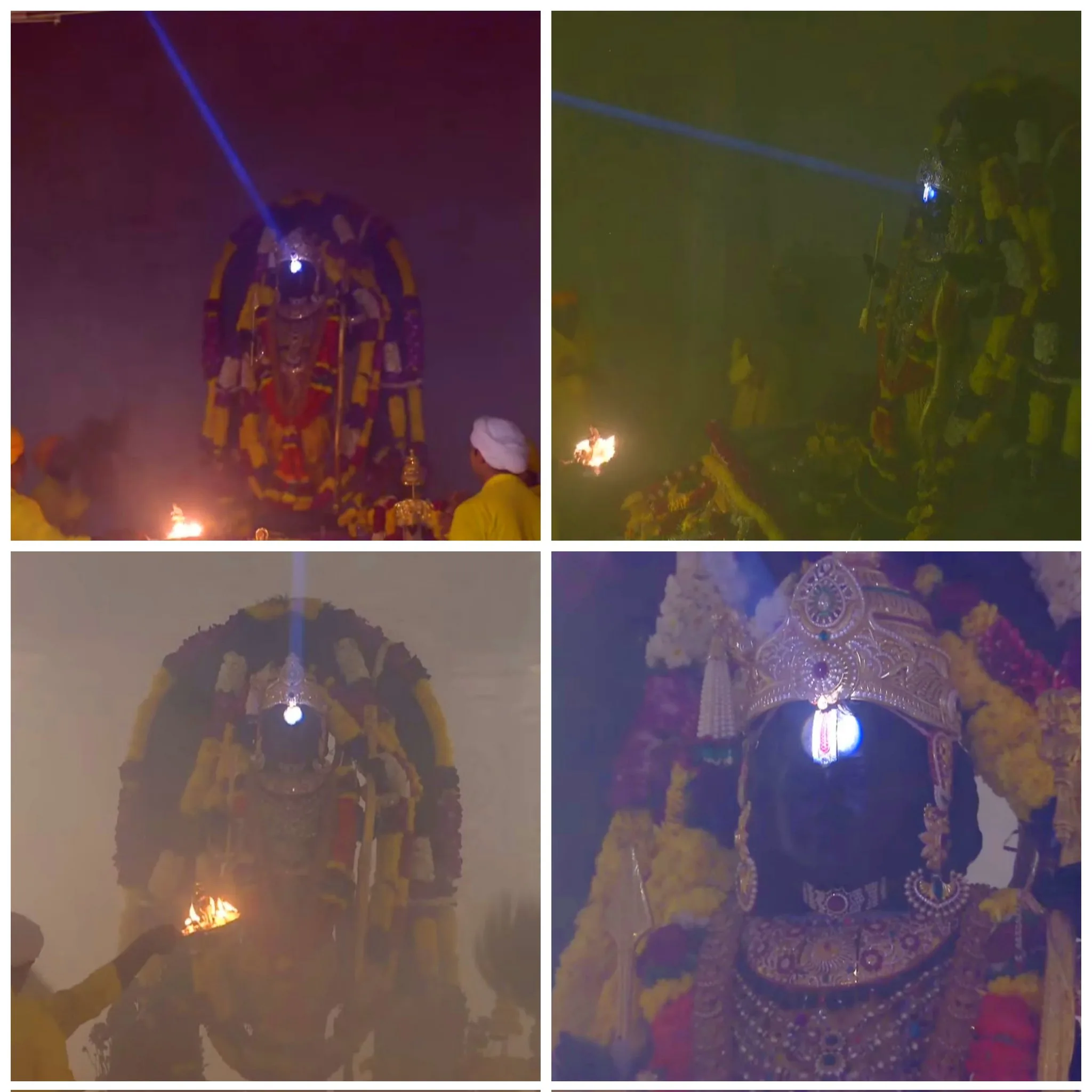
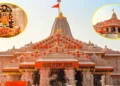
On the auspicious occasion of Ram Navami, the holy city of Ayodhya witnessed a breathtaking celestial spectacle as a ray of sunlight fell directly on the forehead of Ram Lalla’s murti at the Ram Janmabhoomi mandir—a divine ritual known as the Surya Tilak. This spiritual and astronomical phenomenon marked the symbolic birth of Bhagwan Shri Ram, bathing the deity’s face in a golden glow and electrifying the atmosphere with chants, bells and boundless devotion.
Thousands of devotees thronged the Ram Mandir premises from the early hours of April 6, with lakhs more joining via live broadcasts to witness what has now become the spiritual highlight of Ram Navami celebrations in Ayodhya. The Mandir grounds reverberated with Vedic hymns and the rhythmic sound of conch shells while the elaborate abhishek of Ram Lalla took place amid fervent chanting by the pujaris. Ram lalla was adorned in regal attire and dazzling jewellery before the sacred sunlight touched his forehead.
This year, the Surya Tilak occurred at 11:59 AM, when a meticulously aligned beam of sunlight illuminated Ram Lalla’s forehead, creating the appearance of a celestial tilak. The event marks the second annual occurrence of this phenomenon, following its historic beginning on April 17, 2024, when it was first successfully conducted at 12:16 PM during the Pran Prathishtha year of the newly constructed Ram Mandir.
The Surya Tilak is the result of years of scientific planning and architectural brilliance, executed by the Shri Ram Janmbhoomi Teerth Kshetra Trust in collaboration with premier institutions like ISRO, Central Building Research Institute (CBRI), and the Indian Institute of Astrophysics. A team of scientists and engineers designed a high-precision system of lenses, mirrors, brass pipes, and motorised alignment tools to direct sunlight through a 3.5 cm aperture, allowing the beam to fall precisely on Ram Lalla’s forehead every year on Ram Navami.
The entire process is a harmonious blend of science and spirituality, showcasing India’s ancient tradition of temple architecture where celestial alignments were integral. Similar solar alignments are found in historic temples like Konark Sun Temple and Modhera Sun Temple, and the Surya Tilak at Ram Mandir revives this timeless legacy.
The religious significance of this moment lies in the deep-rooted belief that Bhagwan Ram belongs to the Surya Vamsha (Solar Dynasty), tracing his lineage to Surya Dev. The beam of sunlight symbolises a direct blessing from the deity’s cosmic ancestor, highlighting Bhagwan Ram’s divine birth and his role as Maryada Purushottam.
Spiritually, the event marks a moment when divine energy and cosmic precision converge, believed by many to be a darshan of Ram Lalla’s divine aura. It elevates the emotional and spiritual connection of devotees, offering them a rare visual embodiment of divinity.
Culturally, the Surya Tilak is being hailed as a symbol of India’s scientific heritage, fusing traditional temple design with modern astronomical calculations. It’s a testimony to the continuity of Indian knowledge systems, where astronomy, engineering, and devotion coalesce into an act of faith.
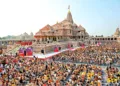
This year, the Ayodhya administration anticipated a footfall of 20 to 30 lakh devotees throughout the day. Authorities ensured smooth arrangements with security, medical aid, and crowd management in place. The mandir was adorned with floral decorations, vibrant lights, and a festive spirit that echoed throughout the city.
Before entering the mandir, many devotees took a holy dip in the Saryu River, a ritual believed to purify the soul before darshan. From across the country, pilgrims arrived with offerings, singing bhajans, and participating in processions to mark the sacred birth of Ram Lalla, the seventh avatar of Vishnu.
According to the Hindu calendar, Ram Navami falls on the Navami Tithi of Shukla Paksha in the month of Chaitra. The day commemorates the birth of Rama Lalla in Ayodhya and is celebrated with grand processions, devotional music, and temple rituals across India.
For many Hindus, especially those who witnessed the construction of the Mandir after decades of spiritual and legal struggle, the Surya Tilak has become more than a phenomenon, it is seen as a celestial affirmation of Ram Lalla’s rightful place in Ayodhya. It stands as a moment when faith meets science, quite literally.
As the rays of the sun touched Ram Lalla’s murti once again this year, devotees looked on with folded hands, moist eyes, and chants of “Jai Shri Ram” echoing through the temple town, marking not just a ritual, but the dawn of a new spiritual tradition that will shine for generations to come.










Comments