Angad's Dialogue with Ravana: A classic example of war diplomacy
September 14, 2026
  • Read Ecopy
  • Circulation
  • Advertise
  • Careers
  • About Us
  • Contact Us
Android AppiPhone AppArattai
Organiser
  • ‌
  • Bharat
    • Assam
    • Bihar
    • Chhattisgarh
    • Jharkhand
    • Maharashtra
    • View All States
  • World
    • Asia
    • Europe
    • North America
    • South America
    • Africa
    • Australia
  • Editorial
  • International
  • Opinion
  • RSS @ 100
  • More
    • World Hindu Congress 2026
    • Op Sindoor
    • Analysis
    • Sports
    • Defence
    • Politics
    • Business
    • Economy
    • Culture
    • Special Report
    • Sci & Tech
    • Entertainment
    • G20
    • Azadi Ka Amrit Mahotsav
    • Vocal4Local
    • Web Stories
    • Education
    • Employment
    • Books
    • Interviews
    • Travel
    • Law
    • Health
    • Obituary
  • Subscribe
    • Subscribe Print Edition
    • Subscribe Ecopy
    • Read Ecopy
  • ‌
  • Bharat
    • Assam
    • Bihar
    • Chhattisgarh
    • Jharkhand
    • Maharashtra
    • View All States
  • World
    • Asia
    • Europe
    • North America
    • South America
    • Africa
    • Australia
  • Editorial
  • International
  • Opinion
  • RSS @ 100
  • More
    • World Hindu Congress 2026
    • Op Sindoor
    • Analysis
    • Sports
    • Defence
    • Politics
    • Business
    • Economy
    • Culture
    • Special Report
    • Sci & Tech
    • Entertainment
    • G20
    • Azadi Ka Amrit Mahotsav
    • Vocal4Local
    • Web Stories
    • Education
    • Employment
    • Books
    • Interviews
    • Travel
    • Law
    • Health
    • Obituary
  • Subscribe
    • Subscribe Print Edition
    • Subscribe Ecopy
    • Read Ecopy
Organiser
  • Home
  • Bharat
  • World
  • Operation Sindoor
  • Editorial
  • Analysis
  • Opinion
  • Culture
  • Defence
  • International Edition
  • RSS @ 100
  • Magazine
  • Read Ecopy
Home Bharat

Angad’s Dialogue with Ravana: A classic example of war diplomacy

Angad's dialogue with Ravana stands as a timeless example of war diplomacy in ancient Indian epics. Sent as an emissary by Bhagwan Rama to the court of the demon king, Angad’s mission was to deliver a final message of peace and the chance for reconciliation before the outbreak of war. His fearless stance, sharp wit, and unwavering loyalty not only conveyed Rama’s offer but also highlighted the strategic use of dialogue in conflict resolution

Dr Punit KumarDr Punit Kumar
Apr 6, 2025, 12:00 pm IST
inBharat, Opinion, Culture
Follow on Google News
Facebook
Twitter
WhatsAppTelegramEmail

War diplomacy has been a crucial element of military strategies across civilizations. The attempt to resolve conflicts through negotiation, intimidation, or demonstration of power before engaging in battle has shaped many historical wars. One of the most striking examples of war diplomacy in ancient Indian literature is the dialogue between Angad and Ravana in the Ramayana. This episode, taking place before the great war between Bhagwan Ram and Ravana, showcases the principles of negotiation, strategic warning, and psychological warfare. Angad, a warrior and envoy of Bhagwan Ram, was sent to the court of Ravana to give him one last opportunity to surrender and avoid destruction. However, Ravana’s arrogance led to the failure of diplomacy and the inevitable battle.

The Ramayana narrates the story of Bhagwan Ram, who embarks on a mission to rescue his wife, Sita, after she is abducted by the demon king Ravana. As Ram prepares for battle with his army of Vanaras, he follows the ethical code of war and sends an envoy, Angad, to Ravana’s court with a final diplomatic message. This reflects the ancient Indian tradition of engaging in dialogue before resorting to war.

Angad, the son of Bali, was chosen for this mission due to his strength, wisdom, and fearless nature. As a diplomat, his role was to persuade Ravana to surrender Sita and avoid bloodshed. However, his mission also had another objective to assess Ravana’s intent and gauge his willingness to negotiate.

Angad’s conversation with Ravana is marked by different stages of diplomacy:

The Initial Offer of Peace
Upon entering Ravana’s court, Angad introduces himself as an envoy of Bhagwan Ram and offers a peaceful resolution. He urges Ravana to return Sita to Ram and seek forgiveness. He emphasises that a great king like Ravana should act with wisdom and not let arrogance cloud his judgment.

Assertion of Power
When Ravana refuses to listen, Angad highlights Ram’s strength and righteousness. He describes the might of Ram’s army, warning Ravana that resistance would lead to the downfall of Lanka. He reminds Ravana of the previous defeats suffered by his forces, including the slaying of his brother Kumbhakarna and his son Meghanada’s impending doom.

Testing the Enemy’s Resolve
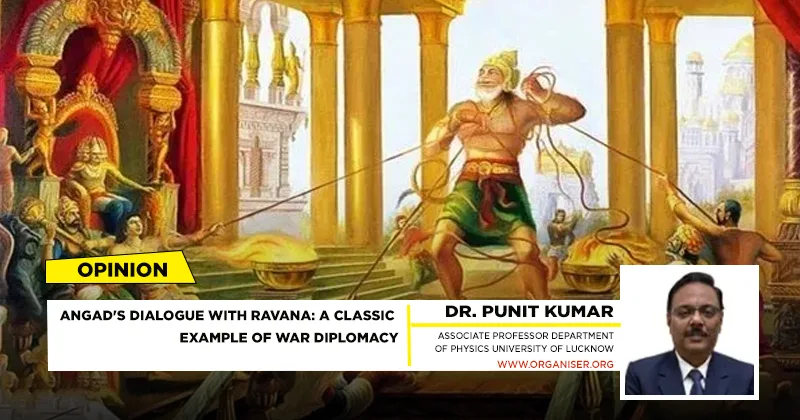
To gauge Ravana’s confidence and the loyalty of his ministers, Angad challenges anyone in the court to move his foot from where it is planted. This act serves as a psychological test, showing that if none of Ravana’s warriors can shift his foot, they stand no chance against the strength of Ram and his forces.

The Humiliation of Ravana’s Court
Several of Ravana’s warriors, including his generals, attempt to move Angad’s foot,  but fail. This not only humiliates them but also shakes the morale of the court. Angad’s defiance serves as a message that Ram’s power is insurmountable and that war will lead to Ravana’s inevitable defeat.

The Final Warning
Despite witnessing the failure of his warriors, Ravana remains stubborn. Angad finally declares that since diplomacy has failed, Lanka will be destroyed. He reminds Ravana of the consequences of his arrogance and warns that the fall of Lanka is near. With his final words, Angad leaps out of the palace and returns to Ram, signaling the end of negotiations.

Analysis of War Diplomacy in the Episode
The dialogue between Angad and Ravana is a textbook example of war diplomacy, involving strategic communication, psychological tactics, and power projection. Several key principles of diplomacy are evident in this episode:

Peace Before War – Angad’s mission aligns with the ethical principles of war, where a final opportunity for peace is offered before engaging in battle. This reflects the ancient Indian tradition of Dharma Yuddha (righteous warfare), which dictates that war should be the last resort.

Psychological Warfare – By planting his foot and challenging the court, Angad engages in psychological warfare. The inability of Ravana’s men to move his foot demoralizes them, planting seeds of doubt in their minds about their chances in battle.

Asserting Authority Without Violence – Angad does not resort to physical combat, yet he successfully asserts the strength of his side. His words and actions alone send a powerful message that Ram’s forces are not to be underestimated.

Testing the Opponent’s Mindset – Through his dialogue, Angad assesses Ravana’s mental state. Despite clear warnings and demonstrations of strength, Ravana’s refusal to surrender reveals his overconfidence and foreshadows his downfall.

The Use of Symbolism – Angad’s unmoved foot symbolizes the unshakable resolve of Bhagwan Ram and his cause. It represents the firm stance of Dharma (righteousness) against Adharma (unrighteousness), showing that no amount of power can defeat the righteous.

The interaction between Angad and Ravana offers valuable lessons in war diplomacy, leadership, and decision making. It emphasizes the importance of diplomacy, as attempts at negotiation can help prevent unnecessary destruction, though arrogance and pride often make conflict inevitable. Strength must also be demonstrated in diplomacy, as Angad’s display of confidence and power reinforced his position without resorting to violence. The episode highlights the dangers of arrogance in leadership, as Ravana’s refusal to acknowledge Ram’s power and dismissing diplomatic advice ultimately led to his downfall. Additionally, it underscores the significance of psychological tactics in warfare, as Angad’s challenge and the failure of Ravana’s warriors to move his foot demoralized the opposition. Most importantly, the episode reinforces the central theme of Ramayana that righteousness ultimately triumphs over evil, as Angad’s mission was not just about diplomacy, but also about upholding dharma.

The dialogue between Angad and Ravana stands as a compelling example of war diplomacy in ancient epics. It illustrates how negotiations, power demonstrations, and psychological tactics are crucial components of military strategy. Despite the failure of diplomacy in this instance, the episode serves as a lesson on the consequences of arrogance and the importance of wisdom in leadership. In today’s world, where conflicts still arise, this story remains relevant, reminding us of the value of negotiation, strategic foresight, and moral strength in resolving disputes.

Topics: diplomacyRavanaWarAngadDialogue
Share
Tweet
SendShareSend
✮ Subscribe Organiser YouTube Channel. ✮
✮ Join Organiser's WhatsApp channel for Nationalist views beyond the news. ✮
Previous News

Navreh 2025: Kashmiri Pandit community celebrates indigenous new year with resilience amid 35 years of exile

Next News

Surya Tilak adores Ram lalla’s forehead on Ram Navami; Bharat witnesses divine ritual

Related News

BRICS Summit 2026: Iran-UAE talks amid West Asia conflict; Reflects India’s diplomatic clout for regional peace

Bharat Mandapam emerges as India’s new diplomatic landmark as New Delhi prepares to host BRICS Summit 2026

BRICS Summit 2026: Bharat Mandapam set to welcome world as India’s diplomatic pride stands alongside US, Russia, China

PM Modi and Bangladesh PM Tarique Rahman

Future trajectory of India-Bangladesh relations

Rahul Gandhi & Sandeep Dikshit make insensitive comments on PM Modi & Italian PM

Rahul Gandhi’s insensitive comment on PM Modi’s diplomacy & Italy PM Meloni; MEA urges respect towards foreign leaders

DRDO calls MSMEs to build swarm drones; The game-changing tech to consolidate India’s capabilities in next-gen warfare

Prime Minister Narendra Modi and New Zealand Prime Minister Christopher Luxon

India-New Zealand Strategic Partnership: A new horizon for New Delhi’s economic diplomacy

Load More

Latest News

At just 19, Mohammad Nabeel built an online Al-Qaeda network in UP

Al-Qaeda plot in UP: 19-year-old Mohammad Nabeel arrested over plan to recruit youths for Jihad

A representative image

Bankers Books Evidence Act 2026 to replace 1891 law from October 1: Here’s what will change?

SSC CGL exam Schedule (This is an AI generated image)

SSC CGL Tier 1 exams from September 30 to October 30; Check schedule and admit card details, vacancies

New Delhi, Sep 12 (ANI): Prime Minister Narendra Modi holds a bilateral meeting with Chinese President Xi Jinping on the sidelines of the BRICS Summit 2026, in New Delhi on Saturday. External Affairs Minister S. Jaishankar, NSA Ajit Doval and Principal Secretaries to the PM, Pramod Kumar Mishra and Shaktikanta Das also present. (@MEAIndia X/ANI Photo)

BRICS 2026: Why Putin, Xi and Pezeshkian meetings stand out in PM Modi’s diplomacy

Odisha Chief Minister Mohan Charan Majhi addresses the media at Bhubaneswar airport after returning from his UAE visit on September 13, 2026.

Odisha secures Rs 2.43 lakh crore investment proposals during CM Majhi’s five-day UAE outreach programme

Bhagwan Ganesh

Ganesh Chaturthi: Rationale behind worshipping Bhagwan Ganesh

RSS Akhil Bharatiya Sah-Bauddhik Shikshan Pramukh Deepak Vispute addressing the gathering

‘Nation First’ should be the guiding principle for every individual, regardless of their Field: Deepak Vispute

‘India was not poor; it was made poor’: The truth re-emerges through Jema Ferrer’s perspective

Six years after talent manager Disha Salian was found dead, her father Satish Salian on September 11 recorded a detailed statement with the Central Bureau of Investigation (CBI), naming Shiv Sena (UBT) leader Aaditya Thackeray, actors Dino Morea and Sooraj Pancholi, and others.

Disha Salian Murder Case: Father names Aaditya Thackeray in CBI statement; Lawyer claims gang rape, murder cover-up

Release of a book at Vishwa Bandhutva Diwas programme that was organised in Ujjain

Bharat’s youth rooted in sacrifice, service & discipline can give new direction to World: Parag Abhyankar

Load More
  • Privacy
  • Terms
  • Cookie Policy
  • Refund and Cancellation
  • Delivery and Shipping

© Bharat Prakashan (Delhi) Limited.
Tech-enabled by Ananthapuri Technologies

  • Home
  • Search Organiser
  • Bharat
    • Assam
    • Bihar
    • Chhattisgarh
    • Jharkhand
    • Maharashtra
    • View All States
  • World
    • Asia
    • Africa
    • North America
    • South America
    • Europe
    • Australia
  • Editorial
  • Operation Sindoor
  • Opinion
  • Analysis
  • Defence
  • Culture
  • Sports
  • Business
  • RSS @ 100
  • Entertainment
  • More ..
    • Sci & Tech
    • Vocal4Local
    • Special Report
    • Education
    • Employment
    • Books
    • Interviews
    • Travel
    • Health
    • Politics
    • Law
    • Economy
    • Obituary
  • Subscribe Magazine
  • Read Ecopy
  • Advertise
  • Circulation
  • Careers
  • About Us
  • Contact Us
  • Policies & Terms
    • Privacy Policy
    • Cookie Policy
    • Refund and Cancellation
    • Terms of Use

© Bharat Prakashan (Delhi) Limited.
Tech-enabled by Ananthapuri Technologies