





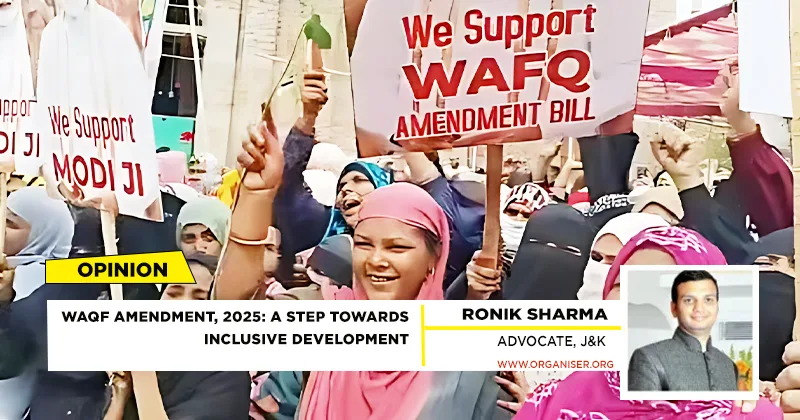
Following hours of discussion by parliamentarians by various political parties, Lok Sabha finally passed the Waqf (Amendment) Bill 2025. 288 members voted in favour, and 232 members voted against the bill in Lok sabha in the most recent amendment of 2025. The house also gave approval to the Mussalman Wakf (Repeal) Bill 2024 which repeals the Mussalman Wakf Act 1923. In addition to improving its efficacy, the Waqf amendment 2025, aims to address flaws in the previous Waqf act and its amendments and ensure that the new amendment of 2025 (UMEED) operates fairly.
From a proper standpoint, the central government’s initiative will safeguard Waqf properties, which are meant for the benefits of ordinary muslims. These properties must be handled properly to guarantee that their revenue helps people in need and for their advancement. The purpose of this amendment of 2025 (UMEED) is to preserve that integrity. The most recent amendment, which follows a constitutional and legislative procedure. It is a well-known fact that the ‘WAQF’ properties are meant for the welfare of the community, especially for the benefit of the ordinary Muslims, be it for education, healthcare, or religious purposes, but it is not for those who utilise it for their personal benefits and for their families upliftment and for providing benefits to their other relatives and also not for some influential person’s only. In the last parliament session, the central government moved two bills on August 8, 2024 the Waqf (Amendment) Bill 2024, and the Mussalman Wakaf (Repeal) Bill, 2024 were introduced in the LoK Sabha but were sent to a joint parliamentary committee (JPC) after an uprora from the other opposition members in the house. Supporting all members of the society without prejudice and promoting inclusive development at the micro level are the central government’s primary goals.
The most recent waqaf legislation amendment states that the central government’s primary goal is to serve ‘ordinary muslims’ not powerful individuals. As per the UMEED, the new Waqf amendment of 2025, known as the Unified Waqf Management, Empowerment, Efficiency, and Development Act, will not only repeal several of the discriminatory clauses of the 1995 Waqf Act but will also redress the numerous issues, problems, and challenges concerning waqf properties nationwide and will also improve the shortcomings in managing the waqf properties and also boost inclusive development overall with a positive approach for an ordinary individual. The new Waqf amendment act of 2025 (UMEED) includes elements that are intended to improve the management of the waqf properties in a more efficient manner throughout the nation, lessen the burden of litigation, and strengthen and support the muslim community as whole. Whether for religious, medical or educational purposes, the waqf properties are not only intended for the benefit of a powerful individual but also for the general public. Land grabbing, false claims over waqfs, and abuse by politically connected muslims have caused alarm among ordinary, impoverished muslims, especially women, according to numerous examples over the past several years.
The politically driven and self-styled influential have frequently utilised these properties for their own gain rather than helping the underprivileged, betraying and exploiting the worries of the average person. In accordance with Islamic law, it is important to note that ‘waqf’ refers to properties that are solely used for charitable and religious purposes. But land mafia politically motivated, used these charitable things for their personal benefits. Currently, more than eight lakh properties totalling more than nine lakh acres approximately and valued at over one lakh crores are under the jurisdiction of the waqf boards nationwide. As a result, they are now the nation’s third-largest landowner. Although there have occasionally been waqf reforms, they have been ineffective and have not addressed issues that the ordinary muslims face.The goal of the recently proposed amendment of 2025 is to guarantee the protection, preservation and good use of Waqf properties.
In order to address the long standing problems of corruption, poor managemen, Waqf Mafia encroachment on Waqf holdings. The new amendment is an important legislative step towards the inclusive development. In addition to improving transparency. The new modification to the 2025 Waqf law will also create a strong system of accountability and good governance within Waqf boards and offer opportunity to all ordinary muslims. The absence of appropriate identification and digitization has been one of the main issues with property management. It is important to note that not all islamic nations have Waqf properties, and those nations are devoid of waqfs. Bharat is the only country in the whole world with legally protected waqf boards. The new amendment in the Waqf act will provide justice to ordinary muslims so that they cannot be subjected to discrimination.
The new provision of the Waqf act 2025 (UMEED) will eliminate cases where properties were falsely claimed as Waqf despite the original owner lacking legal title and the key changes where “Waqf by User Revision – Only properties officially registered as Waqf will remain so. Greater Oversight – A government officer above the rank of Collector will investigate claims over Waqf properties. Donor Clarification – Any person practising Islam for five years can dedicate property. Legal Recourse – Courts may accept applications beyond six months ifjustified. protection of lInheritance Rights – The new provision safeguards legal heirs’ rights, including women. The central government is fully responsible and exclusively in charge of keeping an eye on and addressing any discriminatory issues as well as problems involving the improper management of Waqf properties by influential persons who not only betray the common man but also play with their emotions. In general, the Waqf amendment, 2025, (UMEED) brings about much-needed reforms to enhance effective management of Waqf properties, prohibit unauthorised claims, control waqf land mafia and limit corruption.
There were several flaws in the old law, including irrevocabliity of Waqf properties, unnecessary litigation and poor management, a lack of court supervision, unregulated property claims, Muttawalis abuse of power. Further, there is a debate on the constitutionality of the Waqf act. In addition to safeguarding the interests of the ordinary muslims and the general public. The Waqf amendment of 2025 aims to re-establish the legitimacy of Waqf boards by placing a strong emphasis on administrative accountability, transperancy, and legal ownership verification. It will also give an opportunity to ‘Ordinary Muslims’ and be another step towards inclusive development.
















Comments