





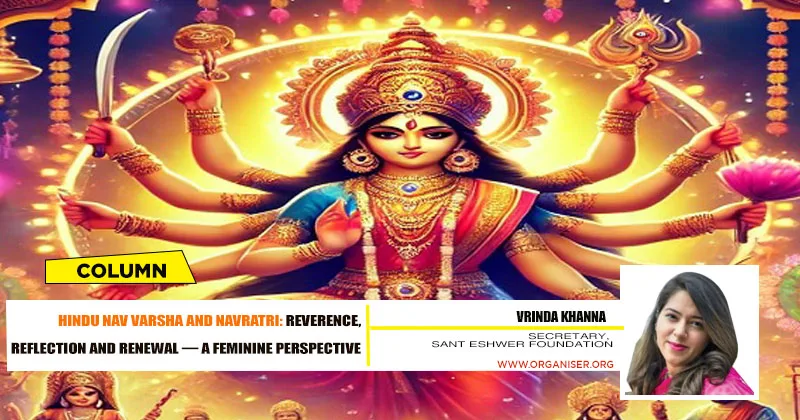
Hindu Nav Varsha, the New Year as per the Vikram Samvat calendar, is more than just a change in dates—it is a celestial and spiritual reset. Unlike the Gregorian calendar, which follows only the solar cycle, the Hindu calendar harmonises both lunar and solar movements, making it deeply attuned to the natural rhythms of the universe. But Hindu Nav Varsha isn’t just about the universe finding its rhythm—it’s about us realigning with our roots, our traditions, and our understanding of dharma. This is why it also marks the start of Chaitra Navratri, a period dedicated to the divine feminine energy—Devi, Shakti, the cosmic mother.
Creation and the Power of the Feminine
Ancient Hindu scriptures describe how, after creating the universe, Bhagwan Brahma sought guidance on how life should sustain itself. According to the Shiva Purana, he turned to Devi Parvati, who revealed a profound truth:
“For creation to flourish, women must walk the Earth as the bearers of life.” This isn’t just history—it is a timeless message. Women are not just participants in existence; they are the foundation of it. Without them, there is no birth, no nurturing, no civilisation. The Rigveda, one of the world’s oldest scriptures, beautifully acknowledges this power:
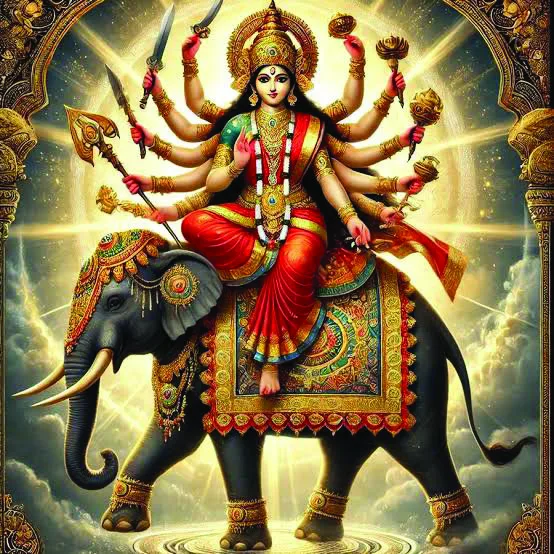
“I move with the Rudras and Vasus, with the Ādityas and all Gods. I uphold Mitra and Varuna, Indra and Agni, and the two Ashwins.” — Rigveda 10.125.1
This verse, spoken by Vak (the Goddess of Speech and Knowledge), reminds us that the feminine force is not separate from existence—it is existence. From the cosmos to culture, from war to wisdom, from nurturing to leadership, the divine feminine moves through it all.
Chaitra Navratri and the Journey of a Woman
As Navratri progresses, it represents the journey of the Devi in her nine forms — a journey that also corresponds to the stages of a woman’s life. Just like a girl who walks out of the house to explore the journey of her world, the first day opens with Shailputri, the innocent and powerful daughter of the mountains. “Where women are honoured, there the Gods reside.” In ancient Bharat, women were not only protected; they were worshipped. Gargi and Maitreyi debated issues of philosophy in religious assemblies, queens such as Ahilyabai Holkar made wise governance of kingdoms, and warriors such as Rani Durgavati led forces. Education, power, and leadership were their birthrights.
With each passing day of Navratri, Devi transforms from a seeker of knowledge to a fierce protector, from a nurturer to the destroyer of evil. Katyayani, the warrior goddess, reminds us of women like Rani Lakshmibai, who fought for her land, and countless unnamed women who rise every day to protect their dignity. “Do not yield to weakness, O Arjuna! It does not befit you. Stand up and fight!” This was Krishna’s call to Arjuna, but isn’t it also a call to every woman who has ever been told to step back? To every girl who has been asked to stay silent instead of standing tall?
Navratri ends with Siddhidatri, the final form of the Devi, where Shiva and Shakti become one, symbolising perfect balance, harmony. In the philosophy of Sanatan Dharma, one cannot exist without the other.“Without Shakti, Shiva is powerless; without Shiva, Shakti is directionless.”
Reclaiming the True Sanatan Legacy
Sanatan Dharma doesn’t just acknowledge the feminine—it places her at the very center of existence. The concept of Shakti isn’t a metaphor; it’s the recognition that creation, sustenance, and transformation all flow from the feminine force. Without her, there is no life, no movement, no balance. The divine in Sanatan culture isn’t singularly masculine—Shiva is incomplete without Shakti, Vishnu without Lakshmi, and Brahma without Saraswati. This isn’t just symbolism; it reflects the natural order of the world where both forces must coexist as equals.
Now, compare this to Abrahamic traditions, where the feminine takes a secondary role. In the Book of Genesis, Eve is created from Adam’s rib—not as an independent force, but as an extension of man. Islam takes this even further. Instead of granting women rights, it ties them to restrictive practices like Halala, polygamy, triple talaq , and male guardianship laws. These aren’t just cultural practices—they are embedded in religious law. The idea of a female divine figure is absent; God is exclusively referred to in masculine terms, shaping a worldview where men are inherently dominant.
Navratri represents the journey of the Devi in her nine forms — a journey that also corresponds to the stages of a woman’s life. Just like a girl who walks out of the house to explore the world
This fundamental difference in worldview has shaped civilisations in distinct ways. In Bharat, ancient women were rishikas, warriors, queens, and philosophers, actively shaping society. In the West and the Middle East, religious frameworks historically confined women to domestic roles, with religious institutions often prohibiting female leadership. This fundamental difference in perspective has had a deep impact on how civilisations evolved. In Bharat, women were rishikas, philosophers, warriors, and queens—shaping society as leaders and thinkers. In contrast, religious frameworks in the Middle East and the West confined women to domestic roles, limiting their education, leadership, and rights for centuries. Even today, while Western feminism struggles for basic rights, Sanatan Dharma never needed feminism—because it already saw women as powerful, divine beings thousands of years ago.
“These women, full of life, move freely and choose their own paths.” This was the vision of Sanatan Bharat—a land where women didn’t just survive; they thrived.
Bharat Rising: The Return of Shakti
As we enter this New Year, it is heartening to see that the call for restoring Shakti is not just a distant dream—it is becoming a reality. Across every field, women are reclaiming their rightful place, embodying the power and wisdom that Sanatan Dharma has always upheld.
From young girls excelling in STEM fields to more and more women taking part in active politics, from female entrepreneurs shaping the economy to sants and spiritual leaders guiding the world—Shakti is not just awakening; she is already rising. The barriers that once held her back are being dismantled, and the spirit of our ancient civilisation is shining through once again. We are not just seeking change anymore; we are witnessing it. The essence of Devi is being recognised not just in temples but in boardrooms, classrooms, battlefields and even in politics where we unanimously welcomed a 33.3 per cent reservation. With each passing year, Bharat is embracing its true legacy—a civilisation where wisdom and power, knowledge and compassion, Shiva and Shakti, walk together in perfect harmony.
This Hindu Nav Varsha is not just a time for renewal; it is a celebration of the fact that we are returning to our roots. We are remembering who we are, reclaiming what was lost, and rebuilding Bharat as it was always meant to be—a land where Shakti is not just worshipped, but truly revered, and celebrated in every aspect of life. This is not just a beginning. This is our resurgence. Women are the truth and essence of Brahma.















Comments