





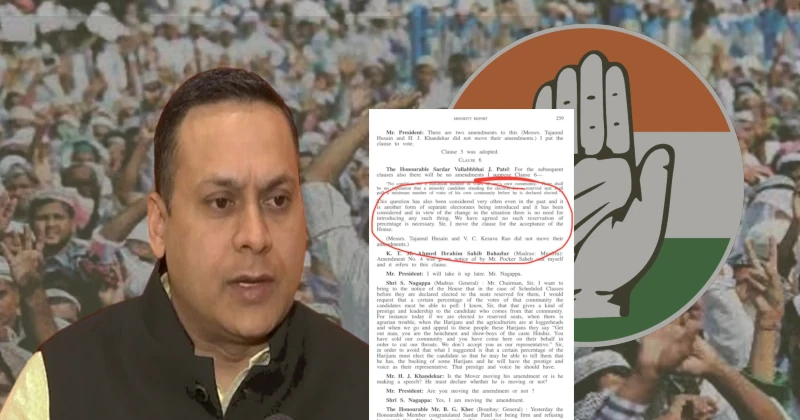
The Congress party’s history of prioritising Muslim reservations over constitutionally mandated quotas for Scheduled Castes (SC), Scheduled Tribes (ST), and Other Backward Classes (OBC) has once again come under the spotlight. BJP IT cell head Amit Malviya recently exposed how the Congress systematically removed SC/ST reservations from government-funded institutions like Jamia Millia Islamia (2011) and Aligarh Muslim University (1981), ensuring that ‘minority’ institutions remained exempt from providing reservations to these communities. This pattern reflects a long-standing policy of appeasement, disregarding constitutional principles and court rulings.
The most glaring example of Congress’s pro-Muslim reservation agenda is its relentless effort to enforce religion-based quotas in Andhra Pradesh, despite repeated judicial rejections. The party made no less than five attempts to push through unconstitutional Muslim reservations, each time facing legal rebuke.
Congress’s Prioritization of Muslim Reservations Over SC, ST, and OBC Rights
The Congress government systematically removed constitutionally mandated SC/ST reservations from government-funded institutions like Jamia Millia Islamia (2011) and Aligarh Muslim University (1981) in… pic.twitter.com/LIxZWYtN2r
— Amit Malviya (@amitmalviya) March 24, 2025
Recently congress government appeasement policy came to the fore in Karnataka as they called for changing the constitution to provide religion based reservation .The row erupted over Karnataka Deputy Chief Minister DK Shivakumar’s controversial remarks on “changing the Constitution” to accommodate religion-based reservations. The BJP has accused the Congress leader of attempting to undermine constitutional values, triggering a fierce backlash.
The controversy erupted after BJP national spokesperson Shehzad Poonawalla shared a viral video of Shivakumar speaking at an event. In the clip, he is heard saying, “A good day will come, a lot of changes will be there… the Constitution will be changing.” Seizing on this statement, the BJP accused Congress of plotting constitutional amendments to grant religion-based reservations, specifically for Muslims.
Attempting damage control, Shivakumar claimed his words were misconstrued, arguing, “I only referred to past constitutional amendments based on court rulings. The BJP is twisting my statement to mislead the public.”
This comes as the Congress-led Karnataka government already faces heat over its controversial 4 per cent Muslim quota in government contracts and procurement, announced by CM Siddaramaiah in the state Budget on March 7.
Earlier this month, Chief Minister Siddaramaiah announced that Muslims would receive reservation in government contracts below Rs 2 crore and procurement of goods and services below Rs 1 crore, a move widely criticised for appeasement politics. The announcement came as part of his record 16th Budget presented on March 7, further fueling accusations of divisive policies.
Timeline of Congress’s Muslim Reservation Push in Andhra Pradesh:
- July 12, 2004: The newly elected Congress government under Y.S. Rajasekhara Reddy announced 5per cent reservations for Muslims in government jobs and educational institutions.
- September 21, 2004: The Andhra Pradesh High Court struck down the order.
- November 2004: Congress set up the D. Subrahmanyam Commission to justify the reservations.
- June 14, 2005: The Commission recommended a 5 per cent Muslim quota, violating the Supreme Court’s 50per cent cap on reservations.
- June 20, 2005: The state government issued an ordinance overriding the court’s ruling.
- October 25, 2005: The state passed a bill formalising the reservations.
- November 21, 2005: The Andhra Pradesh High Court declared it unconstitutional, citing flawed criteria for identifying Muslims as a backward class.
- December 14, 2005: The state government appealed to the Supreme Court.
- January 4, 2006: The Supreme Court granted a temporary stay but halted recruitments under the quota.
- April 17, 2007: Congress persisted by referring the issue to another commission led by P.S. Krishnan.
- July 7, 2007: Based on new recommendations, the Andhra Pradesh government issued a fresh order granting a 4 per cent Muslim reservation.
- February 8, 2010: A seven-judge bench of the Andhra Pradesh High Court again struck down the law, ruling that religion-based quotas violated the Constitution.
- March 25, 2010: The Supreme Court temporarily upheld the quota but referred it to a constitutional bench.
- December 22, 2011: Just before the Uttar Pradesh elections, the UPA government created a 4.5 per cent Muslim sub-quota within the OBC quota, reallocating OBC seats to Muslims.
- May 29, 2012: Andhra Pradesh High Court struck down the 4.5 per cent sub-quota, marking the fourth rejection of Congress’s Muslim reservation attempts.
- June 13, 2012: The Supreme Court upheld the High Court’s ruling, declaring the quota unconstitutional.
- February 2014: The UPA government appealed the case to the Supreme Court for a constitutional bench ruling.
Despite repeated failures, the Congress party has remained committed to enforcing religion-based reservations, sidelining SC, ST, and OBC communities.
Congress’s bias toward Muslim reservations is not just a state-level phenomenon. It has been openly endorsed by senior Congress leaders at the national level. On December 9, 2006, then-Prime Minister Dr. Manmohan Singh declared: “We will have to devise innovative plans to ensure that minorities, particularly the Muslim minority, are empowered to share equitably in the fruits of development. They must have the first claim on resources.”
Just before the 2009 Lok Sabha elections, on April 14, 2009, he reiterated: “Minorities, especially poor Muslims, should get priority when it comes to national resources.” These statements cemented Congress’s intent to prioritise Muslim reservations and resources over SC, ST, and OBC communities, despite constitutional limitations and judicial verdicts.
Religion-based reservations were categorically rejected by the Constituent Assembly on August 28, 1947. Sardar Vallabhbhai Patel, then Chairman of the Minority Committee, strongly opposed such quotas, stating: “If you want to bring this back again, then go to Pakistan.” Yet, Congress has consistently attempted to reinstate religion-based quotas.














Comments