






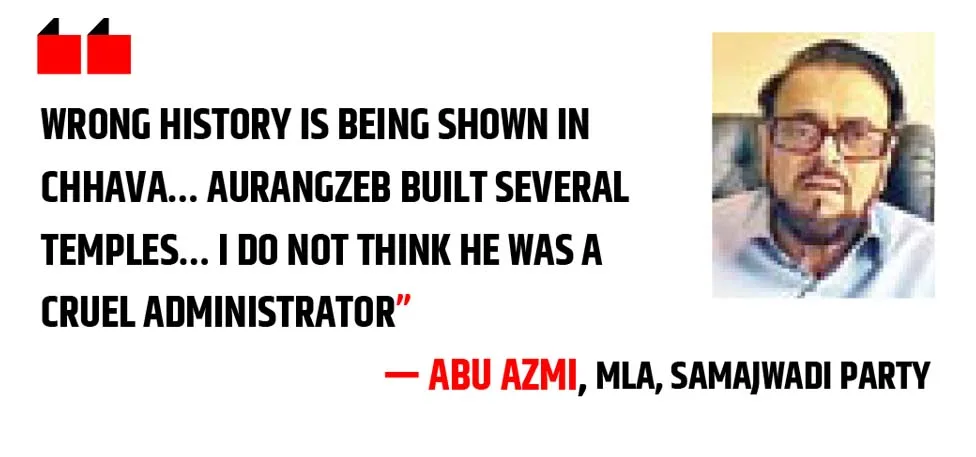
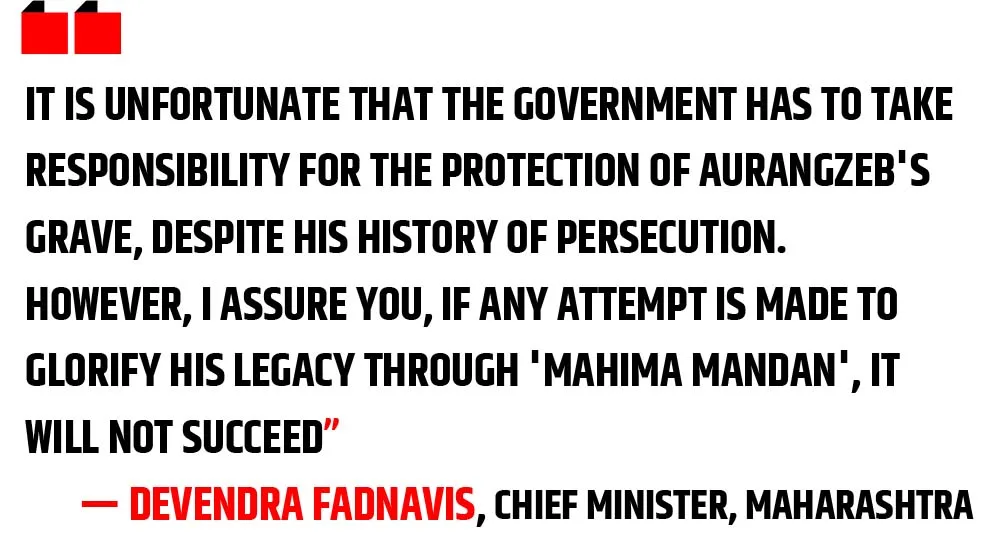
The contemporary debate surrounding Aurangzeb’s bigotry and religious fanaticism has intensified, with his issued “farmaans” (imperial orders) cited as evidence of his extremism and anti-Hindu stance. Numerous primary historical texts, including Mirat-i-Ahmadi, Mirat-i-Alam, Maasir-i-Alamgiri, Aurangzebnama, Futuhat-i-Alamgiri, Aurangzebachya Darbarche Akhbar, Ahkam-i-Alamgiri, Veer Vinod, Rathod ri Khyat, Mundiyad ri Khyat, and Jodhpur Rajya ri Khyat, offer insights into his religious policies, suggesting that, like his father Jahangir, Aurangzeb pursued an anti-Hindu and intolerant approach. This historical record is now being re-examined in modern political discourse, where Aurangzeb’s actions fuel contemporary narratives of communal division.
In 1644 AD, while serving as the Governor of Gujarat, Aurangzeb issued an order mandating strict adherence to Quranic law in Ahmedabad, resulting in the demolition of twenty Hindu temples. During the Holi festival, the traditions of Holika Dahan and the lighting of lamps during Diwali in shops were prohibited. Furthermore, the creation of clay idols of deities such as Lakshmi and Ganesh was banned, and the minting of coins bearing deity images was forbidden.
However, the situation experienced a shift during the two tenures of Raja Jaswant Singh as the Subedar of Gujarat (March 1659-61 and July 1671-September 1672 AD). During these periods, Raja Jaswant Singh facilitated the repair of demolished temples, permitted Hindus to worship their deities, and allowed the public celebration of Hindu festivals. He emerged as a proponent of Hindu revivalism, acting as a significant obstacle to Aurangzeb’s goal of establishing Islamic dominance. In one instance, Jaswant Singh launched a night attack on an Aurangzeb military unit in Kurad village, causing the Mughal army to retreat and stopping him from looting and plundering. While Aurangzeb downplayed the incident, claiming it ultimately benefited the Mughals by preventing Jaswant Singh from staying and potentially undermining their Islamic ambitions, the incident highlighted the resistance Aurangzeb faced.
Another incident from 1644 AD, while Aurangzeb was Subedar of Gujarat, involved the slaughter of a cow within the Chintamani temple, built by jeweller Satidas in Sahaspur, and its subsequent conversion into the Quwwat-ul-Islam mosque. Despite the reliance of the Mughal state on Hindu bankers for financial support, particularly Johri Satidas, a prominent merchant and banker from Surat, Shah Jahan, upon learning of the incident, ordered the temple’s restoration. However, due to the desecration caused by the cow slaughter and the defacement of deity statues, the Jains ceased worshipping in the temple, and for Hindus, it lost its sanctity. This incident reveals Aurangzeb’s demonstrably anti-Hindu sentiment, seemingly disregarding the potential loss of crucial Hindu banker support. Later, Aurangzeb attempted to regain Satidas’s support by granting him land in Pargana Shatrunjay, showcasing a policy of appeasement.
After ascending to the throne, Aurangzeb eliminated his brothers and swiftly implemented Islamic principles throughout the Mughal Empire. His forces attacked Kamrup, the Ruler of Assam, and Roop Narayan, the Zamindar of Cooch Behar, achieving victories that were followed by acts of religious fanaticism, including the demolition of temples within the conquered territories and the removal of temple bells, which were then packed into trunks. Aurangzeb referred to Hindus as “kafirs” and his forces as the “Lashkar of Islam,” indicating a significant escalation of his extremist views.

In 1667 AD, Qazi Abul Muqaram reported to Aurangzeb that large gatherings of Hindus were occurring at the Kali temple in Barapulla, Delhi. Attempts by Mughal servants Aminuddin Shahmdar and Salar Saud Gazi Talwar to disperse the crowds were unsuccessful. In response, Aurangzeb ordered the demolition of all temples in the area. A Brahmin who attempted to defend the temple killed a beldar and injured three others before being killed himself. His head was severed, and the Kali temple was demolished. In the same year, Aurangzeb banned the worship of Sheetla Mata and the Saptami Sheetla Mata, which was worshipped seven days after Holi. These actions, both direct and indirect, represent Aurangzeb’s systematic attacks on Hindu faith and traditions, including the destruction of their places of worship. This strategy aimed to undermine the mental fortitude of Hindus, weakening their resolve and potentially leading them to convert to Islam.
Resistance from Hindu Kings
In 1669, Aurangzeb issued an order to demolish the Govardhan Nath ji temple in Gokul. Temple priest Gosain ji, in response, relocated the Nath ji idol to Jodhpur, where Raja Jaswant Singh provided it with sanctuary. Subsequently, the Vigraha was established in the Sihad village of Mewar, which is now widely known as the Nathdwara temple. This incident, alongside others, demonstrates that, much like the Marathas, Rajput Raja Jaswant Singh of Jodhpur stood as a formidable obstacle to Mughal supremacy. Aurangzeb held Raja Jaswant Singh in such regard that he refrained from entering his kingdom during his lifetime. However, Aurangzeb persisted with his temple and gurukul destruction campaign in Delhi, Agra, and their surrounding regions.
Attack on Educational
In 1669 AD, Aurangzeb issued a decree to close all Hindu schools and gurukuls, ordered the demolition of temples, and discontinued the Hindu education system. Temples in Thatta, Multan, Banaras, and Mathura were systematically demolished, schools were shut down, and Vedic texts, Hindu literature, and books on rational sciences were destroyed. These gurukuls and Brahmin-led institutions were central to Hindu education. By dismantling this system, Aurangzeb sought to dismantle the Bharatiya knowledge system, thereby facilitating the subjugation of Hindus by Muslims. Large numbers of Hindu teachers were dismissed from their positions, and many were killed, leading to a decline in Hindu literacy rates and a corresponding increase in the Muslim educated class.
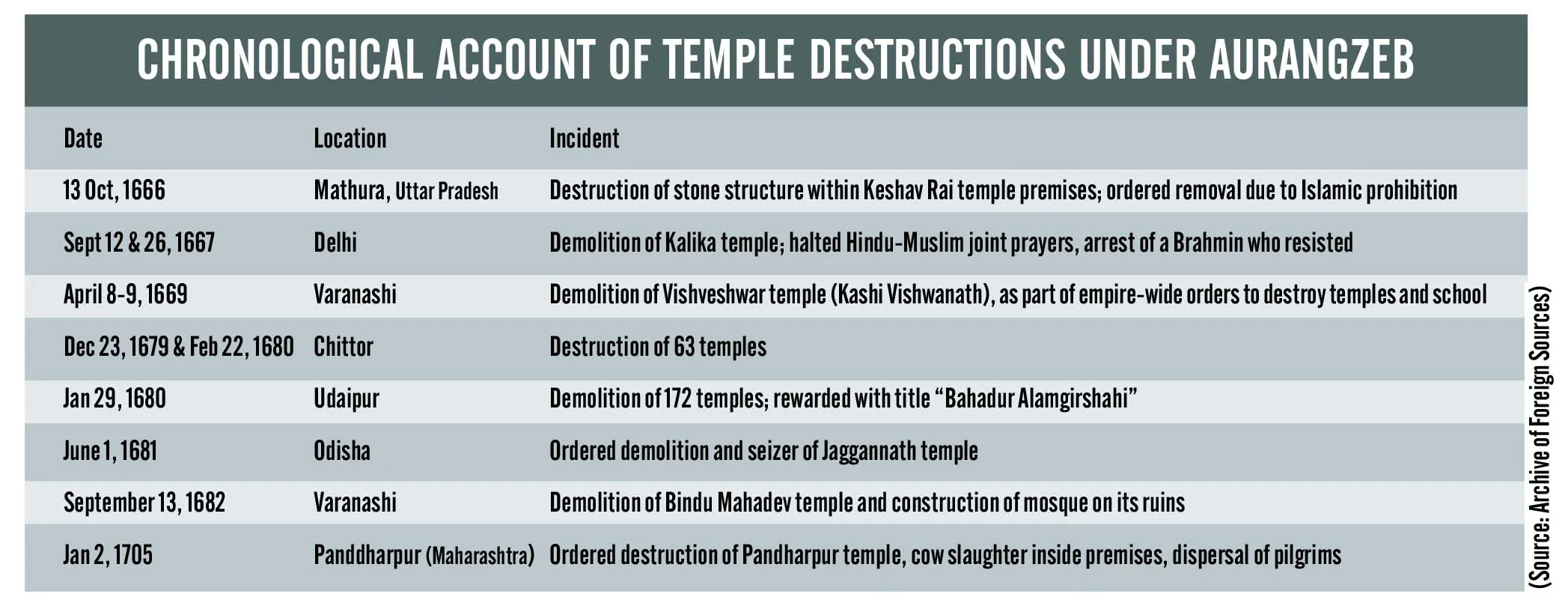
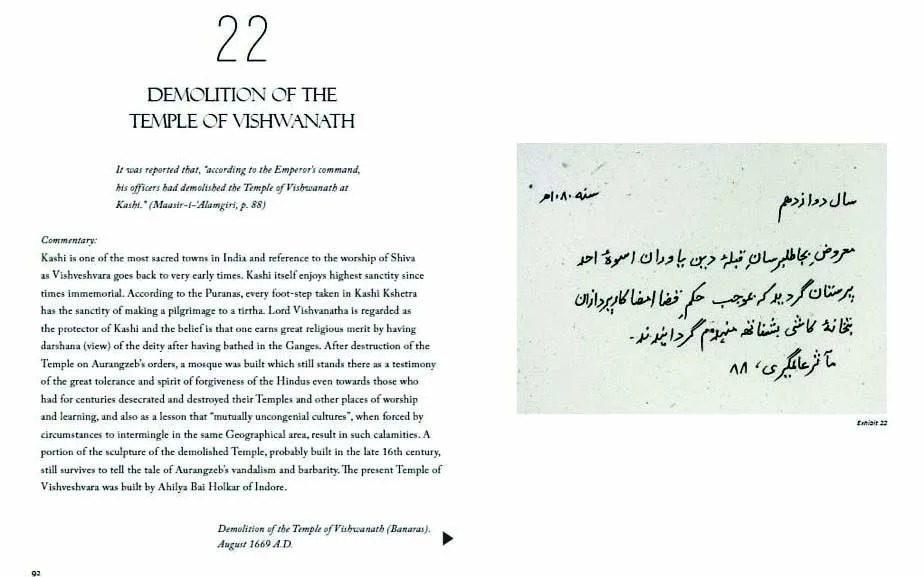
In 1669 AD, Aurangzeb implemented stringent measures to control Banaras Varanasi, a city of profound religious significance to Hindus, considered a place of Moksha (liberation). He initiated a campaign of temple destruction, the killing of Hindu scholars, and the renaming of Hindu landmarks with Muslim Islamic names. To further erase the historical presence of Hindus, Aurangzeb initiated a campaign to rename prominent Hindu sites. Mathura was renamed Islamabad, and Banaras Varanasi was renamed Mohammadabad, effectively attempting to erase Hindu historical memory and prevent future claims to these areas. In 1683 AD, under Aurangzeb’s orders, Diwan Rafiul Amin demolished the Bindu Madhav temple and erected a mosque. Aurangzeb’s officials actively participated in these acts of destruction, with those who successfully demolished Hindu places of worship receiving rewards, promotions, and prestigious titles. For example, Hussain Ali Khan, who destroyed 175 temples in Chittor, was honoured with the title “Alamgir” by Aurangzeb in the Delhi Durbar.
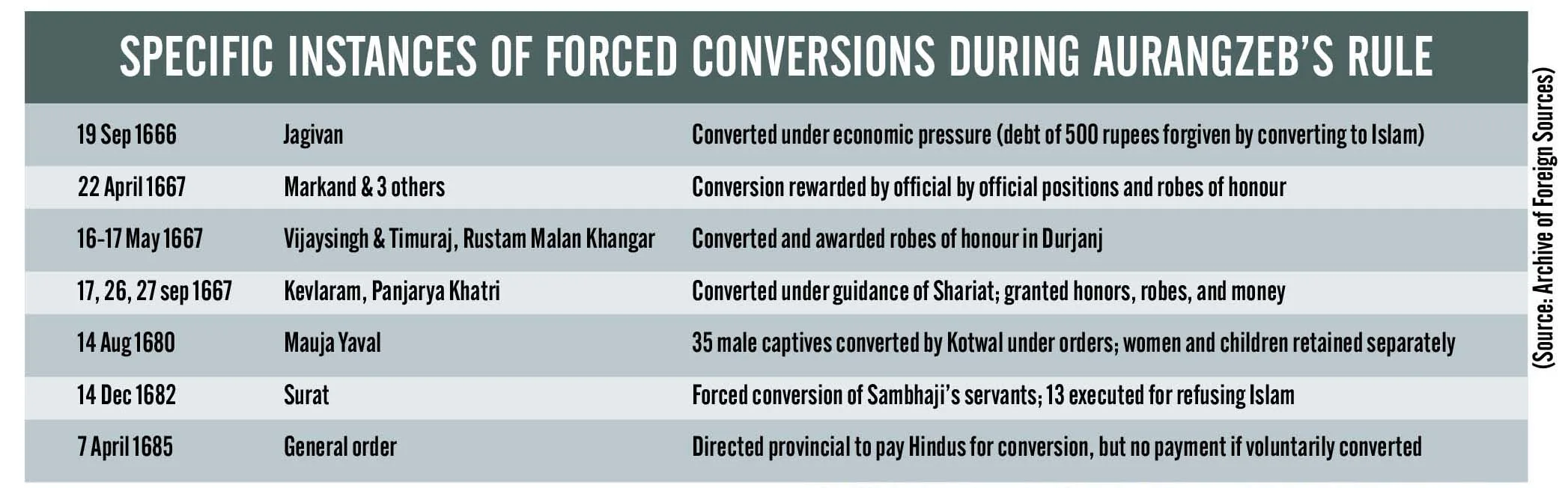
Aurangzeb effectively transformed temple destruction into a state-sanctioned policy, encouraging Muslims to view it as a virtuous act and a primary objective. He ordered the desecration of Hindu idols, sometimes burying them, to establish a lasting legacy as a staunch supporter and defender of Islam. This period was marked by systematic efforts to dismantle Hindu culture and civilisation, contradicting claims that Aurangzeb was a protector of Hindus or a builder of temples. His reign was characterised by actions aimed at the deliberate and forceful erosion of Sanatan Dharma.

Attempts at Islamisation of Bharat
Aurangzeb, driven by his ambition to establish Dar-ul-Islam (a land governed by Islamic law), appointed Jaswant Singh as the Subedar of Kabul. He issued the farmaan ordering Jaswant Singh to systematically destroy all Hindu temples within the Marwar region. However, Jaswant Singh, a Rajput ruler known for his pragmatism and understanding of regional dynamics, vehemently objected to this directive. He pointedly reminded the Mughal officials that during the reign of Sawai Jai Singh, a period of relative peace and stability, no temples had been subjected to demolition. Furthermore, he issued a stark warning: should any temple in Marwar be harmed, he would retaliate by ordering the destruction of all mosques within the region. Jaswant Singh’s resolute stance and the threat of widespread destruction of mosques deeply alarmed the Mughal officials. Confronted with the potential for escalating religious conflict and the destabilisation of a strategically important region, they ultimately chose to withdraw the farmaan, effectively rescinding Aurangzeb’s order. As gleaned from historical accounts, Aurangzeb’s psyche reveals a complex interplay of religious zeal and authoritarian control. His relentless pursuit of Islamic dominance suggests deep-seated insecurity, masked by rigid piety. The systematic destruction of Hindu temples and educational institutions points to a fear-driven intolerance, aimed at consolidating power. Despite strategic pragmatism, his religious ideology prevailed. Resistance, notably from Raja Jaswant Singh, highlighted the limits of his extremism. His actions, like renaming cities and emphasising his forces as “Lashkar of Islam,” betray a desire for a lasting, religiously defined legacy, potentially fueled by paranoia and a need for absolute control. Aurangzeb’s legacy is one of cultural destruction and religious animosity, ultimately weakening the Mughal Empire through his divisive policies.
(With profound gratitude to Dr Nisha Bhardwaj, a history scholar and an independent researcher, for sharing primary records on this historical piece)
















Comments