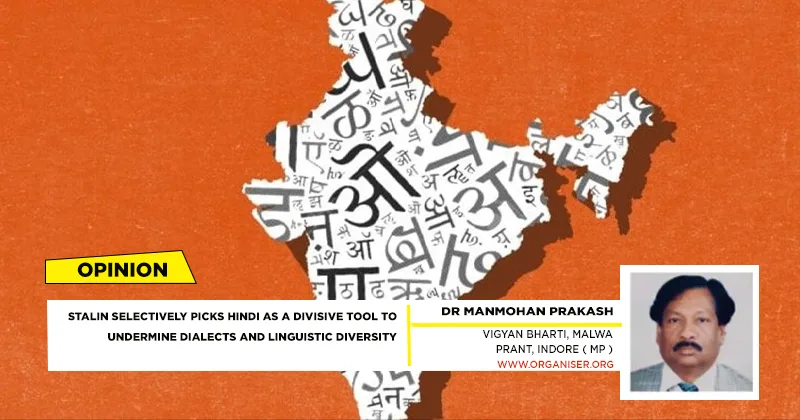
Stalin selectively picks Hindi as a divisive tool to undermine dialects and linguistic diversity
December 5, 2025
  • Read Ecopy
  • Circulation
  • Advertise
  • Careers
  • About Us
  • Contact Us
Android AppiPhone AppArattai
Organiser
  • ‌
  • Bharat
    • Assam
    • Bihar
    • Chhattisgarh
    • Jharkhand
    • Maharashtra
    • View All States
  • World
    • Asia
    • Europe
    • North America
    • South America
    • Africa
    • Australia
  • Editorial
  • International
  • Opinion
  • RSS @ 100
  • More
    • Op Sindoor
    • Analysis
    • Sports
    • Defence
    • Politics
    • Business
    • Economy
    • Culture
    • Special Report
    • Sci & Tech
    • Entertainment
    • G20
    • Azadi Ka Amrit Mahotsav
    • Vocal4Local
    • Web Stories
    • Education
    • Employment
    • Books
    • Interviews
    • Travel
    • Law
    • Health
    • Obituary
  • Subscribe
    • Subscribe Print Edition
    • Subscribe Ecopy
    • Read Ecopy
  • ‌
  • Bharat
    • Assam
    • Bihar
    • Chhattisgarh
    • Jharkhand
    • Maharashtra
    • View All States
  • World
    • Asia
    • Europe
    • North America
    • South America
    • Africa
    • Australia
  • Editorial
  • International
  • Opinion
  • RSS @ 100
  • More
    • Op Sindoor
    • Analysis
    • Sports
    • Defence
    • Politics
    • Business
    • Economy
    • Culture
    • Special Report
    • Sci & Tech
    • Entertainment
    • G20
    • Azadi Ka Amrit Mahotsav
    • Vocal4Local
    • Web Stories
    • Education
    • Employment
    • Books
    • Interviews
    • Travel
    • Law
    • Health
    • Obituary
  • Subscribe
    • Subscribe Print Edition
    • Subscribe Ecopy
    • Read Ecopy
Organiser
  • Home
  • Bharat
  • World
  • Operation Sindoor
  • Editorial
  • Analysis
  • Opinion
  • Culture
  • Defence
  • International Edition
  • RSS @ 100
  • Magazine
  • Read Ecopy
Home Bharat

Stalin selectively picks Hindi as a divisive tool to undermine dialects and linguistic diversity

India's linguistic diversity is threatened, with nearly 400 languages and dialects at risk of extinction in the next 50 years. While some blame Hindi for overshadowing regional dialects, experts argue that factors like migration, cultural shifts, and English dominance play a bigger role in language decline

Dr Manmohan PrakashDr Manmohan Prakash
Mar 23, 2025, 04:30 pm IST
in Bharat
Follow on Google News
FacebookTwitterWhatsAppTelegramEmail

India is a vast country where various castes, religions, communities, languages, and dialects are still prevalent. According to an estimate, more than 19,500 languages and dialects have been spoken in India (per the 2011 Census). Out of these, around 121 languages are spoken by more than 10,000 people, while only 22 languages have been recognised in the Eighth Schedule of the Indian Constitution.

According to UNESCO’s Atlas of the World’s Languages in Danger, approximately 197 languages in India are endangered. Some Indian languages and dialects that have become extinct in recent decades include Aka-Kora, Aka-Bo (whose last known speaker died in 2010), Aka-Jeru, and Aka-Beya from the Andaman and Nicobar Islands; Mouri from Uttar Pradesh; Saraswati from North India; Rangbol from Himachal Pradesh and Uttarakhand; Malto spoken among tribal groups in Jharkhand and West Bengal; Toto spoken by the Toto community in West Bengal; and certain Monpa sub-dialects spoken in Arunachal Pradesh. Meanwhile, Kumar (spoken in Himachal Pradesh), Toda, Kodagu, and Tulu (spoken in Karnataka and Tamil Nadu), Malto (in Jharkhand), and Siang (spoken in Arunachal Pradesh) are on the verge of extinction.

From time to time, some individuals have attempted to hold Hindi responsible for the declining usage of certain languages and dialects to curb its growing national and international influence while maintaining the dominance of English. However, the extinction of a language or dialect is a complex process involving several factors. These include:

  1. Preference for mainstream languages in education and employment.
  2. Migration from villages to cities and from India to foreign countries.
  3. Lack of interest among the younger generation in speaking traditional dialects.
  4. Mainstream languages are promoted through television, the internet, and social media, while dialects receive little attention.
  5. The perception that speaking in small-group dialects signifies backwardness.
  6. Cultural assimilation and linguistic mixing lead one language or dialect to merge into another, losing its original identity.
  7. A small population of speakers, often confined to remote and inaccessible regions (such as certain tribal communities), whose decline leads to the disappearance of their dialects.
  8. There is an increasing number of inter-caste and inter-linguistic marriages, where a common language (such as Hindi or English) is adopted for communication, causing dialects to fade from daily use.

Linguists argue that a language generally does not become extinct because it has its script, well-developed grammar, and written literature. Dialects, however, often lack these attributes, making them more vulnerable to extinction.

In this context, Tamil Nadu’s Chief Minister recently stated that Uttar Pradesh and Bihar were never part of the “Hindi Heartland,” that Hindi has engulfed regional languages, and that the effort to establish an undivided Hindi identity is erasing ancient Indian languages such as Bhojpuri, Maithili, Awadhi, Braj, Bundeli, Garhwali, Kumaoni, Magahi, Marwari, Malvi, Chhattisgarhi, Santali, Angika, Ho, Kharia, Khortha, Kurmali, Kurukh, and Mundari. Was this statement made with an eye on the upcoming Bihar and Uttar Pradesh assembly elections? Or is it an attempt to attract non-Hindi-speaking voters? Do such statements not serve to divide society based on dialects when our country is already divided by caste, religion, sects, and regional languages? Isn’t this a calculated political insult to Hindi as the national language?

Another question arises: If some South Indian dialects are also on the verge of extinction, is Hindi responsible for that too, even though the local population hardly uses Hindi in those regions?

This is not the first attempt to divide Indian language speakers and pit them against one another. During British rule (from the Battle of Plassey in 1757 to India’s independence in 1947), oppressive policies were implemented to promote English while sidelining Hindi and other Indian languages. Under Macaulay’s Minute on Education (1835), English was the language of government administration and education. It was mandated for higher education and government jobs, given priority in court proceedings, and English speakers were appointed to high-ranking positions. Hindi speakers were looked down upon and treated with contempt. However, despite these suppressive policies, Hindi survived and emerged as the language of unity during India’s independence movement.

Once again, a conspiracy is being hatched to set Hindi against its dialects and blame it for the declining number of dialect speakers. At the same time, a foreign language (English) is being promoted.

It is important to understand that the extinction of dialects is not just an issue in India but a global concern. An estimated 30,000 languages have become extinct since the dawn of human history. Today, approximately 7,000 living languages worldwide, of which 3,000 are endangered. According to the People’s Linguistic Survey of India, India has around 780 languages and dialects, of which 400 are at risk of extinction in the next 50 years. In the last 50 years alone, India has lost 250 languages (which can also be classified as dialects). In the early 21st century, Aka-Jeru (2009), Aka-Bo (2010), and Aka-Kari (2020) in the Andaman Islands became extinct. Of the 19,569 mother tongues recorded in India, only 121 remain today and are not classified as endangered (fewer than 10,000 people speak endangered languages).

Most Indian educators agree that India’s linguistic diversity is unique and that preserving it is essential to safeguarding our cultural heritage. Recognising the significance of all languages and dialects, central and state governments have continuously worked to protect endangered languages and dialects. This is also the objective of India’s National Education Policy 2020, which emphasises incorporating regional languages into school education, documenting rare languages through universities and research institutions, and promoting them through online and digital platforms.

Most importantly, local communities must take pride in their language or dialect and communicate with their children. By doing so, we can honour Hindi, regional languages, and local dialects and contribute to their preservation. To protect dialects, measures such as teaching them in schools, promoting them through cultural programs like songs, theatre, and festivals at the panchayat and tehsil levels, and incorporating them into dialogues in local films should be implemented.
Topics: Indian LanguagesSouth Indian dialectsHindiNEPNational Education Policy-2020
ShareTweetSendShareSend
✮ Subscribe Organiser YouTube Channel. ✮
✮ Join Organiser's WhatsApp channel for Nationalist views beyond the news. ✮
Previous News

Bharatiya Nyaya Vyavastha & Bharatiya Nyaya Darshan: A legacy far superior to colonial law

Next News

Beyond Freebies: Modi’s economic reforms is empowering the middle class and MSMEs

Related News

Representative image

Bharatiya Bhasha Utsav 2025: Honouring Subramania Bharati and celebrating India’s linguistic diversity

Hindi and Bengali carry forward Bharat’s linguistic legacy to the global stage

A representative image

Digital Bharat Speaks in 22 Languages: How India is using technology to preserve its linguistic diversity

CM Mohan Charan Majhi at a event on the “National Education Policy 2020 and Indian Knowledge Tradition” held at the Central Sanskrit University, Puri

NEP 2020 a bridge between Indian thought and modern knowledge: CM Mohan Majhi

A representative image

How NEP is reshaping Indian classrooms and student learning?

The Arthayam Conclave, jointly organised by Organiser Weekly and the National Stock Exchange (NSE)

Arthayam by Organiser-NSE: ‘Ekatma Manav Darshan in action’ brings ground realities and vision together

Load More

Comments

The comments posted here/below/in the given space are not on behalf of Organiser. The person posting the comment will be in sole ownership of its responsibility. According to the central government's IT rules, obscene or offensive statement made against a person, religion, community or nation is a punishable offense, and legal action would be taken against people who indulge in such activities.

Latest News

PM Modi presents Putin with Bhagavad Gita, chess set, and silver horse

Cultural ties strengthened: PM Modi presents Putin with Bhagavad Gita, chess set, and silver horse

Image for representational purpose only, Courtesy Vocal Media

Bihar to get ‘Special Economic Zones’ in Buxar and West Champaran

Thirupparankundram Karthigai Deepam utsav

Andhra Pradesh: AP Dy CM Pawan Kalyan reacts to Thirupparankundram row, flags concern over religious rights of Hindus

23rd India-Russia Annual Summit

India-Russia Summit heralds new chapter in time-tested ties: Inks MoUs in economic, defence, tourism & education

DGCA orders probe into IndiGo flight disruptions; Committee to report in 15 days

BJYM leader Shyamraj with Janaki

Kerala: Widow of BJP worker murdered in 1995 steps into electoral battle after three decades at Valancherry

Russian Sber bank has unveiled access to its retail investors to the Indian stock market by etching its mutual fund to Nifty50

Scripting economic bonhomie: Russian investors gain access to Indian stocks, Sber unveils Nifty50 pegged mutual funds

Petitioner S Vignesh Shishir speaking to the reporters about the Rahul Gandhi UK citizenship case outside the Raebareli court

Rahul Gandhi UK Citizenship Case: Congress supporters create ruckus in court; Foreign visit details shared with judge

(L) Kerala High Court (R) Bouncers in Trippoonithura temple

Kerala: HC slams CPM-controlled Kochi Devaswom Board for deploying bouncers for crowd management during festival

Fact Check: Rahul Gandhi false claim about govt blocking his meet with Russian President Putin exposed; MEA clears air

Load More
  • Privacy
  • Terms
  • Cookie Policy
  • Refund and Cancellation
  • Delivery and Shipping

© Bharat Prakashan (Delhi) Limited.
Tech-enabled by Ananthapuri Technologies

  • Home
  • Search Organiser
  • Bharat
    • Assam
    • Bihar
    • Chhattisgarh
    • Jharkhand
    • Maharashtra
    • View All States
  • World
    • Asia
    • Africa
    • North America
    • South America
    • Europe
    • Australia
  • Editorial
  • Operation Sindoor
  • Opinion
  • Analysis
  • Defence
  • Culture
  • Sports
  • Business
  • RSS @ 100
  • Entertainment
  • More ..
    • Sci & Tech
    • Vocal4Local
    • Special Report
    • Education
    • Employment
    • Books
    • Interviews
    • Travel
    • Health
    • Politics
    • Law
    • Economy
    • Obituary
  • Subscribe Magazine
  • Read Ecopy
  • Advertise
  • Circulation
  • Careers
  • About Us
  • Contact Us
  • Policies & Terms
    • Privacy Policy
    • Cookie Policy
    • Refund and Cancellation
    • Terms of Use

© Bharat Prakashan (Delhi) Limited.
Tech-enabled by Ananthapuri Technologies