





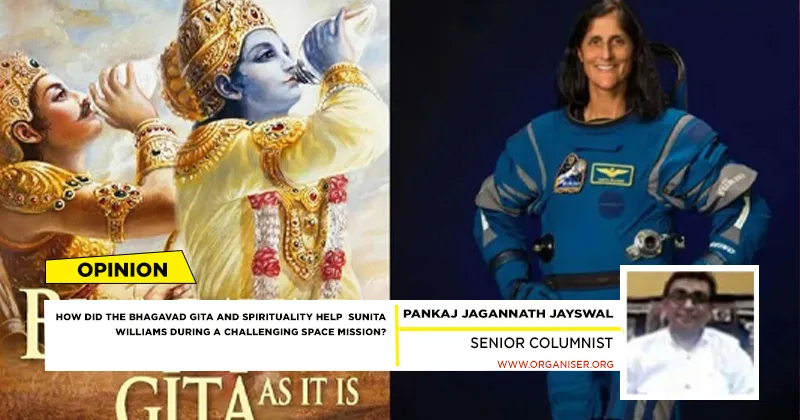
In an era when the world is full of individuals with short tempers, hectic lives, depressed and nervous mindsets, and suicidal behaviour, despite higher living standards and significant technical advancements in all areas of life. Crime and violence are also increasing. What might be the reasons? After so much comfort and improvement in life, why do people get so frustrated when dealing with minor obstacles, and why have difficulties and challenges become a burden? We need to take it seriously and learn from the recent example of Sunita William’s return from a space mission that was fraught with problems and life-threatening incidents for more than nine months.
Only a genuinely spiritual and rooted individual can accomplish this with ease, peace of mind, and continued faith in God. Sunita Williams has a strong connection to Bharatiya spiritual heritage. Her deep understanding of the Bhagvad Gita, which she has stated on multiple occasions, and her heavenly knowledge of Bhagwan Krishna’s life skills enable her to stay calm and cheerful in any scenario. Sunita Williams’ life clearly demonstrates the compatibility of science with Bharatiya knowledge of the Bhagavad Gita, Vedas, and Upanishads. Modern materialistic engineering must be combined with inner engineering to achieve the best results in all aspects of life, as demonstrated by Sunita Williams’ current space expedition.
Mind management remains the most challenging endeavor, notwithstanding advancements in every industry, including space exploration. Mind management has been a fundamental part and purpose of the ancient Bharatiya system. We can see this in the lives of Bhagwan Krishna, Rama, religious and spiritual saints such as Adi Shankaracharya and Swami Vivekanand, as well as freedom fighters such as Chhatrapati Shivaji Maharaj, Maharana Pratap, Ahilyadevi Holkar, Rani Laxmibai, and many more. Sunita Williams’ deep spiritual heritage must be learned by the world’s youth.
Let’s look at how she developed her deep roots
Perhaps the most striking demonstration of Williams’ cultural links was her decision to carry ancient Sanatan writings into space. During her voyages, she carried copies of the Bhagavad Gita and the Upanishads, which provided her with the wisdom and spiritual grounding she need while orbiting Earth for extended periods of time. “These books were quite appropriate to carry to space,” Williams stated in interviews following prior flights.”The teachings brought clarity and concentration to what can be isolated missions.” There’s something about the perspective you receive from space that makes you reflect seriously on your existence and purpose.”
The Bhagavad Gita, with its teachings on duty, purpose, and the nature of existence, seemed especially significant as she looked down on Earth from above. Sunita has stated that the text’s emphasis on doing one’s duty without regard for the outcome connected with her astronaut career, which required rigorous attention to procedures and missions to be balanced with acceptance of variables beyond one’s control. “In space, you’re confronted with both the vastness of the universe and the fragility of human existence,” she once told. “The Gita’s philosophical insights about our place in the cosmos felt particularly relevant when observing Earth as a small blue marble against the infinite blackness of space.”
Williams’ spiritual connection stretched beyond the scriptures. On one of her space trips, she carried a miniature idol of Bhagwan Ganesha, the Hindu god revered as the remover of barriers and patron of new beginnings. “He had to come with me to space,” she said simply, emphasizing the act’s personal significance. For Sunita, having this image of Lord Ganesha aboard was more than just symbolic; it reflected her faith in heavenly protection throughout the inherently dangerous enterprise of space exploration. The appearance of this religious symbol in a spacecraft’s modern surroundings demonstrates Williams’ seamless blending of her cultural history with her scientific career. It highlights how faith and science can coexist while providing distinct forms of direction and consolation.
During video conferences with Indian students, Sunita has frequently discussed the value of cultural identity and how her Indian origin has influenced her viewpoint as an astronaut. These contacts have encouraged thousands of young Indians to seek professions in science and space exploration. “I hope my journey demonstrates that you do not have to abandon your culture to explore new frontiers,” she said in a 2019 interview. “In fact, bringing your unique perspective and background can enrich the experience for everyone.”
Not just Sunita Williams, but many other scientists, philosophers, and intellectuals from the Western world saw the importance of Bharatiya spiritual wisdom and tradition in their personal lives as well as scientific research and creativity. However, youths in India have been misled to reject and diminish the rich spiritual inheritance of Sanatan Dharma and the ancient Bharatiya culture. As a result, to weaken the youth, the Macaulay education system was maintained long after independence, causing damage to the core of Bharatiyatva and slowing social, economic, and research-oriented progress. When the present government attempts to implement a new national education policy that focuses on both ancient and modern knowledge in order to form a personality that will thrive in accordance with one’s passion and the needs of the nation. Many political groups, deep state forces, and the Left-Islamic ecology are opposed to the new education system for selfish reasons. As a society, if we do not understand the message of celebrities such as Sunita Williams, ex-ISRO chief Somnath, and many other scientists and intellectuals who follow rich Bharatiya wisdom and heritage such as Nikola Tesla, Neil Bohr, Heisenberg, and others, we are on the wrong track and will further weaken ourselves and the rich Bharatiya heritage and wisdom.
Remember that Sanatan Dharm provides the world with actual knowledge and thoughts regarding mind management. Mind engineering is the most difficult type of engineering research or activity, and Sanatan Dharm’s old knowledge systems offer insights on it. We, as Indians, must adopt our own life skill engineering concepts in order to create a healthier, happier, and more technically robust society, nation, and world with sustainable development. Sunita Williams should inspire millions of young people to establish a personality that combines old and modern knowledge, as well as Bharatiya spirituality-based living skills.












Comments