After realising that their fake narratives against the three-language NEP2020 have lost steam and only their own ministers’ double standards are being exposed, the DMK and its allies have now jumped to protest the delimitation exercise, which is yet to be announced officially.
The DMK believed that the time-tested Hindi imposition issue, which it feels can emotionally, ethnically, and effectively provoke a section of the people in Tamil Nadu, would work in its favour.
Hindi Imposition: A Historical Perspective
Hindi imposition was a policy of the British government in India to make Hindi compulsory in schools in areas that did not use Hindi as a regional language. The policy faced stiff opposition and widespread protests in Tamil Nadu, leading to its withdrawal.
How It Started
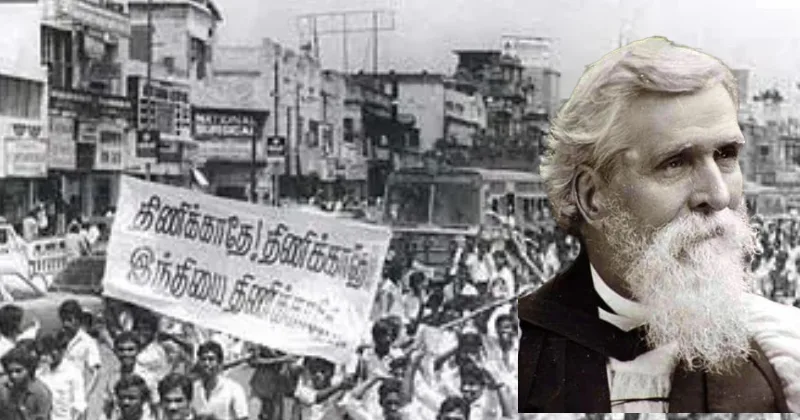
The British in the Madras Province converted Dravidian languages into divisive forces through Christian missionary Robert Caldwell, who was trained to study these languages and concluded that they were linked to the Bible. He was the first person to claim that all languages of the Madras Presidency—Tamil, Telugu, Malayalam, Tulu, and Kannada—were distinct and not connected with Sanskrit, particularly Tamil.
This marked the starting point. His book, A Comparative Grammar of the Dravidian or South-Indian Family of Languages, further strengthened his view. Initially, Caldwell attempted to prove the biblical notion that all languages of the world derived from one common source. Later, he changed his stance, asserting that the languages spoken in South India formed a distinct family separate from the other linguistic families in India. (PFA for the research paper; see the third page titled ” His Legacy To Dravidology”).
If we trace history, poet Subramania Bharathi (1882–1921), Somasundara Bharathi (1879–1959), and Suddhananda Bharathi (1897–1990) witnessed language-related agitations in their times. In 1906, Suddhananda Bharathi published Hindi Pothumozhi Vendaam (Hindi should not be a common language).
In 1927, Karanthai Tamil Sangam in Thanjavur organised a meeting condemning this announcement. Protests were held in Salem, Tirunelveli, Chennai, and Trichy, which became a turning point in the language struggle. According to poet Nandalala in his book Trichy: Oorum Varalarum, more than 10,000 people participated in a rally on 26 December 1937, presided over by Somasundara Bharathi. Four elephants led the rally holding the Tamil flag. The final condemnation meeting was held on 27 February 1938.
Revolutionary poet Bharathidasan declared, “Indhikku Tamil Natil aahikkamaam. Neengal Ellorum Varungal naatinarey” (Should Hindi dominate Tamil land? All Tamils, come and join the march!).
On 21 April 1938, the Congress issued a Government Order (GO) making Hindi compulsory in schools. The first phase of the language struggle (1937–1940) escalated in May when protesters in Trichy decided to march to Chennai. About 100 people from Tamilar Perumpadai (Tamilian Army) set off on 1 August and reached Chennai on 11 September.
The Indian National Congress government in Madras Presidency announced in 1937 that Hindi would be taught in secondary schools. E.V. Ramasamy (Periyar) and the Justice Party led by A.T. Panneerselvam opposed this move. Protests erupted across Tamil Nadu in 1938, leading to a government crackdown that included arrests and the deaths of two protesters.
In the Constituent Assembly, Hindi was voted as the official language by a single vote. However, English was to continue as an associate official language for 15 years. The British government made Hindi optional in February 1940. When the Congress government resigned in 1939, the British governor of Madras, Lord Erskine, withdrew the policy.
The term Hindi imposition is considered a form of linguistic imperialism, which refers to using one language to force others into adopting it.
The anti-Hindi imposition agitations of 1937–40 and 1940–50 led to a change of guard in the Madras Presidency. The main opposition party to the Indian National Congress in the state, the Justice Party, came under Periyar’s leadership on 29 December 1938. In 1944, the Justice Party was renamed Dravidar Kazhagam.
On 10th August 1937, the then Prime Minister of Madras Presidency, C. Rajagopalachariar (Rajaji), announced that Hindi would be made compulsory in schools. Orders had been issued. There were protests opposing the same, and in 1940, it was dropped.
T.T. Krishnamachari, during the Constituent Assembly Debate on 5th November 1948, said:
“I refer to this question of language imperialism. There are various forms of imperialism, and language imperialism is one of the most powerful methods of propagating the imperialistic idea… This kind of intolerance makes us fear that the strong Centre which we need, a strong Centre which is necessary, will also mean the enslavement of people who do not speak the language of the legislature, the language of the Centre… My honourable friends in UP do not help us in any way by flogging their idea of ‘Hindi Imperialism’ to the maximum extent possible. Sir, it is up to my friends in UP to have a whole-India; it is up to them to have a Hindi-India. The choice is theirs.”
After much debate, the Constituent Assembly decided on a compromise called the Munshi-Ayyangar formula (named after K.M. Munshi and Gopalswamy Ayyangar, members of the Constituent Assembly). It ensured that the Indian Constitution would not specify any National Language.
Again in 1948, after India attained freedom, Madras Rajadhani made Hindi compulsory, but it was rolled back in 1950 by withdrawing the order. In the Official Language Act, amendments were made stating that along with Hindi, English could continue. The then Congress Chief Minister, M. Bakthavachalam, announced in March 1964 that the three-language formula would be implemented in the state.
A joint action committee – Tamizhag Manavargal Hindi Ethirppu Sangam (Tamil Nadu Students’ Hindi Opposition Association) was formed. Thanith Tamil Iyakkam (Independent Tamil Movement), started by Maraimalai Adigal in 1916, was at the forefront of the linguistic purity movement.
The Official Languages Act came into effect in 1963 upon the expiry of the 15-year period specified in Article 344 of the Indian Constitution. C.N. Annadurai, as the lone representative of the DMK in the Rajya Sabha, spoke vehemently against the Act. He wanted an indefinite continuation of English as an official language, as it would “distribute advantages and disadvantages evenly” among Hindi and non-Hindi speakers.
As early as 1959, then Prime Minister Jawaharlal Nehru had given an assurance in Parliament that English would continue to be in use as long as non-Hindi-speaking people wanted it.
DMK founder C.N. Annadurai announced that 25th January would be observed as Black Day. He and over 3,000 others were detained under preventive custody.
Central ministers C. Subramaniam and O.V. Alagesan submitted their resignations in protest against the imposition of Hindi. Shastri accepted them and forwarded them to the President. However, the President, Sarvepalli Radhakrishnan, refused to accept Shastri’s recommendation and advised him against precipitating matters.
Shastri made a radio broadcast on 11th February 1965, promising to honour Nehru’s assurances. He also assured Tamils that English would continue to be used for Centre-State and intra-state communications, and that the All India Civil Services examination would continue to be conducted in English.
In 1965, during the Hindu agitation, its cadres torched trains, buses, and post offices, and defaced rail signboards, much like what they are doing now. The then Congress government witnessed it helplessly. When the DMK came to power in 1967, as a reward, they gave them jobs in the police, electricity department, and schools.
Two of those jailed – Natarajan from Chennai and Thalamuthu from Kumbakonam – died in prison due to illness.
During the first and second phases of the language struggle, several lost their lives. However, the Dravidian parties observe 25th January every year as Veer Salute to language martyrs, but only for 12 of their leaders. They have named some buildings and roads after them, but none of their family members have been recognised, rewarded, or accommodated in government as ministers or party officials.
The impact of the 1965 agitation was felt in the 1967 state assembly elections. The Congress government lost power in Tamil Nadu. A student leader, P. Sreenivasan, defeated Congress veteran and former CM K. Kamaraj in his hometown.
The New Education Policy was introduced in 1986 during Rajiv Gandhi’s period. Navodaya and the three-language formula were envisioned in it. But the Tamil Nadu government firmly rejected it.
So, the Dravidian parties turned the language struggle into an emotional issue for the people of Tamil Nadu. But this was not the 1960s. With the advent of active social media and television media, their bluff and false narrative have no takers. They cannot escape the accusation that their own children study in three-language CBSE schools, while the poor, who study in government schools, are left with only two languages. It is a fact that most politicians own CBSE schools.
As BJP’s Annamalai rightly said: “56 lakh students are studying in CBSE schools in Tamil Nadu, against 52 lakh in government schools. From less than 200 CBSE schools in 2006, they have now risen exponentially to 2,010 schools. This is proof of the need for a trilingual policy. Government schools continue to teach only two languages, which has resulted in many parents shifting their children to private (CBSE) schools. This has inadvertently created a ₹30,000 crore market for private education.”
He asks, “How can we expect the DMK to allow three-language schools in government institutions and permit Navodaya, PM Shri, and other schools? It will kill their business.” Even the children of functionaries who defaced name boards are studying in CBSE schools with Hindi as a language. The irony is that they do not even know Hindi or English letters properly. That was their standard of education. In the current agitation, they exploited government school students to take part in protests against Hindi.
அரசு பள்ளி மாணவர்களை படிக்க விடாமல் பள்ளியிலிருந்து அழைத்து வந்து திமுக TSHIRT அணிவித்து ஹிந்தி எதிர்ப்பு போராட்டத்தில் கலந்து கொள்ள வைக்கும் அளவிற்கு வந்துவிட்டது இந்த ஆளுங்கட்சி திமுக
ஏழை எளிய அரசு பள்ளி மாணவர்களின் வாழ்க்கையை பலி கொடுத்து தாங்கள் நடத்தும் CBSE பள்ளிகளில்… pic.twitter.com/sXvsZBIHCY— Dr. Alisha Abdullah (@alishaabdullah) February 25, 2025
Annamalai criticised the ‘shallow political rhetoric’, exposing its hypocrisy and doublespeak on the alleged imposition of Hindi. He asked why DMK leaders oppose the three-language policy while their own children attend schools that offer multiple languages. He said in a tweet:
“(I) Had seen a few misguided individuals roaming around with a can of black paint, striking Hindi letters in opposition to the three-language formula in the New National Education Policy. We would humbly suggest that they visit the Enforcement Directorate and Income Tax Office with the same can of black paint. They can check for the addresses of these offices from the corrupt DMK ministers, as they frequently visit these places.”
Had seen a few misguided individuals roaming around with a can of black paint, striking Hindi Letters in opposition to the three-language formula in the New National Education Policy. We would humbly suggest that they visit the Enforcement Directorate and Income Tax Office with…
— K.Annamalai (@annamalai_k) February 24, 2025
The DMK IT wing shared a video and a picture of a student who offered ₹5,000 to the government if the Centre refused to provide funds. But what they failed to observe is that the girl, in school uniform, is a student of Trinity Central School (CBSE), where she (Jaculine Rose) studies Hindi. She cannot understand any of these things.
She says: “Greetings, my name is Jaculine Rose. I am studying in 5th grade, and I hail from Kanyakumari district. Can the orphan language Hindi think of ruling over my ancient language, Tamil? We will always oppose Hindi. Tamil is also called nectar — Tamil is the delight of our lives, Tamil is virtue, Tamil is life. What if the Union government, which is supposed to provide Tamil Nadu with education funds, does not provide them? I am giving ₹5,000 from my little savings to the Tamil Nadu Education Department with happiness. Long live Tamil!”
Similarly, another girl, Nanmugai from Cuddalore, has donated ₹10,000 to the Chief Minister from her savings. She is an LKG student. What does she know about NEP and Hindi imposition? Or does she even know what ₹2,000 crores is?
#JUSTIN முதலமைச்சருக்கு கல்வி நிதி வழங்கிய மழலை
கடலூர்: முதலமைச்சர் உரை கேட்டு நன்முகை என்ற சிறுமி மத்திய அரசு தர மறுத்த ₹2000 கோடி-க்கு, தன் பங்களிப்பாக தனது சேமிப்பிலிருந்து ₹10,000ஐ தமிழ்நாடு முதலமைச்சர் சிறப்புத் திட்டத்தில் நிதியளித்துள்ளார்#CMStalin #Child… pic.twitter.com/qY6q0GdXq5— News18 Tamil Nadu (@News18TamilNadu) February 23, 2025
“Her father, Dr. Kalaikovan, a lung specialist and Cuddalore East district medical wing in charge, is a hardcore supporter of the DMK,” says a vlogger.
அடேய்களா 😂😂
என்ன டா இவ்வளவு சீக்கிரம் Expose ஆகுறீங்க @Anbil_Mahesh 🤣#GetOutStalin | #Annamalai https://t.co/IxhzvGJFbU pic.twitter.com/pI0rgWmsmH
— ᴋᴀʀᴛʜɪ (@TwitzKarthi) February 23, 2025
நீல சாயம்.வெளுத்து போச்சு டும்டும்டும்
ராஜா வேஷம் கலஞ்சி ஓச்சு டும்டும்டும்.தொலைகாட்சிகளில் பிளாஷ் நியூஸ்.
4 வயது சிறுமி முதல்வருக்கு மத்திய அரசு நிதி தரவில்லை என்றால் என்ன நான் பங்களிப்பை தருகிறேன் என 10000 ரூபாய் காசோலை தந்துள்ளார்.
உடனே பிரதமரே இது… pic.twitter.com/MJf5qW1EfS
— Saravanaprasad Balasubramanian (Modi ka Pariwar) (@BS_Prasad) February 26, 2025
Girl students from Paramakudi Government School in Ramanathapuram district can be seen in a viral video appealing to Chief Minister Stalin to implement the central government’s trilingual education scheme. They said in one voice:
“Don’t government school students have the right to study trilingual education, Chief Minister? Please allow poor students like us to utilise this opportunity.”
The children of TN are asking for implimentation of three language learning scheme.
But the DMK Govt is not in favour of it.
Reason cited by State Govt as "three language formula will lead to Hindi imposition" is absurd & false.@BJP4India@India_NHRChttps://t.co/P8Ztr40NPC— CHAND R (@CHANDR39779820) February 20, 2025
CM Stalin, in an epistle to party vassals, said: “This is a continuous struggle, a rightful fight against cultural onslaught and a battle to protect Mother Tamil from a hegemonic language… They keep imposing Hindi, and we continue resisting it. This fight against dominance will continue until it is ended.”
Critics point out, “We are ready for another language war. There will not be any compromise in this battle.”
“Stalin’s mother tongue is Telugu, as is the case for most of his ministers and MPs.”
Education Minister Dharmendra Pradhan has clarified that there was no imposition of Hindi on anyone in the NEP.
Why did they take up the Hindi agitation when the assembly polls are due next April? Vijy Sriram, in a post, says:
“Seeman EVR issue – Thirupparankundram issue – Three-language issue – Delimitation issue. Did you notice the TN media headlines for the last two months, which started right after the Anna University issue? The Vidiyal group is very shrewdly setting the narratives, ensuring that no debate or discussion on their own administration takes place in the mainstream media. The opposition parties, including the BJP, should not overlook this trend and must keep fighting against them in their own turf.”
https://twitter.com/sriramchennai07/status/1894562797377474901
Political commentator and editor of Tamil Weekly Thuglak, S. Gurumurthy, says: “Today, 60 lakh students in CBSE schools—rising by the day—study Hindi. Over 5 lakh students appear in the Dakshin Bharat Hindi Prachar Sabha exams. Meanwhile, 83 lakh students in government and aided schools don’t study Hindi. 47% of Tamil Nadu students read Hindi.”
Today 60 lac students who are in CBSE schools which rising by the day all study Hindi. Over 5 lac students appear in Dhakshin Bharat Hindi Prachar sabha exams. 83 lac students in govt and aided schools don't study Hindi. 47% TN students read Hindihttps://t.co/eQy7ZCXFdc
— S Gurumurthy (@sgurumurthy) February 26, 2025
Another person said: “After realising that their protests against the New Education Policy #NEP2020 have lost steam and that only their ministers are getting exposed for their hypocrisy, @mkstalin and his camp suddenly jumped to #delimitation of constituencies when nobody was actually talking about it.”
C.R. Kesavan, BJP leader and grandson of Rajaji, says in a post on X: “The DMK’s dangerous hypocrisy has been unmasked and exposed by our @BJP4TamilNadu President, @annamalai_k ji. The DMK has a dubious two-language policy—one for private government schools and another that victimises government school students. DMK’s divisive federalism will fail.”
The DMK’s dangerous hypocrisy unmasked and exposed by our @BJP4TamilNadu President, @annamalai_k ji. The DMK has a dubious two language policy- one for the private govt schools and another one which victimises the govt school students. DMK’s divisive federalism will fail. https://t.co/Xqh3xZJmoV
— C.R.Kesavan (@crkesavan) February 24, 2025
After seeing that their anti-Hindi rhetoric failed to cut much ice and garner public support, the DMK has now jumped to the delimitation issue. Though, Union Minister Amit Shah has said that there will be no reduction in Lok Sabha seats for Tamil Nadu and other southern states.