





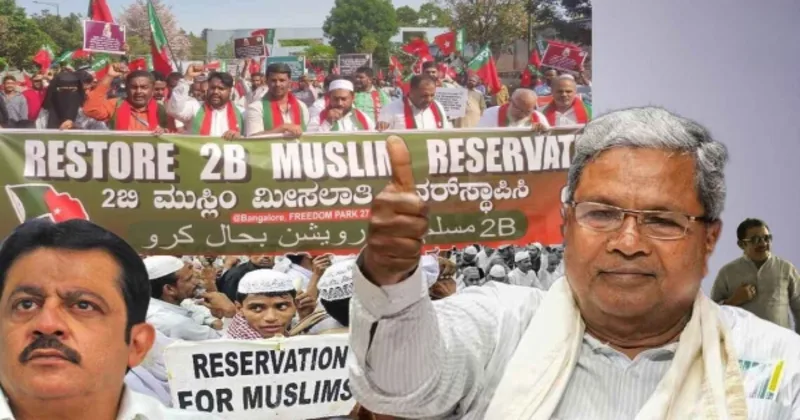
Bengaluru: The current scenario regarding reservations in Karnataka has ignited heated debates, particularly surrounding the demand for increasing the minority reservation for Muslims from 4 per cent to 10 per cent. Recently, the Karnataka state minister for Minority Welfare, Hajj, and Waqf, B Zaid Jamir Ahmad Khan, has directed that a review of this application be conducted in accordance with the rules. This directive has once again placed reservations at the forefront of political discourse, attracting the attention of opposition parties who see this as an opportunity to criticize the ruling government.
The controversy began with an official memo that emerged, revealing the communication between ministerial aides that questioned the validity of the existing reservations for Muslims. The Karnataka Minority Engineers Association, led by President Farooq Junaid, has been vocal in their demand to enhance the minority quota, stating that the recent revocation of the 4 per cent reservation has caused significant distress in the community. Their letter, addressed to the minister on November 7, 2024, highlights the potential imbalance in representation and urges the government to re-establish this crucial support.
Critics of the government’s decision to scrap the 4 per cent reservation contend that while it was aimed at restructuring access to various benefits, it largely undermined the socio-economic progress of marginalized communities. The previous BJP-led government, during its tenure, had removed this quota citing various administrative reforms. However, this move was met with fierce backlash from the Muslim community, who felt their rights were systematically stripped away in the name of political maneuvering.
Additionally, the concern regarding the educational landscape cannot be understated. As outlined in the correspondence from the Karnataka Minority Engineers Association, the enhancement of the SNQ (Supernumerary quotas) from 5 per cent to 7 per cent is crucial for enabling deserving candidates to pursue engineering disciplines. This is not merely a numerical adjustment; it is about empowering future generations with the tools needed for their success in a highly competitive environment.
Critically, government officials must recognize that the dynamics of identity politics and socio-economic realities are intertwined. A simplistic adjustment of percentages does not account for the historical injustices faced by minority communities. Policymakers ought to engage with affected groups comprehensively to ascertain genuine needs rather than responding reactively to political pressures.
BJP Condemns Muslim Reservation
The Bharatiya Janata Party (BJP) has strongly opposed the proposal to extend reservations for Muslims in Karnataka, emphasizing that religion-based reservations violate the constitutional framework of India. This stance comes in light of a recent Supreme Court ruling, which deemed such reservations unconstitutional, stressing that reservations should be based on social and economic criteria rather than religious identity.
BJP leader MLC C T Ravi stated that the party believes in inclusivity and meritocracy, warning that religion-based quotas undermine the principle of equality enshrined in the Constitution. The Supreme Court’s decision has highlighted concerns over potential polarization and division within society, reinforcing the need for a unified approach to empowerment rather than dividing communities along religious lines.












Comments