





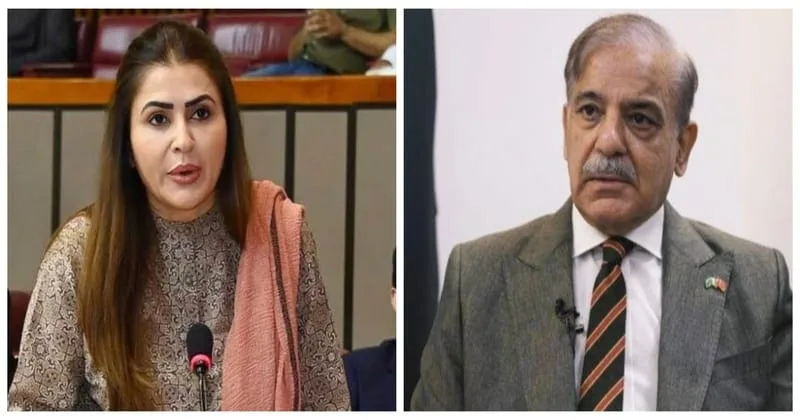
Shazia Marri, considered close to Bilawal Bhutto Zardari, has said that if Prime Minister Shehbaz Sharif’s government took a “u-turn” on its commitments, it may face serious problems with the Pakistan People’s Party (PPP). She said the PPP would not only boycott the upcoming budget but also initiate a “more serious step”. However, she did not elaborate on what other step the PPP, which was supporting the PML-N government from the outside, could take. This is being interpreted as a veiled threat to Prime Minister Shehbaz Sharif that his government cannot survive without PPP support.
Incidentally, tensions between the PML-N-led coalition and the PPP have been there for a long time, due mainly to what the latter calls “unfulfilled promises’’. The differences between the two parties had become so sharp that a meeting between President Asif Zardari and PM Sharif alone could douse the fires that threatened to go out of hand. In December 2024, the Sharif-Zardari meeting succeeded in papering over major differences between the two parties.
However, this meeting of two top leaders of the respective parties failed to resolve disagreements. To convey his party’s unhappiness with PM Sharif, PPP Senator Saleem Mandviwalla claimed openly that the PM’s Office ignored directives from the Presidency (Zardari).
Amid severe strains in the ties, PML-N leaders met PPP counterparts a couple of days ago, and they were assured they wouldn’t be treated as “outsiders’’ in Punjab.
Speaking during a telecast on DawnNewsTV, PPP leader Marri said that her party would not only boycott the upcoming budget but would also adopt a “more serious step” if the government failed to fulfil its commitments regarding the Public Sector Development Programme (PSDP). Incidentally, one of the major components of the PSDP programme is regional equalisation.
“If the Prime Minister and the Minister for Planning and Development do not fulfil the commitment regarding PSDP, if they take a u-turn this time, then I think we will not only boycott the budget but will take a more serious step,” she said, without elaborating what that step entailed.
Marri is one leader who often articulates the PPP stance on various issues in public on behalf of Bilawal. She said the country was “not in the position’’ to endure such steps (as her party could take, if cornered). The government should have thought about its decision/s first, adding that her party was not under any compulsion to continue support to the PML-N; rather, it had stakes due to its “maturity and political wisdom”.
“I think this is a very delicate government, and I don’t think there has ever been a government as weak as this one,” she said. “And this weak government is not realising the situation it is in, how much it needs the PPP,” she said.
Local Bodies Elections
In January, the PPP held a meeting of its Central Executive Committee (CEC), where it demanded that the Federal government should hold local government polls in Punjab and Islamabad as per the agreement it had made with the ruling coalition. Incidentally, the last elections for Islamabad and Punjab local bodies were held a decade ago in 2015. These bodies completed their five-year tenures in early 2021, after which there has been a clamour to hold these elections.
The PML-N had promised its coalition partner, the Pakistan People’s Party (PPP), which is supporting it from outside, to hold these elections. This promise was made almost a year ago during the government formation during the PPP-PML-N negotiations. However, Prime Minister Shehbaz Sharif has found all sorts of excuses to repeatedly postpone these elections, much to PPP’s chagrin.
The PPP led by Bilawal Bhutto Zardari has strong support in the Islamabad capital region and hopes to do well as and when these elections are held. It also has some pockets of support in Punjab, hoping that its good showing will lead to the weakening of Chief Minister Maryam Nawaz’s hold on the province.
In contrast, PML-N has become weaker over the last year due to conceding substantial ground to the Army, as well as the judiciary, and is trying to postpone these elections on flimsy grounds. Some of PML-N’s decisions have alienated a large section of voters from it, and any local polls, if held at this time, are unlikely to boost its image.
It is interesting to note how the Punjab Chief Minister Maryam Nawaz has repeatedly found ways to postpone elections to the local bodies. Under the rules, the elections are to be held within four months of the expiry of the term of local bodies. However, it has been four years now since these elections were held.
These elections have been stalled by the Maryam Nawaz government by repeatedly amending the laws pertaining to the local bodies. As such, it is not clear even now if the holding of local body elections would be facilitated by her government.
Maryam Nawaz Stalling Polls
In February-end, the Election Commission of Pakistan (ECP) had lamented Punjab government’s unwillingness to hold local bodies polls. The ECP has also asked the provincial government to expedite the legislative process so that the commission could begin the delimitation process.
A full bench of ECP, headed by Chief Election Commissioner Sikandar Sultan Raja, had issued these instructions during the hearing of a case related to the conduct of local government elections in Punjab. Despite that, the provincial government has not taken any steps to hold the local elections in Punjab. Apparently angered by this attitude, the PPP has now decided to queer the pitch for the PML-N governments, both at the Federal level and in Punjab.
The main reason for the escalating differences between the PML-N and the PPP is the new canals being planned on the Indus River, which is considered a lifeline by lower riparian Sindh. In fact, Sindh has for the past several decades been a stronghold of PPP, and any action deemed to be anti-Sindhi is likely to cause it setbacks. This is the reason why it has been warning the Federal government and the provincial Punjab government to desist from the construction of these canals.
Out of the six new canals being planned on the Indus, that going to Cholistan region of Punjab is the most controversial. However, this canal has the backing of Pakistan Army chief General Asim Munir. As such, Punjab CM Maryam believes that while PPP may take on her party, it cannot afford to go against the Army. Incidentally, the PPP is usually rather circumspect in taking on the Army as it has lost two of its tallest leaders, Zulfikar Ali Bhutto and Benazir Bhutto to two military strongmen, namely General Zia ul Haq and General Pervez Musharraf.
Instead of now taking directly on the Army, the PPP has been pressing for immediate convening of the Council of Common Interests (CCI). For resolving differences among various provinces, the CCI is the authorised body where representatives of all provinces are present. However, the Federal government has seen that no CCI meeting has been held for the last 11 months.











Comments