





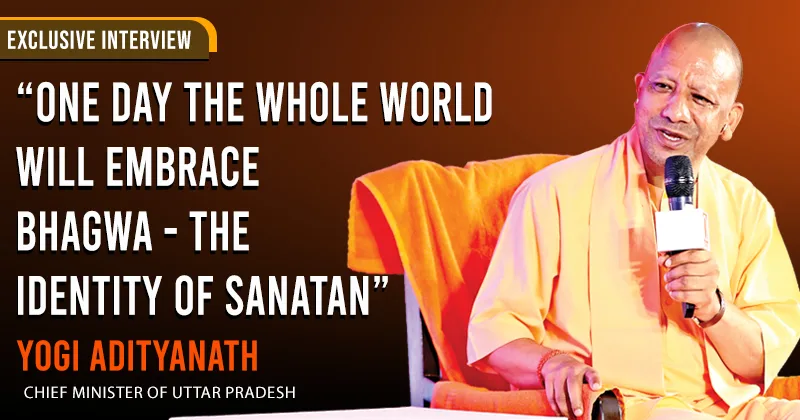
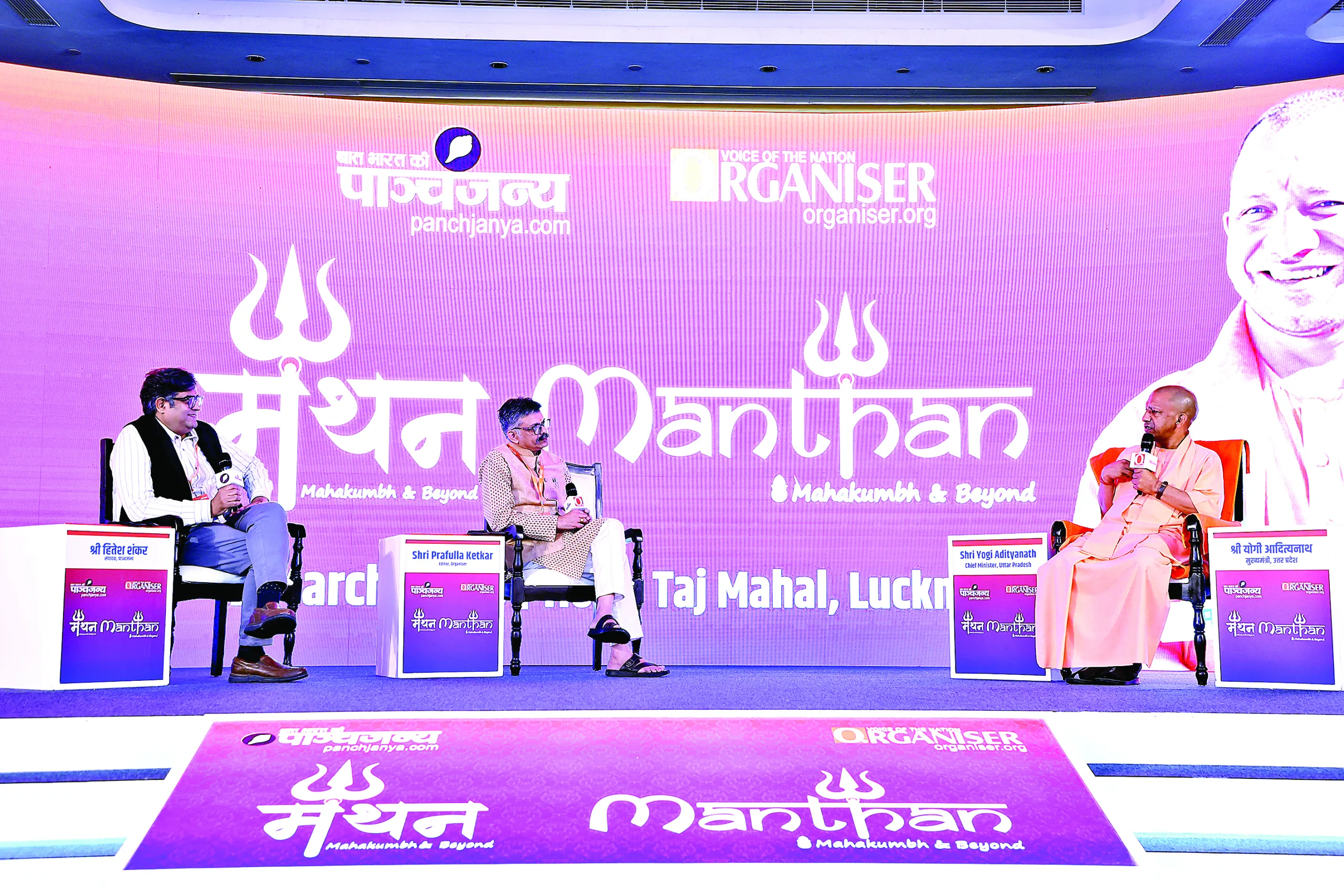
The Mahakumbh in Prayagraj was a sacred confluence of spirituality, tradition, prosperity, integrity and cultural continuity that has stood the test of time. While the grandeur of Mahakumbh 2025 captivated the world, it also served as a reflection of a New Bharat, one that is assertive, organised, and deeply rooted in its Sanatan Dharma. After formal inauguration of Manthan – Mahakumbh and Beyond in Lucknow on March 12, 2025, the man at the centre of this historic congregation Uttar Pradesh Chief Minister Yogi Adityanath had an exclusive conversation with Organiser Editor Prafulla Ketkar and Panchjanya Editor Hitesh Shankar. As the “Maharaja of Mahakumbh”, Yogi Adityanath shares his vision, the challenges he faced, and the profound significance of this spiritual spectacle in shaping the global perception of Bharat. Excerpts:
(Prafulla Ketkar): The Mahakumbh has been an age-old tradition, and different people have perceived it in different ways. Being at the very heart of this grand event; being “Maharaja of Mahakumbh,” how do you perceive the success of this event?
The Mahakumbh was not just an event; it served as a platform to showcase Bharat’s strength and the true essence of Sanatan Dharma to the world. At the same time, it played a crucial role in transforming perceptions about Uttar Pradesh. In both these aspects, we have been successful.
The Mahakumbh showed Bharat’s true identity—it showed what Bharat stands for, its strength, and the fact that Sanatan Dharma is at its very core.
If one truly wishes to understand Sanatan Dharma, it is not about caste, sectarian divides, regional differences, or gender distinctions. The Mahakumbh exemplified this unity. Millions of people—regardless of their backgrounds—took a dip together in the sacred Triveni Sangam. This is the very essence of Ek Bharat, Shreshtha Bharat; this is the grand and noble philosophy of Sanatan Dharma.
(Hitesh Shankar) You mentioned that the world was observing the Mahakumbh with awe. But there are some who have consistently tried to view Uttar Pradesh with doubts. We witnessed this even during the COVID-19 pandemic. Similarly, there was a deliberate attempt to present the Mahakumbh in a particular light. What message would you like to convey to those who have such approach?
“जैसी दृष्टि, वैसी सृष्टि”—The way one perceives the world shapes their reality. Those who view everything with negativity cannot be expected to appreciate something with a positive outlook. Their persistent negativity has placed them on the back foot, and they have lost the trust of the people.
Such pessimist people are incapable to do anything. It’s not like they didn’t get a chance. Take the 1954 Kumbh, Bharat’s first after independence—under Congress rule at both the State and Central levels. It was marked by severe mismanagement, filth, chaos, and a tragic loss of over 1000 lives. Every Kumbh after that, whether in Prayagraj, Haridwar, or elsewhere, suffered similar fates—be it in 1974 or 1986. The Kumbh in 2007 and 2013, when the Samajwadi Party was in power are a living example to this.
In 2013 Kumbh Mela, the Prime Minister of Mauritius visited Prayagraj. But upon witnessing the filth, disorder, and muddy ghats, he was so disheartened that he could not even take a dip. With tears in his eyes, he left! This was the unfortunate image of the Kumbh that had been projected for decades.
Those who were making pessimistic comments, are the same people who made the Kumbh a den of mismanagement, filth, and chaos. Leftist and foreign media used such mismanagement as an opportunity to malign Bharat and Sanatan Dharma, presenting Kumbh as a chaotic and unclean gathering.
In 2019 Prime Minister Narendra Modi Ji asked us that this perception has to be changed. We worked tirelessly; and I am glad that the 2019 Kumbh is known for its cleanliness and orde. We aimed to make Kumbh – Divya Kumbh, Bhavya Kumbh (Divine & Grand Kumbh), and also connected it with Swachchhta (Cleanliness), Suraksha (Safty), and Digital.
Initially, people dismissed Digital Kumbh as an exaggeration. But technology played a massive role in ensuring smooth operations. A digital lost-and-found center helped reunite 54,000 missing individuals with their families. A digital tourist map allowed pilgrims to navigate effortlessly. 1.5 lakh smart toilets were set up, each integrated with QR codes for real-time monitoring of cleanliness. An App in 11 languages (including UN-recognised languages) ensured that international visitors could communicate without barriers.
We anticipated an enormous turnout—potentially 40 crore devotees. So, we meticulously planned to minimise walking distances, ensuring no devotee had to walk more than 3–5 km.
But our critics began their propaganda from day one. They tried to cast doubts, spread falsehoods, and create unnecessary panic. But the people of Bharat, and the global Hindu community, had their own response—by participating in record numbers.
During the six major bathing days, three were Amrit Snans. On Makar Sankranti 3.5 crore devotees took ablutions, on Mauni Amavasya (Jan 28–30), 15 crore devotees over three days; and each day after Mauni Amavasya 1.5 to 2 crore devotees took bath.
“If one truly wishes to understand Sanatan Dharma, it is not about caste, sectarian divides, regional differences, or gender distinctions. The MahaKumbh exemplified this unity. Millions of people—regardless of their backgrounds—took a dip together in the sacred Triveni Sangam ”
At one point, due to the overwhelming crowd, we had to hold back nearly 2 crore devotees in neighbouring districts—Jaunpur, Bhadohi, Mirzapur, Chitrakoot, Fatehpur, Kaushambi, Pratapgarh, and Rae Bareli—to ensure safety. We were using AI tools for face recognition and the people who took bath many times were cleared off.
Even with these measures, the sheer scale of participation was historic. In just 45 days, over 66.3 crore devotees became part of this sacred gathering, making it the largest spiritual, cultural, and religious congregation in the world.
Even UNESCO recognised this transformation. UNESCO has recognised Kumbh as an Intangible Cultural Heritage of Humanity. The Director of UNESCO, who personally attended the event, acknowledged that the work done by UNESCO in 2019 by the efforts of Prime Minister Modiji can be seen here.
(Prafulla Ketkar) In 2013, the Prime Minister of Mauritius had to leave without taking a dip in the Triveni Sangam. However, today, with Prime Minister Narendra Modi personally presenting the sacred Triveni water at his doorstep, wouldn’t you say this is the biggest testament to the success of this Mahakumbh?
I am deeply grateful to Prime Minister Modi for presenting the sacred Triveni water to the Honorable Prime Minister of Mauritius, along with a Banarasi saree for his wife. These two gifts from Uttar Pradesh will remain an eternal symbol of our connection with Mauritius.
In 2019, the Prime Minister of Mauritius visited the Kumbh again, with a large delegation of 450 members, and was able to take a holy dip in the Sangam. This time the King of Bhutan personally participated in the Kumbh. Over 100 Ambassadors, Ministers, and prominent dignitaries from across the world attended, bearing witness to the unparalleled spiritual and cultural magnificence of the Mahakumbh.
(Prafulla Ketkar) People observed a significant positive change in the way the administration functioned, particularly in the behaviour of the Uttar Pradesh Police. What specific changes were introduced that led to this transformation in the administration’s approach?
Unlike a permanent city, the Mahakumbh is held in a temporary city, which essentially functions as an independent district. We understood this unique requirement and, a year in advance, appointed officials by November 2022. Infrastructure was developed in Prayagraj and in the neighbouring districts. The difference between pre-2019 Prayagraj and post-2019 Prayagraj is striking. The city’s entire transformation has been visible to everyone.
Despite being a city with thousands of years of spiritual and historical significance, past Governments handed it over to mafia rule, parallel criminal networks hindered development.
Prayagraj is home to Bharat’s first Gurukul, established by Maharishi Bharadwaj. The sacred Akshayavat, had been inaccessible to devotees for nearly 500 years, Patalpuri was similarly neglected. Shringverpur Dham had also been encroached upon through land jihad under previous Governments. Dwadash Madhav was illegally occupied, so was the Nag Vasuki temple. We undertook the mission of restoring the city’s spiritual and cultural identity.
Today Prayagraj is mafia-free. 12 grand corridors were constructed connecting all these significant places, which are open throughout the year.
The previous Government’s focus was on land grabs, on exploiting traders, on undermining women’s safety. However, we have the leadership. Our team ensured the vision of Prime Minister Narendra Modi was implemented effectively.
(Hitesh Shankar): In politics, we often see a contradiction between actions and words. A similar situation was observed in Delhi. Do you think the public has managed to remove this contradiction?
Bharat’s democracy is deeply mature, and people are aware of who is genuine and who is not. Those who questioned the purity of the Triveni Sangam have themselves been exposed for their failure in governance, particularly in cleaning the Yamuna river in Delhi.
Uttar Pradesh, under Samajwadi Party, was getting funds under Namami Gange Project, but it didn’t act. We, on the other hand, transformed Kanpur’s Sisamau drain—once a pollution hotspot—into a selfie point, ensuring not a single drop of sewage enters the Ganga. Yamuna flows through Delhi, yet remains polluted due to mismanagement. Had they prioritised public welfare, cities like Mathura, Vrindavan, and Agra would have received clean water. Those who are themselves surrounded by corruption and inefficiency are questioning the purity of the Ganga. The people of Delhi have given their response—it is not the Triveni that needs cleansing, but their governance and intent.
“UNESCO has recognised Kumbh as an Intangible Cultural Heritage of Humanity. The Director of UNESCO, who personally attended the event, acknowledged that the work done by UNESCO in 2019 by the efforts of Prime Minister Modiji can be seen here ”
(Prafulla Ketkar): Foreign media, especially English-language outlets, often portray you with certain labels—sometimes calling you “saffron-clad. “In the Mahakumbh, you were not just the Chief Minister but also a Mahant at the centre of the event. How significant was it to have someone deeply connected to the traditions and Akhada system leading such a grand event?
I believe anyone with faith and devotion towards Sanatan Dharma could have successfully organised the Mahakumbh. But, the support and presence of the revered saints and Akhadas played a crucial role in the successful execution of the Maha Kumbh. It was they who prioritised the convenience of millions of devotees over other considerations.
On Mauni Amavasya (January 29), when a tragic incident occurred around 1:30 AM, leading to injuries and fatalities. We knew there was a massive crowd—5 crore people in the Mahakumbh area, 3-4 crore en route, and 2 crore in neighboring districts—we requested the saints to postpone the Amrit Snan for safety reasons.
While the administration hesitated, the Akhadas readily agreed. By noon, when the crowd had reduced, all 13 Akhadas resumed their ritual bath. This is the true faith and adherence to Sanatan Dharma. This incident stands in contrast to those who engage in mindless protests and sit-ins elsewhere. Throughout the Mahakumbh, the saints led, the devotees followed, and the government facilitated. My role as both a Mahant and a Chief Minister, my saffron robes did help to build a trust and coordination, making this event a grand success.
(Hitesh Shankar): But what about those whose faith remains stuck with Aurangzeb, who insist on naming their children after Taimur? How do you address such a mindset that refuses to integrate?
History has shown that whoever played with Bharat’s faith ultimately perished. There is no place for such forces in this land, and their downfall has been inevitable. Sanatan Dharma is an eternal tradition that governs the universe itself.
The Mahakumbh, Kashi and Ayodhya have proven that faith can be the foundation of prosperity. It provides livelihood without discrimination—from taxi drivers to traders, from airline pilots to street vendors, all benefit regardless of caste or religion. The economy thrives where faith is respected.
However, those who conspire against Bharat’s heritage while glorifying invaders like Aurangzeb should also acknowledge their downfall. Even Aurangzeb’s own father, Shah Jahan, cursed him, stating that no one should have a son like him. While imprisoned by Aurangzeb, Shah Jahan was denied even a sip of water and died in agony. Sahjahan cursed his son that Hindus are better who offer water even to their dead ancestors. If someone truly admires Aurangzeb, they should first name their own children after him and be prepared to suffer his fate.
“The previous Government’s focus was on land grabs, on exploiting traders, on undermining women’s safety. However, we have the leadership. Our team ensured the vision of Prime Minister Narendra Modi was implemented effectively”
This is New Bharat, where the nation’s true heroes are honoured, and those who tried to erase Bharat’s faith are exposed. The Pran Pratishtha of Shri Ram Mandir in Ayodhya after 500 years in January 2024 and the grand organisation of the Mahakumbh in January 2025 stand as powerful symbols of this resurgence. Bharat is now on a path to becoming the world’s leading economy while also preserving and protecting its spiritual heritage. The world recognises this—even Indonesia, the country with the largest Muslim population, embraces its Hindu roots. Their national currency features Ganapati, their airlines are named Garuda, and Ramayana is a national festival. Their President even acknowledged that his DNA would trace back to Bharat. Those who benefit from Bharat yet glorify its invaders should rethink their stance. Otherwise, when the truth emerges—just like it did in the Sambhal excavation, exposing historical realities—they may find themselves with nowhere to hide.
(Hitesh Shankar): You mentioned Sambhal—some thought it was a yorker, but it turned out to be
a full toss.
Sambhal is a historical truth, and I have always spoken about it openly. As a Yogi, I respect all faiths, sects, and religious traditions. At Gorakshpeeth, there is no discrimination—people from all backgrounds sit together and partake in meals without distinctions of caste, region, language, or sect.
However, forcibly occupying sacred sites and suppressing faith is unacceptable. This is where Sambhal’s truth emerges. Our Puranas, written between 3,500 and 5,000 years ago, mention Sambhal as the site of Bhagwan Vishnu’s tenth incarnation. This is long before the advent of Islam 1,400 years ago.
The destruction of temples in Sambhal (1526) and Ayodhya (1528) by Mir Baqi is a historical fact. Sambhal was once a great pilgrimage site, with 68 sacred places, of which only 18 have been rediscovered so far.
There were 19 ancient wells, all of which have now been excavated. For the first time in 56 years, Shivling Abhishek (offering water to Bhagwan Shiva) was performed at a temple in Sambhal. For decades, those who sought to divide society based on caste and religion ignored this truth. But history cannot be erased, and Sambhal’s spiritual significance is now being restored.
(Hitesh Shankar): You are bringing up historical facts, which is perhaps why some say, “Kagaz Nahi Dikhayenge.”
We are already showing the papers—our scriptures and Puranas. It would be better if those questioning first read the Puranas before attempting a debate (Shastrarth) with me.
(Prafulla Ketkar): In just one year, the Kashi Vishwanath Corridor was completed, the grand Ram Mandir in Ayodhya was built, and now the Mahakumbh has been successfully organised. What comes next?
We have already allocated funds for Mathura-Vrindavan, and the path ahead is clear. Our work
will continue.
(Hitesh Shankar): While others saw crises, you turned them into opportunities.
During times of crisis, serving and supporting the people was the priority. Though I was entrusted with this responsibility by Prime Minister Modi and my party, the real mandate comes from the people. When the world was struggling, we stood strong with the people. That was the moment to stand by them, reassure them, and lead from the front. We declared, “Let the virus fight us first before reaching the people.” Now that the opportunity has come, the world may perceive me in various ways, but the truth is I wear
Bhagwa (saffron), which is my identity and the identity of Sanatan Dharma.












Comments