





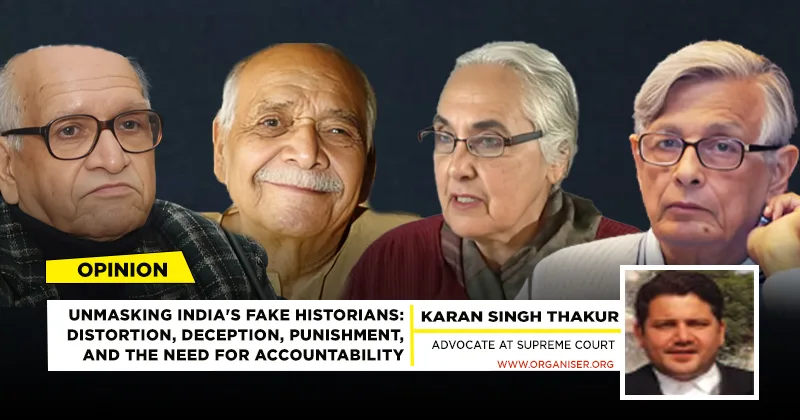
History is not just a record of the past—it shapes national identity, influences public perception, and determines the lessons future generations learn. However, when history is deliberately distorted, it becomes a tool of deception rather than enlightenment. While Western nations enforce strict laws against historical revisionism, India remains plagued by so-called historians who manipulate facts, glorify oppressors, and suppress inconvenient truths.
For decades, a select group of self-proclaimed intellectuals has controlled the historical narrative, whitewashing medieval atrocities and fabricating stories to fit their ideological biases. Unlike in the West—where Holocaust denial is punishable by law—in India, fake historians continue to shape public discourse without consequence. The time has come to unmask these distorters, expose their deception, and demand accountability, ensuring that history remains a pursuit of truth, not propaganda.
In India, those who distort medieval history and conceal past atrocities have established themselves as the ultimate authorities on history—without archival research, evidence-based methodology, or accountability. Yet, their dominance remains unquestioned.
In contrast, Western nations do not tolerate historical distortion. For instance, in 2006, British historian David Irving was sentenced to three years in prison in Austria for denying the Holocaust. Similarly, in Germany, Horst Mahler faced repeated imprisonments from the early 2000s to 2017 for Holocaust denial, Nazi salutes, and conspiracy claims.
France follows the Gayssot Act, under which historian Vincent Reynouard faced multiple convictions for Holocaust denial. Ernst Zündel, a German-Canadian, was deported from Canada to Germany and sentenced to five years in prison in 2007. Others like Germar Rudolf, Bishop Richard Williamson, Jürgen Graf, Ursula Haverbeck, and Pedro Varela were also exiled or imprisoned for questioning the official Holocaust narrative.
India’s Fake Historians Remain Untouched
Despite such strict measures abroad, Indian historians who manipulate facts and whitewash medieval atrocities continue to enjoy authority without scrutiny. Dr KK Muhammed exposed many of these so-called historians, particularly regarding the Babri Masjid dispute. The Allahabad High Court unmasked several historians, including Sushil Srivastava, Supriya Verma, Jaya Menon, Suvira Jaiswal, Shirin Ratnagar, Suraj Bhan, and Shireen Moosvi, for presenting false claims in court.
Thanks to their distorted narratives, today’s youth remain fixated on Akbar’s so-called greatness while ignoring historical realities. Figures like Alauddin Khilji, who burned Nalanda, and Aurangzeb, who executed Hindus en masse, are portrayed as “secular.” Meanwhile, Tipu Sultan, responsible for large-scale forced conversions and massacres, is hailed as a “revolutionary.”
History must serve as a mirror reflecting the unfiltered truth, not as a tool for ideological manipulation. While Western nations have strict laws against historical distortion, India continues to suffer from unchecked academic dishonesty, where fabricated narratives glorify invaders, erase atrocities, and mislead generations. These distortions are not mere academic errors—they shape national identity, public perception, and policymaking, often at the cost of historical justice.
If nations like Austria, Germany, and France can criminalize false historical claims to protect the integrity of their past, why should India allow history to be hijacked by propaganda? It is time to demand accountability from historians, challenge falsehoods paraded as facts, and ensure that the next generation inherits a history rooted in truth, not deception. Only then can India break free from the shadows of manipulated history and reclaim its rightful past.










Comments