





In 2022, BLA carried out a suicide bombing around Karachi University, killing three Chinese teachers, perhaps one of the first glimpses of BLA making its striking pattern more intense. After that, BLA continued to hit Pakistan’s security establishment with a more hardened and in-depth approach. The BLA attack on August 26, 2024, where at least 23 Punjabi travellers were killed in the Rarasham area of Musakhail District in Balochistan when cadres of Baloch Liberation Army (BLA) offloaded passengers from trucks and buses and shot at them after checking their identities. This incident was just the beginning to mark Balochi’s insurgency revival. But perhaps BLA’s attempt to carry out the deadliest strike on Pakistan was yet to be seen.
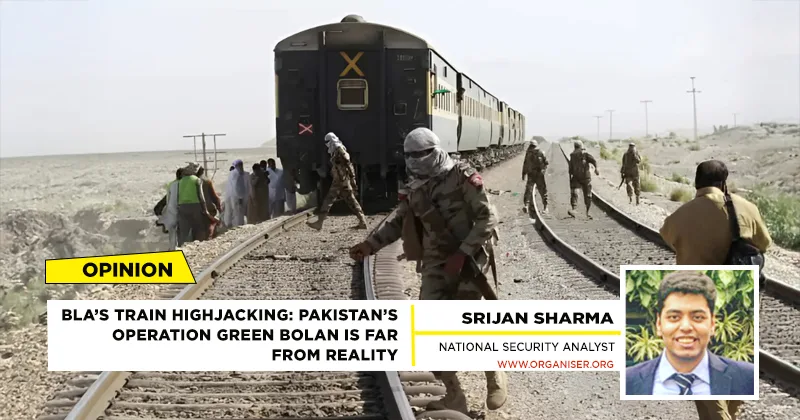
On March 11, 2025 BLA hijacked a passenger train, the Jaffar Express travelling to Peshawar from Quetta carrying around 400-500 passengers. BLA insurgents detonated explosives when the train was passing through a tunnel and even sabotaged the tracks before detonation so the train could stop in a mountainous region. After the train stopped, BLA insurgents opened fire and stormed into the train and held many as hostages. In contrast, they held civilians as hostages, they executed the Pakistani soldiers/security personnel travelling on the train. According to reports and BLA’s claim, around 50 people have been killed, but it’s eyebrow-raising as many international media houses have reported that around 100 coffins are at the Peshawar station, which raises suspicion over actual fatalities.
Operation Green Bolan: Tactical Success But Strategic Failure
Pakistan security establishments have confirmed that they have killed all 33 insurgents involved in hijacking and rescued hostages held by BLA in an “complex operation” codenamed “Green Bolan where Pakistan carried out multiple coordinated air-ground operations against BLA insurgents. Pakistan’s security establishment still sees this as a successful operation, perhaps this will give Pakistan more room to unleash more hardened and brutal operations against BLA, however, a closer look at this operation will suggest that this was a strategic failure.
First: Push more terror groups like TTP and ISIS-KP to carry out large-scale or high-intensity terror attacks.
Second- BLA’s suppression is far from over and such partial successful terror strikes will further fuel and strengthen the will to plan and execute such attacks.
Third- Poor strategic planning and operational execution of counter terror and insurgency operations. Pakistan’s ongoing ambitious counter terrorism operation Azm-E Istekam still struggles to deliver results on the ground. Moreover, Pakistan’s half-hearted and selective terror approaches thanks to Parvez Musharraf’s “know-it-all” and cunning attitude. Initiatives like Operation Sher Dil and Zalzala were launched to counter this rising menace, particularly in tribal areas such as South Waziristan. However, while addressing immediate threats on the surface, these operations failed to uproot terrorism at its core.
Fourth- Such a terror strike attempt will put Pakistan in a serious security nightmare situation, where Pakistan could face a multi-prong attack from various outfits, where one outfit will try to take advantage of the other outfit’s actions, like the struggle we saw and are currently witnessing in Syria.
Lesson From US: The Battle of Tora Bora
The US’s war on terror in Afghanistan and hunt for Osama Bin Laden ended with a strategic failure. In the quest to hunt down the US’s most wanted, the US security establishment carried out a bombing and on-the-ground operation campaign in the complex terrain of Tora Bora and a Taliban stronghold region from November 30, 2001 to December 17, 2001. The operation ended with destruction of Taliban’s stronghold areas, but it failed to achieve its primary strategic objective, capture or kill Osama Bin Laden, as Laden managed to escape. Moreover, the US’s lethal strikes in Tora Bora led to the beginning of the Taliban insurgency that led to the fall of Afghanistan in December 2001, where the US paid a heavy cost for almost two decades. Similarly, Pakistan cannot see the strategic picture of the current situation and instead blows trumpets of short-term successes. Pakistan’s problem still looms at the core level, which could lead to a mayhem-like situation in the future.
BLA’s In-Depth Strikes
In August last year BLA launched a sophisticated and coordinated operation codenamed Herof, which means Dark Storm, where BLA claimed to have killed 130 military personnel during a series of coordinated attacks across Balochistan.
The intensity of operation, at least at the ground level, appeared to be relatively high, and such coordinated attacks showcase the possibility of the Balochistan Liberation Army(BLA)’s strategic revival, which will have dynamic ramifications for Pakistan’s security matrix in the coming months or even years. Meanwhile, a comparative analysis of terrorism-related fatalities in the first eight months of each respective year in the province shows 2024 as the highest since 2015. This year’s BLA’s attacks against Pakistan’s Army establishments have significantly gained not only operational momentum but also yielded practical and in-depth strikes, an assessment of the 29th January attacks till 14 August gives an account of BLA’s increasing precision and in-depth striking capabilities which is still haunting Pakistan’s Security establishments.
The Baloch Revival
The Internal security situation in Pakistan seems to be in risky waters. The Islamist terror groups have joined BLA forces, and organised and precision-guided strikes show two key possibilities in the long-standing Baloch Insurgency. First, organised planning capability allows them to carry out strikes on a large scale and fuels the most critical part, Baloch nationalism. Second, unlike ordinary hit-and-run strikes, enhanced striking capabilities have helped BLA carry out effective strikes. There has always been a static argument in the spectrum by Pakistan’s security establishment; that is, Pakistan has a strong capability of suppression, and like years back, they can still crush the BLA force. However, this argument gets hollowed by events after Pakistan’s resolve, as happened earlier this month. The building consistency in Balochs as organised political and guerilla forces with the increasing support of various terror factions tells that Balochis have the strength to revive themselves despite years of Pakistan’s brutal suppression. The Baloch nationalism, which was fragmented, showed some signs of upward momentum, especially after Operation Herof. One more glaring observation that further strengthens this Balochi upsurge is that these operations and armed struggles are not limited to the landed elite or Sardars for leadership and are more inclusive of women and working-class people. This sense of inclusivity strengthens nationalism and enlarges the capacity of armed struggle, which will help BLA cadres to sustain ground for more time against the Pakistan Army, unlike years ago when the momentum of BLA hit after a brutal response from the Pakistan security establishment.
The most interesting part of this possible revival is Mahrang Baloch, leader of the Baloch Yakjehti Committee (BYC), who weaved out a non-violent political stage to mobilise and politically strengthen the currents of Baloch nationalism. The political bells are being arranged, and the recent speech and rally of Mahrang Baloch is touching the nerves of local Balochis in Gwadar. According to reports, if security forces had not forced so many to turn away, the BYC protest in Gwadar would have drawn a crowd of 200,000. It is the first time such massive unity and mobilisation has occurred among Balochis. Speaking to a leading newspaper in the US, Mahrang Baloch said, “We started mass mobilisation in schools as well as going door-to-door to provide the youth … with political education. From an organised armed struggle to an organised political upsurge, the revival of Baloch nationalism shows promising signs of strong struggle.
The Resurgence Implications
Pakistan faces significant challenges to safety and security commitments, especially after a terror attack in Pakistan’s Darul Uloom under the backdrop of the ICC event a few weeks ago. Under the present circumstances where Pakistan is at risk of becoming a terror hotbed, the possibilities of such spotlight events are slim, and this setback will hit Pakistan’s counter-terror credentials harder and bring colossal embarrassment, especially from its political forces inside the country. The first implication is quite apparent, which is diplomatic and the fall of the image at the global level. Second, is a strain on the Pakistan-China relationship as Gwadar and the CPEC region are currently under severe threat from BLA. Third- Dangers of socio-political instability where the Pakistan security establishment might increase its force against political and social activists in Pakistan after Asim Munir’s hint at digital terrorism. Fourth, a possible prolonged battle with terror groups can further complicate the security situation in Pakistan. Fifth- through a slim possibility, but chances of Pakistan-US getting a bit closer for counter-terrorism cooperation can help Pakistan to avail some benefits and geopolitical rent from the US, as recently the US renewed Pakistan’s F-16 package, US appreciation for clandestine engagement in tracking and handover of ISIS terrorists. Most notably, the US State Department has shown solidarity and commitment with Pakistan’s counter-terror efforts and consistently condemned BLA attacks. Such developments were not quick in India. At least former R&AW chief Vikram Sood, on his X(formerly Twitter) handle, said, “The U.S. never made such statements for India when Pak-based Pak-inspired terrorists were at work in Kashmir”, reacting to the U.S.’s statement on BLA attacks. As Pakistan stands at risk of multiple instabilities even after running the operations for months, it is seriously forced to re-look at Pakistan’s deteriorating health of national development.















Comments