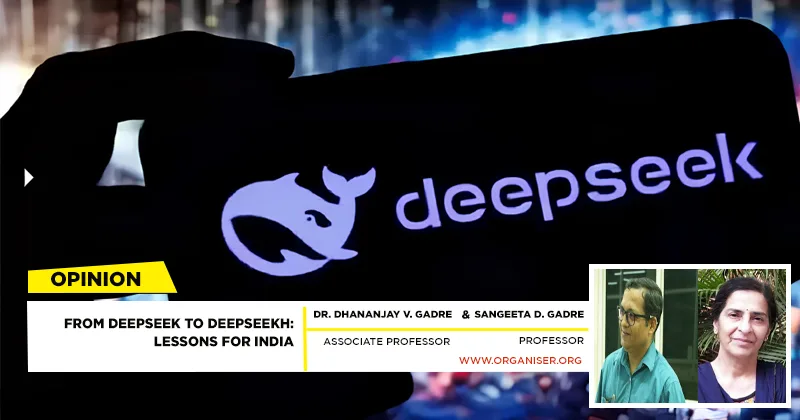
From DeepSeek to DeepSeekh: Lessons for India
December 5, 2025
  • Read Ecopy
  • Circulation
  • Advertise
  • Careers
  • About Us
  • Contact Us
Android AppiPhone AppArattai
Organiser
  • ‌
  • Bharat
    • Assam
    • Bihar
    • Chhattisgarh
    • Jharkhand
    • Maharashtra
    • View All States
  • World
    • Asia
    • Europe
    • North America
    • South America
    • Africa
    • Australia
  • Editorial
  • International
  • Opinion
  • RSS @ 100
  • More
    • Op Sindoor
    • Analysis
    • Sports
    • Defence
    • Politics
    • Business
    • Economy
    • Culture
    • Special Report
    • Sci & Tech
    • Entertainment
    • G20
    • Azadi Ka Amrit Mahotsav
    • Vocal4Local
    • Web Stories
    • Education
    • Employment
    • Books
    • Interviews
    • Travel
    • Law
    • Health
    • Obituary
  • Subscribe
    • Subscribe Print Edition
    • Subscribe Ecopy
    • Read Ecopy
  • ‌
  • Bharat
    • Assam
    • Bihar
    • Chhattisgarh
    • Jharkhand
    • Maharashtra
    • View All States
  • World
    • Asia
    • Europe
    • North America
    • South America
    • Africa
    • Australia
  • Editorial
  • International
  • Opinion
  • RSS @ 100
  • More
    • Op Sindoor
    • Analysis
    • Sports
    • Defence
    • Politics
    • Business
    • Economy
    • Culture
    • Special Report
    • Sci & Tech
    • Entertainment
    • G20
    • Azadi Ka Amrit Mahotsav
    • Vocal4Local
    • Web Stories
    • Education
    • Employment
    • Books
    • Interviews
    • Travel
    • Law
    • Health
    • Obituary
  • Subscribe
    • Subscribe Print Edition
    • Subscribe Ecopy
    • Read Ecopy
Organiser
  • Home
  • Bharat
  • World
  • Operation Sindoor
  • Editorial
  • Analysis
  • Opinion
  • Culture
  • Defence
  • International Edition
  • RSS @ 100
  • Magazine
  • Read Ecopy
Home Bharat

From DeepSeek to DeepSeekh: Lessons for India

The rise of China's DeepSeek, an advanced AI model, has sparked discussions on India’s approach to artificial intelligence and technological self-reliance. While DeepSeek represents China’s strides in AI innovation, India must chart its own course—DeepSeekh—rooted in indigenous research, ethical AI development, and self-sufficiency

Dhananjay V GadreSangeeta D GadreDhananjay V GadreandSangeeta D Gadre
Feb 18, 2025, 05:30 pm IST
in Bharat, China, Opinion, India, Sci & Tech
Follow on Google News
FacebookTwitterWhatsAppTelegramEmail

The phenomenal success of DeepSeek carries important lessons for India. Some view it as a significant technological leap for China, even suggesting it has dealt a major blow to the United States, as reflected in the American stock market’s sharp decline, erasing over a trillion dollars in market capitalization. However, the true significance of DeepSeek lies not in geopolitical rivalries but in the broader implications for technological self-reliance and innovation.

Two Key Takeaways for India

Belief in Indigenous Innovation
DeepSeek’s success is a reminder that with self-confidence and sustained effort, it is possible to develop high-end indigenous technologies, retain talent, and curb brain drain. The challenge in India is not a lack of capability but a lack of belief that world-class innovations can emerge from within the country.

Accountability in Higher Education
The success of DeepSeek places immense pressure on India’s premier institutions, such as the IITs and IISc, to justify the thousands of crores allocated annually by Indian taxpayers. Despite this funding, there is little evidence of significant indigenous technology development and productisation. This may be attributed to a prevailing academic culture that prioritizes research publications and patents over real-world engineering and product innovation. Faculty promotions are largely based on the number of papers published rather than their contribution to technological advancements.

Structural Problems in Indian Engineering Education

India’s engineering education system faces three fundamental challenges:

Outdated Teaching Methods: Engineering faculty largely teach from the same textbooks they studied as students, often without integrating practical engineering experience. There is little incentive to acquire hands-on expertise.

Lack of Real-World Application: Many mechanical engineering faculty members have never built a machine, electronics faculty have never designed a commercially viable circuit or system, and computer engineering faculty have never developed socially impactful software. The absence of direct industry engagement hampers innovation.

Dependence on Western Validation: Research priorities are often dictated by Western research trends with little focus on solving local problems. The lives lost due to open manholes, for instance, remain a persistent issue, yet our brightest minds seek training to serve multinational corporations rather than address pressing domestic challenges.

Beyond Increased Investment: A Need for Decolonisation

Some argue that greater investment in science, technology, and education will resolve these issues. However, despite significant government funding, India has not seen commensurate returns due to a persistent exodus of trained professionals. This is not a linear problem solvable merely by increased financial outlays—it is rooted in a history of a thousand years of cultural and linguistic colonization.

Unlike China, which was never colonized, India must undergo a process of decolonization before it can aspire to match China’s technological strides. This requires a shift in mindset—one that prioritizes self-reliance, indigenous problem-solving, and confidence in Indian ingenuity.

India must urgently revamp its school education system, particularly science education, with a sense of urgency. The introduction of Atal Tinkering Labs in schools was a welcome step, but with only 10,000 schools benefiting, it has inadvertently widened the gap between institutions. These labs should foster a genuine spirit of innovation by integrating them more deeply with science education, rather than becoming mere Arduino Training Labs.

Beyond secondary education, engineering—particularly computer engineering—remains the preferred choice for higher studies, often driven by job prospects. As a result, students who cannot afford engineering courses are the ones who typically pursue science education. This trend must change. A significant proportion of students must see science education as a viable and rewarding career path, rather than just a fallback option.

Rediscovering India’s ‘Honne’
A scene from the 2012 movie Emperor captures this sentiment well. In a conversation between General Kajima and General Bonner Fellers, Kajima explains two Japanese concepts:

“There are two Japanese words you should know. Tatemae—the way things appear. Honne—the way things really are. When you look at Japan, you see the most modern and westernized of Asian countries, but that is tatemae, the surface.”

“And honne?” asks General Fellers.

“It is the true heartbeat of my country, which is more than 2000 years old. It has nothing to do with the West. Japan runs on the ancient warrior code of loyalty and obedience.”

India, too, needs to discover its honne—the true essence of its identity and capabilities. Until we break free from the shackles of colonial-era mindsets and external validation, our technological aspirations will remain unfulfilled. The journey from DeepSeek to DeepSeekh—a pursuit of deeper learning and self-reliance—must begin now.

Topics: DeepSeekDeepSeekhGeneral Bonner Fellers
ShareTweetSendShareSend
✮ Subscribe Organiser YouTube Channel. ✮
✮ Join Organiser's WhatsApp channel for Nationalist views beyond the news. ✮
Previous News

Sanskrit is the identity of Bharat; Dayanidhi Maran should apologise

Next News

Drone flying over Ayodhya’s Ram Mandir triggers panic among devotees, YouTuber under suspicion; investigation underway

Related News

South Korea: Chinese AI app DeepSeek illegally shared data of 1.5 million Korean users

Time to address cybercrimes in digital age

OpenAI VS DeepSeek : Illusion of supremacy

Reevaluating AI development: Maximising intelligence against practical uses

A representative image

DeepSeek Faces Backlash: Texas imposes ban over data privacy risks

Representative Image

Government accelerates IndiaAI GPU access portal as DeepSeek challenges AI compute norms

Load More

Comments

The comments posted here/below/in the given space are not on behalf of Organiser. The person posting the comment will be in sole ownership of its responsibility. According to the central government's IT rules, obscene or offensive statement made against a person, religion, community or nation is a punishable offense, and legal action would be taken against people who indulge in such activities.

Latest News

Thirupparankundram Karthigai Deepam utsav

Andhra Pradesh: AP Dy CM Pawan Kalyan reacts to Thirupparankundram row, flags concern over religious rights of Hindus

23rd India-Russia Annual Summit

India-Russia Summit heralds new chapter in time-tested ties: Inks MoUs in economic, defence, tourism & education

DGCA orders probe into IndiGo flight disruptions; Committee to report in 15 days

BJYM leader Shyamraj with Janaki

Kerala: Widow of BJP worker murdered in 1995 steps into electoral battle after three decades at Valancherry

Russian Sber bank has unveiled access to its retail investors to the Indian stock market by etching its mutual fund to Nifty50

Scripting economic bonhomie: Russian investors gain access to Indian stocks, Sber unveils Nifty50 pegged mutual funds

Petitioner S Vignesh Shishir speaking to the reporters about the Rahul Gandhi UK citizenship case outside the Raebareli court

Rahul Gandhi UK Citizenship Case: Congress supporters create ruckus in court; Foreign visit details shared with judge

(L) Kerala High Court (R) Bouncers in Trippoonithura temple

Kerala: HC slams CPM-controlled Kochi Devaswom Board for deploying bouncers for crowd management during festival

Fact Check: Rahul Gandhi false claim about govt blocking his meet with Russian President Putin exposed; MEA clears air

Union Minister for Road Transport and Highways Nitin Gadkari (Right)

India set for highway overhaul as Union Minister Nitin Gadkari unveils nationwide shift to MLFF electronic tolling

RSS Akhil Bharatiya Prachar Pramukh Shri Sunil Ambekar

When Narrative Wars result in bloodshed, countering them becomes imperative: Sunil Ambekar

Load More
  • Privacy
  • Terms
  • Cookie Policy
  • Refund and Cancellation
  • Delivery and Shipping

© Bharat Prakashan (Delhi) Limited.
Tech-enabled by Ananthapuri Technologies

  • Home
  • Search Organiser
  • Bharat
    • Assam
    • Bihar
    • Chhattisgarh
    • Jharkhand
    • Maharashtra
    • View All States
  • World
    • Asia
    • Africa
    • North America
    • South America
    • Europe
    • Australia
  • Editorial
  • Operation Sindoor
  • Opinion
  • Analysis
  • Defence
  • Culture
  • Sports
  • Business
  • RSS @ 100
  • Entertainment
  • More ..
    • Sci & Tech
    • Vocal4Local
    • Special Report
    • Education
    • Employment
    • Books
    • Interviews
    • Travel
    • Health
    • Politics
    • Law
    • Economy
    • Obituary
  • Subscribe Magazine
  • Read Ecopy
  • Advertise
  • Circulation
  • Careers
  • About Us
  • Contact Us
  • Policies & Terms
    • Privacy Policy
    • Cookie Policy
    • Refund and Cancellation
    • Terms of Use

© Bharat Prakashan (Delhi) Limited.
Tech-enabled by Ananthapuri Technologies