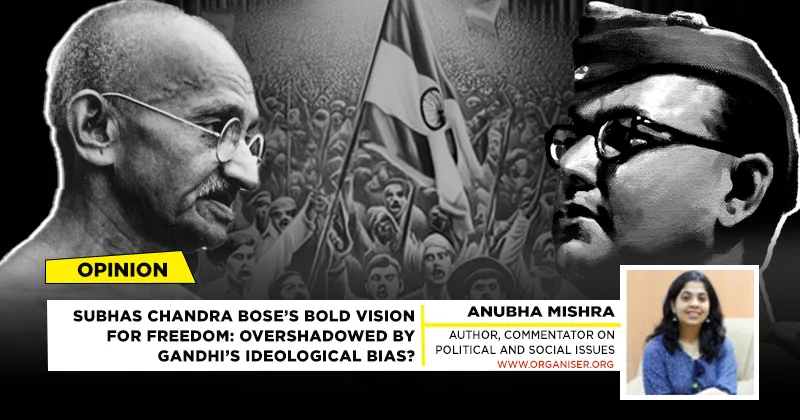
Subhas Chandra Bose’s bold vision for freedom: Overshadowed by Gandhi’s ideological bias?
December 5, 2025
  • Read Ecopy
  • Circulation
  • Advertise
  • Careers
  • About Us
  • Contact Us
Android AppiPhone AppArattai
Organiser
  • ‌
  • Bharat
    • Assam
    • Bihar
    • Chhattisgarh
    • Jharkhand
    • Maharashtra
    • View All States
  • World
    • Asia
    • Europe
    • North America
    • South America
    • Africa
    • Australia
  • Editorial
  • International
  • Opinion
  • RSS @ 100
  • More
    • Op Sindoor
    • Analysis
    • Sports
    • Defence
    • Politics
    • Business
    • Economy
    • Culture
    • Special Report
    • Sci & Tech
    • Entertainment
    • G20
    • Azadi Ka Amrit Mahotsav
    • Vocal4Local
    • Web Stories
    • Education
    • Employment
    • Books
    • Interviews
    • Travel
    • Law
    • Health
    • Obituary
  • Subscribe
    • Subscribe Print Edition
    • Subscribe Ecopy
    • Read Ecopy
  • ‌
  • Bharat
    • Assam
    • Bihar
    • Chhattisgarh
    • Jharkhand
    • Maharashtra
    • View All States
  • World
    • Asia
    • Europe
    • North America
    • South America
    • Africa
    • Australia
  • Editorial
  • International
  • Opinion
  • RSS @ 100
  • More
    • Op Sindoor
    • Analysis
    • Sports
    • Defence
    • Politics
    • Business
    • Economy
    • Culture
    • Special Report
    • Sci & Tech
    • Entertainment
    • G20
    • Azadi Ka Amrit Mahotsav
    • Vocal4Local
    • Web Stories
    • Education
    • Employment
    • Books
    • Interviews
    • Travel
    • Law
    • Health
    • Obituary
  • Subscribe
    • Subscribe Print Edition
    • Subscribe Ecopy
    • Read Ecopy
Organiser
  • Home
  • Bharat
  • World
  • Operation Sindoor
  • Editorial
  • Analysis
  • Opinion
  • Culture
  • Defence
  • International Edition
  • RSS @ 100
  • Magazine
  • Read Ecopy
Home Bharat

Subhas Chandra Bose’s bold vision for freedom: Overshadowed by Gandhi’s ideological bias?

Subhas Chandra Bose, one of India’s most dynamic and visionary leaders, played a pivotal role in the country’s struggle for independence with his bold and uncompromising approach. Unlike Mahatma Gandhi’s philosophy of non-violence and gradualist tactics, Bose believed in direct confrontation with the British colonial regime, a stance that often put him at odds with Gandhi and the Indian National Congress

Anubha MishraAnubha Mishra
Jan 23, 2025, 01:30 pm IST
in Bharat, Opinion
Follow on Google News
FacebookTwitterWhatsAppTelegramEmail

Netaji Subhas Chandra Bose was a fierce nationalist whose defiant patriotism made him one of the greatest freedom fighters in Indian history. He was born on January 23, 1897, in Cuttack, Orissa Division, Bengal Province, to Prabhavati Dutt Bose and Janakinath Bose. After his early schooling, he joined Ravenshaw Collegiate School. From there, he joined Presidency College, Calcutta, but was expelled due to his nationalist activities. Later, he went to the University of Cambridge, UK. He was influenced by the teachings of Swami Vivekananda and Ramakrishna after reading their works at the age of 16.

In 1919, Bose headed to London to take the Indian Civil Services (ICS) examination, and he was selected. Bose, however, resigned from Civil Services as he believed he could not side with the British. His famous slogans are ‘tum mujhe khoon do, main tumhe aazadi dunga‘, ‘Jai Hind’, and ‘Delhi Chalo‘, which still echo in young India’s minds and hearts. He formed Azad Hind Fauj and made several contributions to India’s freedom struggle. He was also sent to prison in Mandalay in 1925 due to his connections with revolutionary movements. He also joined the Non-Cooperation Movement, which was started by Mahatma Gandhi, who made INC a powerful non-violent organisation. During the movement, he decided to work with Chittaranjan Das, who became his political guru. After that, he became a youth educator and commandant of the Bengal Congress volunteers. He started the newspaper ‘Swaraj’. In 1927, after being released from prison, Bose became general secretary of the Congress party and worked with Jawaharlal Nehru for independence. In 1938, he was elected president of the Indian National Congress and formed a national planning committee, which formulated a policy of broad industrialisation. However, this did not harmonise with Gandhian economic thought.

The differences emerged right from their first encounter in 1921 when Netaji questioned Gandhi’s clarity on plans that he created for India’s independence. Adding to their political views, Bose and Gandhi also had diverging views on heritage, religion and development, and all that showed up from time to time during India’s freedom struggle. Seven years after their first meeting, Bose publicly challenged Gandhi, for the first time, on Gandhi’s resolution for dominion status. Although Gandhi narrowly won the resolution, Bose’s and his supporter’s conduct made Gandhi write, “The volunteers dressed in European fashion presented, in my opinion, a sorry spectacle in Calcutta (Congress session 1928),” Gandhi wrote in Young India.” As a result, Bose was removed from the Congress Working Committee, but his resistance and opposition continued.

In the following years, Gandhi and Bose exchanged words quite a few times as round table negotiations went on until Netaji Subhas Bose was jailed and then sent on an exile to Europe in 1932. During his time overseas, Bose met European leaders and Indian students and established contacts. He met Benito Mussolini, too, and saw Nazism and Fascism rise. He gained perspective and started to plan things systematically, only to criticise Gandhian politics more strongly.

Responding to an accusation of “following Gandhi blindly”, Netaji wrote in 1934, “I have no faith in the Congress Working Committee dominated by the satellites of Mahatma Gandhi”. Bose’s election as Congress president in 1938 was seen as a temporary measure by Gandhi. “I have observed that Subhas is not dependable. However, there is nobody who can be the President,” Gandhi wrote to Vallabhbhai Patel in a letter.

Gandhi, by then, had been nurturing Jawaharlal Nehru as India’s leader and made his choice evidently clear. Bose also lent support to Gandhi’s Quit India Movement but feared Gandhi and Congress might settle for a dominion status.

The onset of World War II widened differences between Bose and Gandhi, with Bose forming his party and advocating a more radical approach, while Gandhi chose a moment of slowdown. Bose did not subscribe to Gandhi’s idea of supporting the British in the Great War that started in 1939. In what is known as the Tripuri crisis, Bose won the presidency by defeating Gandhi-backed Pattabhi Sitaramayya. Bose had to pay the price and was disqualified from the presidency of the Bengal Provincial Congress Committee and expelled from Congress committees for three years in 1939. Bose was jailed in 1940, and the following year, in 1941, he fled to Germany. As Bose was looking to organise armed resistance against the British, Gandhi maintained that India would not seek the help of a foreign power to gain independence. Bose and Gandhi were at loggerheads many times.

Mahatma Gandhi’s Non-Cooperation movement had little impact, but it was the military resistance of Netaji Subhas Chandra Bose that led to the end of the British Raj in India. A conversation between the then British Prime Minister Clement Attlee and the then Acting governor of West Bengal, Justice PB Chakraborthy rules the same.

“When the governor asked Atlee the reason, why the Britishers left India, Atlee said, that it was out of fear that the Britishers were not secure in India.”

In spite of all this, there were glaring differences between Gandhi and Subhas, and in political life, both posed against each other. Young Netaji was a firebrand nationalist who believed in the tradition of Tilak and Aurobindo. Gandhiji, on the contrary, was a reluctant nationalist who belonged to the tradition of his mentor Gokhale and Tagore. Bose’s strong revolutionary urge for the emancipation of his motherland made him critical of many of Gandhiji’s techniques. There was respect despite the discord.
Topics: Netaji Subhash Chandra BoseMahatma Gandhi
ShareTweetSendShareSend
✮ Subscribe Organiser YouTube Channel. ✮
✮ Join Organiser's WhatsApp channel for Nationalist views beyond the news. ✮
Previous News

“Land of knowledge”: Bihar’s tableau at R-Day parade to showcase Nalanda ruins, newly built university & Bhagwan Buddh

Next News

Breaking Stereotypes: Scottish Hindu Foundation hosts Parliamentary Reception to address Hinduphobia

Related News

Mahatma Gandhi and Dr. Keshav Baliram Hedgewar

Gandhi and Hedgewar, From power to service, An inspiring journey of national vision

(Left) Mahatma Gandhi (Right) Former PM Lal Bahadur Shastri

PM Modi hails Gandhi’s ‘Viksit Bharat’ Path, Lal Bahadur Shastri’s ‘extraordinary’ statesmanship on birth anniversary

Mahatma Gandhi statue vandalised in London's Tavistock Square

Indian High Commission in London ‘strongly’ condemns vandalism of Mahatma Gandhi’s statue at Tavistock Square

Karnataka: HC denies bail to rape accused Syed Farvez Musharraf, cites Manusmriti & Gandhi on women’s safety

Just two days before Bharat celebrated its 79th Independence Day, the nation lost one of its bravest daughters and a living link to the Azad Hind legacy, Lieutenant Bharati ‘Asha’ Sahay Choudhry affiliated to Rani Jhansi Regiment of INA

Lieutenant Asha Sahay: The INA Rani who passed away two days before 79th Independence Day of Bharat

CPI who has a history of denouncing Gandhi used him as shield to counter Savarkar

Load More

Comments

The comments posted here/below/in the given space are not on behalf of Organiser. The person posting the comment will be in sole ownership of its responsibility. According to the central government's IT rules, obscene or offensive statement made against a person, religion, community or nation is a punishable offense, and legal action would be taken against people who indulge in such activities.

Latest News

DGCA orders probe into IndiGo flight disruptions; Committee to report in 15 days

BJYM leader Shyamraj with Janaki

Kerala: Widow of BJP worker murdered in 1995 steps into electoral battle after three decades at Valancherry

Russian Sber bank has unveiled access to its retail investors to the Indian stock market by etching its mutual fund to Nifty50

Scripting economic bonhomie: Russian investors gain access to Indian stocks, Sber unveils Nifty50 pegged mutual funds

Petitioner S Vignesh Shishir speaking to the reporters about the Rahul Gandhi UK citizenship case outside the Raebareli court

Rahul Gandhi UK Citizenship Case: Congress supporters create ruckus in court; Foreign visit details shared with judge

(L) Kerala High Court (R) Bouncers in Trippoonithura temple

Kerala: HC slams CPM-controlled Kochi Devaswom Board for deploying bouncers for crowd management during festival

Fact Check: Rahul Gandhi false claim about govt blocking his meet with Russian President Putin exposed; MEA clears air

Union Minister for Road Transport and Highways Nitin Gadkari (Right)

India set for highway overhaul as Union Minister Nitin Gadkari unveils nationwide shift to MLFF electronic tolling

RSS Akhil Bharatiya Prachar Pramukh Shri Sunil Ambekar

When Narrative Wars result in bloodshed, countering them becomes imperative: Sunil Ambekar

Ministry of Civil Aviation mandates emergency action: IndiGo ordered to stabilise flight operations by midnight

Chhattisgarh CM Vishnu Deo Sai at Panchjanya Conclave, Nava Raipur, Image Courtesy - Chhattisgarh govt

Panchjanya Conclave: Chhattisgarh CM Sai shares views on development projects in Maoist hotbed, women empowerment

Load More
  • Privacy
  • Terms
  • Cookie Policy
  • Refund and Cancellation
  • Delivery and Shipping

© Bharat Prakashan (Delhi) Limited.
Tech-enabled by Ananthapuri Technologies

  • Home
  • Search Organiser
  • Bharat
    • Assam
    • Bihar
    • Chhattisgarh
    • Jharkhand
    • Maharashtra
    • View All States
  • World
    • Asia
    • Africa
    • North America
    • South America
    • Europe
    • Australia
  • Editorial
  • Operation Sindoor
  • Opinion
  • Analysis
  • Defence
  • Culture
  • Sports
  • Business
  • RSS @ 100
  • Entertainment
  • More ..
    • Sci & Tech
    • Vocal4Local
    • Special Report
    • Education
    • Employment
    • Books
    • Interviews
    • Travel
    • Health
    • Politics
    • Law
    • Economy
    • Obituary
  • Subscribe Magazine
  • Read Ecopy
  • Advertise
  • Circulation
  • Careers
  • About Us
  • Contact Us
  • Policies & Terms
    • Privacy Policy
    • Cookie Policy
    • Refund and Cancellation
    • Terms of Use

© Bharat Prakashan (Delhi) Limited.
Tech-enabled by Ananthapuri Technologies