






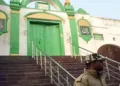
On November 24, 2024, violence erupted during a court-ordered Archaeological Survey of India (ASI) survey of the disputed Shahi Jama Masjid in Sambhal, Uttar Pradesh. The mosque, a protected monument under the ASI, has been at the centre of a longstanding dispute following claims that it was constructed on the ruins of a Hindu temple demolished during the Mughal period.
The ASI survey was initiated following a petition filed by Hindu plaintiffs, led by lawyer Hari Shankar Jain and Hindu Mahant Rishiraj Giri, as part of a civil suit claiming the right to access the mosque premises. The survey aimed to investigate claims that the mosque was built over a demolished Shri Hari temple. The Sambhal civil court ordered the survey, which was conducted under the supervision of an advocate commissioner, district magistrate, and police.
Escalation of Violence
While the first survey on November 19 proceeded peacefully, tensions flared during the second survey on November 24 when the wuzu khana (ablution tank) in the mosque was drained, allegedly to check its depth. This action triggered rumours that excavation was underway, which enraged the gathered crowd.
Reports suggest that approximately 2,000 Muslims from Sambhal and nearby areas gathered outside the mosque. When police instructed the mob to disperse, violence erupted. The crowd began pelting stones and setting vehicles ablaze, forcing the police to use tear gas and a lathi charge to regain control. Shots were reportedly fired from the rioters’ side, and five rioters were killed in the ensuing mayhem. Police personnel, including CO Anuj Choudhary, the SP’s PRO, the SP, and 20 other police personnel, sustained injuries during the violence.
The families of the deceased claimed they were killed in police firing. However, Moradabad Commissioner Anjney Kumar Singh issued a statement asserting that the deaths were caused by bullets fired by the rioters in the chaos.
Historical and Religious Context
Sambhal holds significant religious importance for Hindus, as it is considered to be the birthplace of Kalki, the tenth incarnation of Lord Vishnu, as per various Puranas and Hindu texts. The Shahi Jama Masjid is believed to have been constructed by Mughal ruler Babur in the early 16th century over the ruins of the Shri Hari temple, which adds to the temple-mosque dispute.
The incident on November 24 was not an isolated occurrence of violence in Sambhal. The city has a long and turbulent history marked by repeated instances of communal unrest, the most devastating being the 1978 pogrom, in which over 183 Hindus reportedly lost their lives. This report provides a detailed account of all incidents of violence recorded in Sambhal, spanning from 1936 to the present day.
#1: Violence of 1936-37
Some incidents of communal violence occurred during this period, but no verified factual details are available.
#2: Violence of 1947
At the time of Partition, communal riots engulfed the entire country, and Sambhal was not spared. People from Hatimsarai and surrounding areas fled to seek refuge at the Sambhal police station. Once the riots subsided, Jagdish Sharan, a commission agent from Hatimsarai, along with 20-25 others and a police escort, began their journey home. When they reached Qureshi Wali Gali in Hilali Sarai, just 50 meters from their houses, they asked the policeman to return, believing they were close to safety. Moments later, the group was ambushed by Muslims, including members of the Qureshi community. While others managed to escape, Jagdish Sharan was caught and killed. Official records reported one Hindu death in this incident.
#3: Violence of 1948
Curfew was imposed for over 20 days following riots that resulted in the deaths of six Hindus. The riots were incited by Big Nawab Mahmood Hasan Khan (father of current MLA Iqbal Mahmood), who opened fire. Communal clashes erupted at Katra Ke God in Hakim Sarai, where six Hindus lost their lives. Nawab Mahmood even commissioned a makeshift cannon (Top) from Anwar Mistri (whose son Mukhtiyar now runs a workshop near Hind Inter College). He brought the weapon to Agenti Tiraha with the intention of attacking Hindus but was stopped by Hindu resistance.
#4: Violence of 1953
A Shia-Sunni conflict broke out in Sambhal, leading to significant casualties. Apart from this, communal riots also came to light in the years 1958, 1959 and 1966.
#5: Violence of 1958-59
Several communal riots were reported. In 1958, a two-day curfew was imposed after a violent clash between Hindu and Muslim students at Hind Inter College. Muslim boys from ‘Bera ke Karkhana’ attacked with weapons, including iron claws, leaving 10-12 Hindu students injured.
#6: Violence of 1962
During a by-election for the Amroha and Sambhal Lok Sabha constituency, contested by JP Kriplani, communal tension flared. Prime Minister Jawaharlal Nehru also campaigned during this time. Mahesh Gupta, a former Jan Sangh MLA, was attacked and stabbed by Muslims near a seed warehouse in Ruknuddin Sarai. He sustained severe injuries.
#7: Violence of 1976
On February 29, 1976, a rumour spread that Rajkumar Saini, a mentally unstable man from Petia village, had killed a Maulvi. However, investigations later revealed that the Maulvi was murdered due to a dispute within the mosque committee by another Muslim. Nevertheless, a mob, led by Manzar Shafi and Ataullah Tatari (a time when Dr. Shafiqur Rahman Barq was rising in influence), attacked Hindu religious sites, including the Surajkund temple and the Manas temple. The mob also targeted Sasthal Chowki, attempting to burn Kishanlal’s house. When Hindus resisted, stone pelting ensued, and the mob fled.
During this period, two murders were reported: Harisingh, son of Sukha Singh, resident of Sotipura and Rakesh Vaishya, son of Rameshwar Prasad, resident of Mohalla Kotpurvi.
On April 24, 1976, a major explosion occurred at the house of Kallu, a resident of Nachawan in Kotpurvi Mohalla. His son Salam was severely injured and succumbed to his injuries the following day. In retaliation, Kamta Prasad, an elderly Hindu man, was stabbed to death in Lal Masjid Sarayatrin. Police quickly apprehended the killers and identified the cause of the explosion, which helped restore calm.
Additionally, Jaichand Rastogi was shot dead during this period. In a bid to maintain balance, authorities arrested around 20-22 guilty Muslims and an equal number of innocent Hindus, leading to dissatisfaction among Hindus. A Hindu was also killed outside the city during this unrest. A seven-day curfew was imposed to control the situation.
#8: The Sambhal Riot of March 29, 1978
The most devastating communal riot in Sambhal in 1978 erupted in the aftermath of the Holi festival. Holi was celebrated on March 25, 1978, but tensions simmered between the two communities over specific issues related to the festival. At one site, a Muslim shopkeeper had set up a wooden stall at a location where the Holi pyre was to be lit, while at another, a platform had been constructed. Despite the tension, the wooden stall was removed in time, and Holi was celebrated peacefully.
Background of the Conflict
Tensions escalated further due to a dispute involving Mahatma Gandhi Degree (MGM) College near the Nagar Palika. The college had a policy that any person or institution donating Rs 10,000 could become a lifetime member of its management committee. A cheque for Rs 10,000 had been sent to the college fund by the local Truck Union in the name of Manzar Shafi. The receipt also bore his name. However, the then Sub-District Magistrate (SDM), who was the Vice President of the management committee, refused to recognise Manzar Shafi’s claim, which led to his resentment against the college administration.
Triggering Events and Outbreak
On the day of Holi, the college administration gave ceremonial titles to students, including Muslim girls, which infuriated Manzar Shafi. Matters escalated when Manzar Shafi and Tatari attempted to forcefully shut down the local market. A tea vendor, Pramod Chaiwala, refused to close his shop, prompting Manzar to angrily throw a plate of pakoras. A rumor quickly spread in Deepa Sarai that Manzar had been killed.
Amidst this chaos, SDM Ramesh Chand Mathur narrowly escaped harm when he fled to the Tehsil office as a stampede broke out in the market. To protect rural Hindus caught in the unrest, Banwari Lal led them to his brother-in-law Murari Lal’s shop for safety. Unfortunately, some Muslim middlemen discovered their hiding place and informed the mob.
The Violence and Arson
The enraged mob burned down the entire vegetable market, destroying around 40 Hindu-owned shops and looting them. Under the influence of Dr. Shafiqur Rahman Barq, more compensation was allegedly given to Muslims, even those whose properties were unaffected, while many affected Hindus received nothing.
During the riots, 24 Hindus were brutally killed and their bodies burned collectively using sugarcane husks and tyres. The market gate was broken down using a tractor to allow easier access for the mob. While fleeing to nearby villages, over 160 individuals were killed.
The scale of the violence was staggering, as bodies were found in forests for days afterward. Almost every village reported casualties, and many victims were killed slowly in subsequent days.
Brutal Killing of Banwari Lal Goyal
Banwari Lal, a respected local figure who had loaned money to many Muslims, believed he was safe. Ignoring his wife and son’s warnings, he went to collect dues, trusting his Muslim friends. Once inside the Phad, the mob surrounded him. They taunted him:
“You’ve come to take money with these feet? Let’s cut them off.”
“You’ll take money with these hands? Let’s cut them off.”
They severed his hands and feet before finally killing him by slitting his throat, despite his pleas to be shot instead. His body was burned alongside 23 other Hindus.
Two witnesses, Hardwari Lal Sharma and Subhash Chandra Rastogi, saw this horrific act while hiding in a tarpaulin-covered drum. They also witnessed Hardwari Lal’s brother, a high school student, being stabbed to death.
Lack of Justice and Witness Coercion
In 2010, the primary accused—including Irfan, Wajid, Zahid Hathodia, Shahid, Kamil, Achhan, and Manzar—escaped justice when witnesses turned hostile under pressure. Dr. Shafiqur Rahman Barq reportedly pressured Banwari Lal’s family, leading to their migration from Sambhal around 1995. The Honorable judge expressed disbelief, stating: “I cannot imagine that such people are not being hanged while witnesses are turning hostile.”
The case of the 1978 riots was adjudicated in Moradabad Court, where 48 accused were acquitted due to a lack of evidence. The court questioned why no action was taken under Section 164 of the Indian Evidence Act against the four key witnesses—Baburam Sharma, Brajnandan Varshney, Satish Garg, and Hardwari Lal—who gave affidavits under alleged duress or inducement.
Kidnappings and Violence Against Women
During the riots, a teacher’s wife and daughter were kidnapped by Manzar Shafi. While the teacher’s wife was freed by Hindus, the daughter was allegedly raped before being released. The family fled Sambhal, and no action was ever taken against the perpetrators.
Religious Aftermath: The Ban on Jama Masjid/Harihar Mandir
Using the riots as a pretext, Dr Shafiqur Rahman Barq banned Hindus from entering the Jama Masjid/Harihar Mandir. Previously, Hindus performed kirtans around the havan kund (sacred fire pit) located in the complex. Today, this havan kund is used for wuzu (ablution), erasing its religious significance for Hindus.
#9: 1980 Riot of Triggered by Pig Incident
In 1980, a significant riot broke out in Moradabad after a pig entered the Idgah, causing tensions that spread to Sambhal. In the ensuing violence, a member of the Prajapati community was killed. Vijay Tyagi was detained under the National Security Act (NSA) during this period. The then District Magistrate justified shutting down Tasdiq Ilahi, stating that maintaining a “balance” was necessary, a remark that underscored the common practice of equating the actions of both communities during communal violence.
#10: 1982 Protest Against Babri Masjid Lock Opening
When the lock of the Babri Masjid was opened in 1982, strong protests erupted in Sambhal. On a Friday, between 10,000 to 15,000 Muslims from urban and rural areas gathered to offer Namaz at the Jama Masjid, wearing black armbands as a sign of protest. The crowd extended to Tandon Tiraha, leading to widespread fear and closure of Hindu shops.
Amidst this charged atmosphere, Harishankar Rastogi was shot dead in Guiya Wali Gali, Mo. Dher, by a Muslim resident of Deepasrai over a monetary dispute. Tensions escalated, and Hindus staged demonstrations demanding the perpetrator’s arrest. Under pressure, Dr. Shafiqur Rahman Barq facilitated the surrender of the accused, but the murderer was later acquitted.
#11: 1986 Communal Tensions During Shivratri Procession
By 1986, the Shri Ram Janmabhoomi-Babri Masjid movement had amplified Hindu-Muslim polarization across Uttar Pradesh. On 8 March 1986, during the Shivratri procession, tensions flared when a rumor spread that Hindus would offer water at the Harihar temple on Shiv Teras. Taking advantage of the situation, Rahisurrahman, a tube well operator, shot Pradeep Rastogi, a mentha trader, dead.
The violence escalated:
Bhagwat Sharan Rastogi, who had gone to buy sugar near Tandon Tiraha, was dragged into a shop and murdered. His body was later found in a sack at Nai Sarai police jurisdiction.
Another Hindu was killed near the Manokamna Temple.
Shops were looted and burned during the riot.
Between 6 March 1985 and 6 June 1986, the communal clashes claimed the lives of Sitaram (son of Motiram), Omishnkar (son of Chhedlal), Bhagwat Sharan Rastogi, and Master Kripal Singh. Around 50 arrests were made, and 250 individuals faced preventive detention. Prominent individuals, including Vijay Prakash Tyagi, Rahisurrahman, and Tasdiq Ilahi, were detained under the NSA.
#12: The 1990 Post-Babri Masjid Agitation
In October 1990, BJP workers, under the leadership of Mahesh Kumar Gupta (former MLA), organised a procession in support of the Shri Ram Janmabhoomi movement. The arrests of BJP leader L.K. Advani further heightened tensions.
On 2 November 1990, a large group of armed Muslims gathered at Nakhasa crossing, chanting slogans like “Nara-e-Tadbeer”, “Allah Hu Akbar”, and “Kill Hindus.” Despite the imposition of Section 144, violence erupted. The mob pelted stones at the police, injuring two constables, prompting the police to fire in self-defense.
The clashes continued into 9 November 1990, coinciding with the foundation stone-laying ceremony at Shri Ram Janmabhoomi in Ayodhya, further exacerbating communal divides.
#13: 1992 – Aftermath of Babri Masjid Demolition
On 6 December 1992, the demolition of the Babri Masjid led to violent reactions in Sambhal. Approximately 20,000 Muslims gathered at Nakhasa Tiraha and Chhagagal ki Kothi, attempting to enter the city for arson and looting. On 7 December, Muslim mobs attacked Pakka Bagh Police Chowki, accusing the police of supporting Hindus. The mob pelted stones and opened fire, injuring four PAC constables. Inspector Arvind Kumar fired in self-defense, killing two individuals and dispersing the mob.
However, retaliatory violence ensued: On 8 December, two Hindus were murdered near Chaudhary Sarai and on 22 December, the bodies of three more Hindu victims were recovered in Hayatnagar.
#14: The 1995 Communal Riots in Sambhal
On 2 March 1995, communal clashes reignited in Sambhal. Two Hindu outsiders were killed at Rookuddin Sarai or Mandisarai. Curfew was imposed for eight days to restore order.
#15: The 2019 CAA/NRC Protests
In 2019, protests erupted in Sambhal against the Citizenship Amendment Act (CAA) and the National Register of Citizens (NRC). Thousands of Muslims from localities like Sarayatrain and Deepasrai gathered at the Nagar Palika ground, where they pelted stones, set two roadways buses on fire, and opened fire. In the violence, two Muslims died.
Subsequently, Muslim women, led by Dr. Shafiqur Rahman Barq, staged a two-month-long dharna at Pakka Bagh, Thana Nakhasa. Various Muslim leaders and organizations from outside participated. The protest ended with the enforcement of the nationwide lockdown due to the COVID-19 pandemic.
These events reflect the recurring communal tensions in Sambhal, often sparked by local disputes or larger national developments. From the 1930s to 2024, the region witnessed a series of riots that resulted in significant loss of life, property damage, and the deepening of societal divides.












Comments