





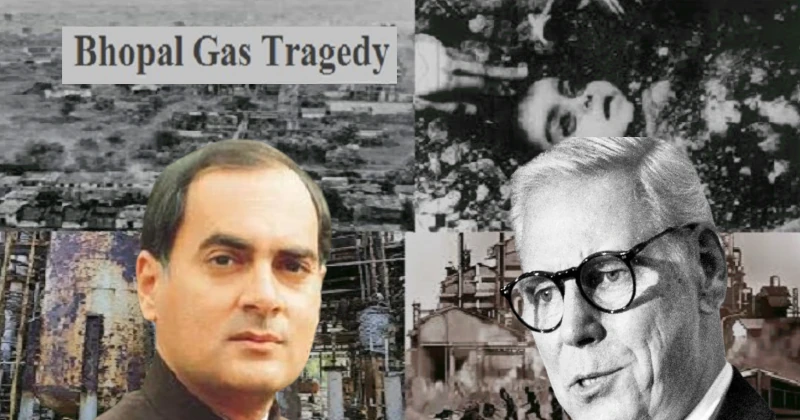
On the fateful night of December 2-3, 1984, a catastrophe unfolded in Bhopal, Madhya Pradesh, as tons of deadly methyl isocyanate (MIC) gas leaked from the Union Carbide India Limited (UCIL) pesticide plant. This industrial disaster, the worst in human history, claimed over 15,000 lives and left over 600,000 people with devastating health effects. However, the tragedy wasn’t merely an industrial accident; it became a grim reminder of the Bharatiya state’s failure to protect its citizens and a stark revelation of how the Congress government prioritized political and personal gains over justice.
At the heart of the tragedy lies the shocking escape of Warren Anderson, then chairman of Union Carbide Corporation (UCC), facilitated by Congress leaders under highly suspicious circumstances. As we delve deeper into the murky details, Rajiv Gandhi’s alleged involvement in a quid pro quo deal with the United States emerges as a chilling betrayal of the victims of Bhopal.
Amid the chaos following the gas leak, there was an overwhelming public demand for accountability. Warren Anderson arrived in Bhopal on December 7, 1984, reportedly to oversee damage control. On his arrival, he was arrested by local authorities based on a written order, signaling a rare moment of justice. However, this accountability lasted less than two hours.
Under the orders of Madhya Pradesh’s Congress Chief Minister Arjun Singh, Anderson was granted bail on a bond of Rs 25,000 and escorted to the airport. Singh personally ensured Anderson’s safe departure to Delhi, from where he fled Bharat and never returned to face trial. This move has since been widely condemned as a betrayal of justice, raising questions about who gave the final approval for Anderson’s escape.
Anderson was placed under house arrest at a guest house, but in a stunning turn of events, the Congress-led Madhya Pradesh government swiftly arranged bail for him. Not stopping there, then-Chief Minister Arjun Singh personally ensured Anderson’s safe exit from Bharat. Anderson was escorted to the Bhopal airport in a government vehicle and boarded a flight to Delhi before leaving for the United States. He never returned to face trial, leaving behind a legacy of evasion and impunity.
According to Swaraj Puri, the Superintendent of Police in Bhopal at the time, Anderson was released on an oral order from “higher-ups.” The specific identity of these “higher-ups” remains a matter of speculation, but Arjun Singh, in his autobiography A Grain of Sand in the Hourglass of Time, claimed that the directive came from the Union Home Ministry under P.V. Narasimha Rao.
However claim was refuted by R.D. Pradhan, the then Home Secretary, who clarified that he assumed office only in January 1985, weeks after Anderson had fled. Pradhan suggested that Singh’s accusations were likely made under pressure from Sonia Gandhi, who had her own reasons for distancing Rajiv Gandhi from the controversy.
Instead, Pradhan hinted that Singh might have been under “external pressure” from a powerful Italian lady, widely believed to be Sonia Gandhi. Swaraj Puri, stated that Anderson’s release was based on an oral order from higher authorities. The identity of these “higher-ups” was never officially disclosed, but growing evidence points to Prime Minister Rajiv Gandhi himself.
Meanwhile, Moti Singh, the collector of Bhopal during the tragedy, revealed that Anderson had used the guest house landline to contact individuals in the US, possibly to coordinate his escape.
The narrative takes a sinister turn with allegations of a quid pro quo deal struck between Rajiv Gandhi and the US government. At the center of this deal was Adil Shahryar, the son of Mohammad Yunus, a close associate of the Nehru-Gandhi family and a trusted aide of Indira Gandhi. Adil Shahryar was serving a 35-year prison sentence in the United States for crimes including fraud, arson, and possession of explosives.
Shahryar had been convicted in 1981 by a US federal court on five counts, including arson, mail fraud, and making and using explosives. He was sentenced to 35 years in prison. Despite the severity of his crimes, Shahryar received a presidential pardon from US President Ronald Reagan on June 11, 1985, coinciding with Rajiv Gandhi’s state visit to Washington.
The timing of the pardon has fueled speculation that Anderson’s escape was part of a deal to secure Shahryar’s release. According to some reports, Mohammad Yunus had allegedly pressured Rajiv Gandhi to intervene on his son’s behalf, even threatening to reveal damaging secrets about the Nehru-Gandhi family, including claims about Jawaharlal Nehru’s involvement in the disappearance of Netaji Subhas Chandra Bose.
This timeline raises serious suspicions that Anderson’s release was part of a secret arrangement to secure Shahryar’s freedom. Reports suggest that Mohammad Yunus had pressured Rajiv Gandhi to intervene on behalf of his son, leveraging his close ties to the Gandhi family.
Warren Anderson was declared a fugitive by Indian courts and remained so until his death in 2014. Despite mounting demands for his extradition, successive governments failed to bring him to justice. The victims of the tragedy were left to contend with inadequate compensation, chronic health issues, and the enduring trauma of that fateful night.
While the Bharatiya judiciary convicted eight former UCIL employees in 2010, these convictions did little to address the scale of the disaster or the culpability of Anderson and Union Carbide.
The evidence suggests that the Congress government, under Rajiv Gandhi, placed the interests of a close family confidant above the lives of thousands of Bhopal victims. Anderson’s escape ensured that neither he nor Union Carbide faced the full brunt of legal accountability. Meanwhile, the victims of the gas tragedy were left to grapple with systemic neglect and inadequate compensation.
This betrayal highlights the Congress party’s callous disregard for justice and its readiness to exploit national crises for political and personal benefit. The incident also exposes the deeply entrenched culture of unaccountability within the party, where loyalty to the Nehru-Gandhi family superseded the principles of governance and democracy.
The Bhopal gas tragedy is more than a tale of corporate negligence; it is a stark indictment of political complicity. Arjun Singh’s actions in facilitating Anderson’s escape, coupled with Rajiv Gandhi’s alleged involvement in a quid pro quo deal, underline the Congress party’s failure to uphold justice.
The victims of Bhopal continue to suffer, with many still awaiting proper compensation and medical relief. Meanwhile, the Congress leadership has evaded accountability, hiding behind a web of bureaucratic denials and shifting blame.
Four decades after the Bhopal gas tragedy, the victims and their families are still seeking justice. The truth about Warren Anderson’s release, the role of Rajiv Gandhi, and the alleged quid pro quo deal must be fully exposed. Only by confronting these uncomfortable truths can Bharat hope to ensure that such a betrayal of its people is never repeated.












Comments