Bhagwan Birsa Munda: An epitome of struggle, sacrifice and inspiration
December 13, 2025
  • Read Ecopy
  • Circulation
  • Advertise
  • Careers
  • About Us
  • Contact Us
Android AppiPhone AppArattai
Organiser
  • ‌
  • Bharat
    • Assam
    • Bihar
    • Chhattisgarh
    • Jharkhand
    • Maharashtra
    • View All States
  • World
    • Asia
    • Europe
    • North America
    • South America
    • Africa
    • Australia
  • Editorial
  • International
  • Opinion
  • RSS @ 100
  • More
    • Op Sindoor
    • Analysis
    • Sports
    • Defence
    • Politics
    • Business
    • Economy
    • Culture
    • Special Report
    • Sci & Tech
    • Entertainment
    • G20
    • Azadi Ka Amrit Mahotsav
    • Vocal4Local
    • Web Stories
    • Education
    • Employment
    • Books
    • Interviews
    • Travel
    • Law
    • Health
    • Obituary
  • Subscribe
    • Subscribe Print Edition
    • Subscribe Ecopy
    • Read Ecopy
  • ‌
  • Bharat
    • Assam
    • Bihar
    • Chhattisgarh
    • Jharkhand
    • Maharashtra
    • View All States
  • World
    • Asia
    • Europe
    • North America
    • South America
    • Africa
    • Australia
  • Editorial
  • International
  • Opinion
  • RSS @ 100
  • More
    • Op Sindoor
    • Analysis
    • Sports
    • Defence
    • Politics
    • Business
    • Economy
    • Culture
    • Special Report
    • Sci & Tech
    • Entertainment
    • G20
    • Azadi Ka Amrit Mahotsav
    • Vocal4Local
    • Web Stories
    • Education
    • Employment
    • Books
    • Interviews
    • Travel
    • Law
    • Health
    • Obituary
  • Subscribe
    • Subscribe Print Edition
    • Subscribe Ecopy
    • Read Ecopy
Organiser
  • Home
  • Bharat
  • World
  • Operation Sindoor
  • Editorial
  • Analysis
  • Opinion
  • Culture
  • Defence
  • International Edition
  • RSS @ 100
  • Magazine
  • Read Ecopy
Home Politics

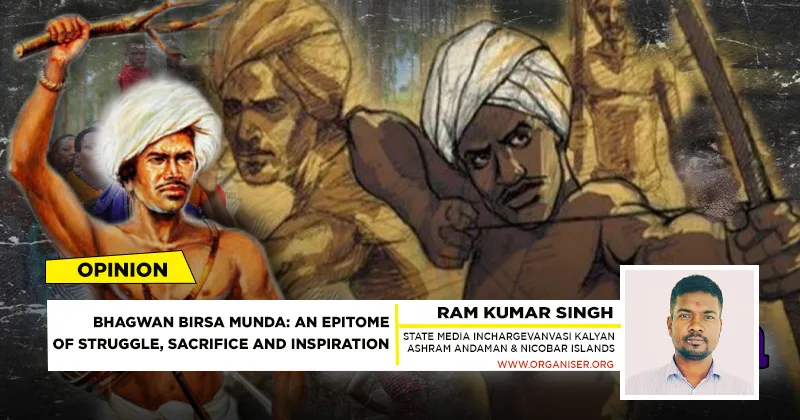
Bhagwan Birsa Munda: An epitome of struggle, sacrifice and inspiration

Bhagwan Birsa Munda stands as a towering symbol of resilience, sacrifice, and inspiration in India’s history. Revered as a tribal leader and freedom fighter, he led a valiant struggle against colonial oppression and the exploitation of indigenous communities

Ram Kumar SinghRam Kumar Singh
Dec 3, 2024, 06:30 pm IST
in Politics, Bharat, Opinion, Jharkhand
Follow on Google News
FacebookTwitterWhatsAppTelegramEmail

India is famous for its diversity in the entire world. It can be divided on many grounds like province, caste, language, customs, etc., but still we see that no one has been able to challenge its integrity. Amidst all this diversity, we are bound in the thread of unity by the blood of our martyrs. This reminds us that Bharat Mata is the mother of all of us and our ancestors have sacrificed their lives to protect her and whenever the country faces a crisis, we will be ready to protect her.

When approximately 750 tribes of India remember the glorious history of their generations, a golden name emerges – “Birsa Munda” whom the forest dwellers tribal bow to with great love and reverence as “Dharti Aaba – Bhagwan Birsa Munda”. The oil painting of Birsa Munda in the Parliament House and his statue in the Parliament premises remind the people that despite little education, limited resources and lack of modern facilities, the tribal society has contributed no less to free the country from the clutches of the British. When Tilak’s mantra “Swarajya is our birthright” had not even resonated in the country, at that time neither the names of Gandhi and Subhash had come on the political scene, then in the backward tribal area of ​​Chotanagpur in Jharkhand, Birsa Munda surprised everyone by challenging the British rule and sounding the clarion call for independence.

The land of Chotanagpur gave birth to this son on November 15, 1875. He was named Birsa because he was born on Thursday in Ulihatu village of Khunti district of Jharkhand. His father Sugana Munda and mother Karmi Hatu were very poor but hardworking. His mother gave birth to the son while working in the field and due to lack of clothes, she brought him home wrapped in a leaf. He had two brothers and two sisters. Birsa’s father wanted to educate him and make him a ‘Bada Saheb’.

Birsa’s father sent him to his maternal uncle’s house where he grazed sheep and goats and learnt his basics in alphabets and mathematics from teacher Jaipal Nag. It was here that he came in contact with Christian Missionaries and due to poverty and a desire to get an education, his family converted to Christian faith. Birsa was baptised at the age of eleven and was named Birsa David. He received his primary education in Burju’s School and for further studies, he joined the Lutheran Mission School in Chaibasa. Since the Chaibasa School was run by Missionaries, emphasis was laid on Bible education there. Beef was given in the hostel. The Munda family where Birsa spent his childhood had the custom of Cow worship and eating beef was beyond his imagination. Birsa refused to eat beef and asked his classmates to also avoid it. When this news reached the school management, Birsa was reprimanded and was also threatened with expulsion from the school.

The Munda tribe has a tradition of keeping a tuft of hair. One day, when a classmate cut off his tuft from behind, his heart was filled with wailing and tears started flowing from his eyes. He could not tolerate the Munda people being described as demonic in school and being ridiculed for their eternal traditions. Birsa said to Pastor Nottrott, “Saheb – Saheb ek Topi” meaning that the British Pastors and the British Rulers are the same. Birsa resolved that he would not stay in Chaibasa even for a moment. Later, he came to Bandgaon and there he met Anand Pandey, a follower of Vaishnav Sect. From whom he learnt about Ramayana, Mahabharata, Hitopadesh etc. and later on he stopped eating meat, he started wearing sacred thread Janeu, started tying a yellow turban on his head and started worshipping Tulsi. He took a firm resolve to end the backwardness and ignorance of his society. He organized a freedom struggle to free the tribal society from foreign Missionaries, Zamindars, British Rulers and exploiters. He organised several meetings to unite the tribal and forest dwellers and gave the clarion call for the Ulgulan revolution.

The tribal youth woke up due to this call of Birsa. Chalkad became the centre of revolutionary movement. At the first phase of protest, a non-cooperation movement was started, Birsa came to be known as Dharti Aaba. The British government was stunned by Birsa’s movement. The British government immediately ordered to arrest Birsa. The Police sent a squad to Chalkad for arrest but the strong protest of the villagers scared the Police armed with guns too, but he was arrested by deceit and brought to Hazaribagh Jail on 25 August 1895. Birsa’s arrest strengthened the desire of his followers to fight the British. When Birsa was released on 30 November 1897, the entire tribal region woke up. They were all demanding a movement with bows and arrows. The work of training, organization, policies and collection of weapons started for a fierce battle with the British. The Sardar’s fight against the exploitation and injustice of the tribal society began. Under the leadership of tribal warrior Birsa, many Police Stations, Churches, Government offices etc. were set on fire. To free themselves from the landlords, they talked about not paying taxes and taking back the rights to the forest. All this infuriated the British Government and many Birsaites were arrested, due to which the movement became more violent.

On 9 January 1900, when Birsa was holding a meeting on the Dombari hill, all the Munda, Oraon, Santhal, Kharia, Ho, Majhi tribals had gathered. Thousands of tribals had gathered singing Birsa’s songs, with putting Chandan Tilak on their foreheads and holding white and red flags in their hands. Then the British got intelligence information that Birsa was holding a meeting. Commissioner H.C. Streattfield reached the Dombari hill and started firing bullets indiscriminately. The battle began from both sides. Arrows, bows, axes, spears and stones could not stand in front of cannons and guns. The entire Dombari hill became red with blood. Birsa went to a safe forest on being requested to keep the movement alive. But he was arrested with the help of informers. On 9 June 1900, this great tribal freedom fighter breathed last mysteriously in Ranchi Jail. It was said that he had Cholera but the belief is that he was poisoned. Birsa is not among us today but the lamp lit by him is still burning. Even today the tribal community remembers him as Dharti Aaba. In the present Indian situation, the tribal community has become a victim of negligence, poverty, exploitation, foreign conspiracies, helplessness etc. There is a need to embrace the tribal society, only then the path of their all-round development will be paved and India will once again become glorious and guide the world and this will be the true tribute to Bhagwan Birsa Munda.
Topics: SanthalBirsa MundaDharti Aaba Bhagwan Birsa Munda
Share36TweetSendShareSend
✮ Subscribe Organiser YouTube Channel. ✮
✮ Join Organiser's WhatsApp channel for Nationalist views beyond the news. ✮
Previous News

Tiger State Expands: Ratapani becomes Madhya Pradesh’s 8th tiger reserve

Next News

Decoding the Adani indictment & digging deeper

Related News

Representative image

Birsa Munda at 150: A glorious tribute to vanvasi resistance, culture, and identity

Janjatiya Gaurav Diwas — Empowering the Roots: Tribal identity in New Bharat

Addressing the gathering as the Chief Speaker, Dattatreya Hosabale Ji, Sarkaryavah (General Secretary) of the Rashtriya Swayamsevak Sangh

“Developmental initiatives in vanvasi areas must empower people rather displacing them”: Dattatreya Hosabale

(From left to Right) National President of ABVP Prof. (Dr.) Rajsharan Shahi, National General Secretary of ABVP Dr. Virendra Singh Solanki and National Organising Secretary of ABVP Ashish Chauhan

Trilogy of struggle, honour and reform: ABVP to launch campaigns focused on Birsa Munda, Rani Abbakka & hostel survey 

Bhagwan Birsa Munda: True son of Bharat Mata, who fought against oppressors

JNU recently hosted a significant Two Days National Conference focused on Indigenous Knowledge, Tribal Traditions, and Cultural Practices

JNU hosts national conference on indigenous knowledge, cultural practices to mark Janajatiya Gaurav Diwas

Load More

Comments

The comments posted here/below/in the given space are not on behalf of Organiser. The person posting the comment will be in sole ownership of its responsibility. According to the central government's IT rules, obscene or offensive statement made against a person, religion, community or nation is a punishable offense, and legal action would be taken against people who indulge in such activities.

Latest News

Historic Civic Win: BJP Set to Rule Thiruvananthapuram Municipal Corporation

Kerala Local Body Election Results 2025: BJP secures historic mandate in Thiruvananthapuram; Makes dent in left bastion

Representative image

Fact-Check: COVID-19 and Neurological Risks: Debunking misleading media claims & highlighting India’s safety measures

Exterior of the Pradhan Mantri Jan Aushadhi Kendra

Karnataka: High Court raps Siddaramaiah Govt, revives Jan Aushadhi Kendras in hospitals; Strikes down closure order

President Murmu offers prayer in Govindajee Temple in Imphal

President Murmu offers prayer in Govindajee Temple in Imphal; Met displaced people in her maiden visit to Manipur

House Democrats introduce a resolution seeking to roll back emergency-based tariffs on Indian imports, warning of economic fallout and strained US–India ties

US Congress members move to end President Trump’s unilateral tariff regime on India, calls move illegal and harmful

PM Modi pays tribute to security personnel killed in the 2001 Parliament attack

2001 Parliament Attack Anniversary: PM Modi and leaders pay tribute to brave security personnel

Representative image

Delhi: “Operation CyHawk phase 2 leads to arrest of 284 people, legal action against 2900,” says Joint CP IFSO

Image for representational purpose: IED blast in Bijapur

Chhattisgarh: 24-year-old woman injured in IED explosion in Bijapur

Representative image

Uttar Pradesh: Varanasi police undertake ‘Operation Torch’; 500 suspected illegal Bangladeshi & Rohingayas identified

Representative image

Tamil Nadu ISIS Radicalisation Case: NIA files supplementary chargesheet against 7 individuals and 1 registered society

Load More
  • Privacy
  • Terms
  • Cookie Policy
  • Refund and Cancellation
  • Delivery and Shipping

© Bharat Prakashan (Delhi) Limited.
Tech-enabled by Ananthapuri Technologies

  • Home
  • Search Organiser
  • Bharat
    • Assam
    • Bihar
    • Chhattisgarh
    • Jharkhand
    • Maharashtra
    • View All States
  • World
    • Asia
    • Africa
    • North America
    • South America
    • Europe
    • Australia
  • Editorial
  • Operation Sindoor
  • Opinion
  • Analysis
  • Defence
  • Culture
  • Sports
  • Business
  • RSS @ 100
  • Entertainment
  • More ..
    • Sci & Tech
    • Vocal4Local
    • Special Report
    • Education
    • Employment
    • Books
    • Interviews
    • Travel
    • Health
    • Politics
    • Law
    • Economy
    • Obituary
  • Subscribe Magazine
  • Read Ecopy
  • Advertise
  • Circulation
  • Careers
  • About Us
  • Contact Us
  • Policies & Terms
    • Privacy Policy
    • Cookie Policy
    • Refund and Cancellation
    • Terms of Use

© Bharat Prakashan (Delhi) Limited.
Tech-enabled by Ananthapuri Technologies