





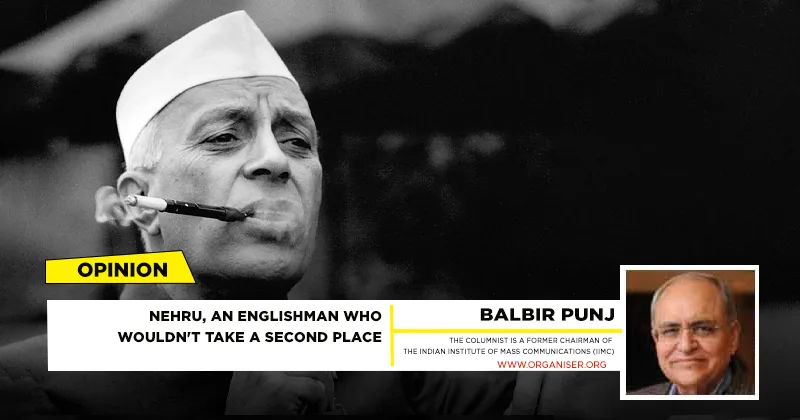
November 14 was the 135th birth anniversary of India’s first Prime Minister, Pandit Jawaharlal Nehru. How will history judge him? Nehru was a patriot who spent nearly nine and a half years in prison for the country’s freedom. This must have been a challenging ordeal, especially for someone born into a wealthy and privileged family. Recently, his descendant and Congress scion, Rahul Gandhi, said in an article that British colonial rule in India became possible because of the support extended to it by certain sections of Indians.
Rahul is right on this count – because those who served the colonial empire also included his ancestors. Successive generations of Nehru’s had undoubtedly worked for the British, strengthened the empire in its formative stage, and made enormous wealth. The Nehru family owed fabled riches and exalted status to its subservient role to the colonial powers over several generations.
According to the official Congress Party website, “Motilal Nehru’s grandfather, Lakshmi Narayan, became the first Vakil of the East India Company at the Mughal Court of Delhi. His father, Gangadhar, was a police officer in Delhi in 1857 when it was engulfed by the Mutiny.” What Congress’s official website and colonial history terms as ‘mutiny’ is known as the ‘First War of Independence’ in the Indian vocabulary.
The website further says, “When the British troops shelled their way into the town, Gangadhar fled with his wife Jeorani and four children to Agra, where he died four years later. Three months after his death, Jeorani gave birth to a boy who was named Motilal… Motilal Nehru passed the matriculation examination from Kanpur and joined the Muir Central College at Allahabad… he soon attracted the attention of Principal Harrison and his British colleagues…”
Indians lost control of Delhi after the East India Company defeated the Marathas in the Second Anglo-Maratha War in 1803-05. After that, the titular Mughal emperor, a pensioner of the Marathas till then, happily started accepting hand-outs from the British. Nehru’s ancestors served both the Mughals and the East India Company.
While Nehru’s commitment to India is unquestionable, his education and familial background often led him to view the country and its diverse challenges through a colonial lens. In 1949-50, despite widespread United Province (Now Uttar Pradesh) governmental and then societal support for the reconstruction of the Ram Mandir in Ayodhya, it was Nehru’s mindless opposition to the Ram janmabhomi reconstruction that was responsible for keeping the issue hanging fire for over seven decades.
Under pressure from Gandhiji and Sardar Patel, Nehru’s cabinet approved the reconstruction of the Somnath Mandir in November 1947. However, following the demise of these two stalwarts, Nehru’s attitude towards the Mandir project changed utterly. He dropped the mask, and his opportunistic face and colonial mindset were out in the open. Nehru objected to the Somnath Mandir reconstruction (something he had approved earlier) and tried to prevent the then-President Dr Rajendra Prasad from attending the fabled Mandir’s inauguration.
Because of the colonial perspective, Nehru often viewed Hindu traditions & practices with contempt. At a conference on architecture in Delhi on March 17, 1959, he stated, “Some of the temples of the South, however, repel me despite their beauty. I can’t stand them. Why? I do not know. I cannot explain that, but they are oppressive; they suppress my spirit. They do not allow me to rise; they keep me down…” Those under the influence of the ‘Nehruvian consensus’ obviously opposed the Janmabhoomi movement; now, they find it difficult to reconcile to the reconstruction of the Ram Mandir at Ayodhya.
In a letter dated May 18, 1959, addressed to the country’s Chief Ministers, Nehru labelled the Hindu community as communal, arguing that “…Muslims in India cannot, like things, adopt aggressive attitudes… It is only when they become afraid that desperation seizes them, and then they may act wrongly and aggressively… responsibility for communal peace rests on the majority community, that is, the Hindus. If there is a breach of this peace, I would start with the presumption that Hindu communal elements have caused it.” This was despite the fact that India had been partitioned on religious grounds under his watch. How wrong and biased Nehru’s understanding of India’s communal problem was subsequently revealed during the persecution of Hindus in Muslim-majority Kashmir during the 1980s-90s. The Muslims in the valley acted menacingly against the local Hindus without any provocation whatsoever. To date, the bulk of Kashmiri Hindus are refugees in their own country because radical Islam’s terror spectre still looms large in the land of their ancestors.
In another instance, when a Congress MP introduced a bill in the Lok Sabha on April 2, 1955, to impose a nationwide ban on cow slaughter—a measure supported by a significant section of the Congress Party—Nehru threatened to resign if it was passed. Sartorial and food preferences are strictly matters of personal choice and taste. In Nehru’s case, however, his food options further underline the hypocritical aspect of his personality. Not only was Nehru opposed to a ban on cow slaughter, beef was his preferred food.
The American analyst and former CIA official Bruce Riedel has corroborated this in this declassified document about the 1956 visit in his book ‘JFK’s Forgotten Crisis: Tibet, the CIA, and the Sino-Indian War’. Riedel writes, “It turned out that the leader of the world’s largest Hindu country liked filet mignon (beef) & enjoyed Scotch as long as it was all private. Nehru’s daughter Indira shared his food preferences.” His disdain for Hindu traditions extended to tacitly endorsing Christian missionary conversion activities under the guise of constitutional freedoms, as evidenced in a letter he wrote to Chief Ministers on October 17, 1952.
Nehru’s worldview, shaped by foreign influences, often disconnected him from ground realities. His hatred towards Jammu & Kashmir Maharaja Hari Singh played a significant role in complicating the Kashmir issue, leading to its internationalisation and enabling Pakistan’s occupation of a third of the region. The clincher on who delayed accession of Kashmir is in Nehru’s speech dated July 24, 1952, in Lok Sabha, where he mentioned that the question of accession “came up before us informally round about July or the middle of July (1947)” and further stated that “we had contacts with the popular organisation there, the National Conference, and its leaders, and we had contacts with the Maharaja’s Government also”. In the same speech, Nehru asserted his stance— “the advice we gave to both was that Kashmir is a special case, and it would not be right or proper to try to rush things there”.
Nehru’s strategic myopia was not limited to Kashmir. He ignored warnings from leaders like Sardar Patel regarding China’s expansionist policies. Nehru supported China’s claim to a permanent seat in the United Nations Security Council, forfeiting India’s opportunity. Pt. Nehru’s infamous letter to Chief Ministers, dated August 2, 1955, states, “Informally, suggestions have been made by the United States that China should be taken into the United Nations but not in the Security Council, & India should take her place in the Security Council. …We cannot, of course, accept this as it means falling out with China, and it would be very unfair for a great country like China not to be in the Security Council.” This kind of decision backfired during the 1962 Sino-Indian War, which resulted in a humiliating defeat and the loss of 38,000 square kilometres of Indian territory. The debacle left Nehru deeply shaken, and he passed away on May 27, 1964.
India inherited a drained treasury after independence. Nehru’s Soviet-inspired socialist model further stifled economic growth, leading to widespread poverty, hunger, and corruption in the 1970s-80s. By 1991, India had to mortgage its gold reserves to service its debts. However, recent economic reforms and progressive policies have allowed the country to overcome this stagnation in recent decades.
History will credit Nehru for leading a fragmented India (over 560 princely states) through a tumultuous era following Partition. Yet, it must also be noted that Mahatma Gandhi’s intervention facilitated his rise to power. The 1946 Congress presidential election is a testament to this, where Gandhi overturned the majority’s decision in favour of Sardar Patel, paving the way for Nehru’s ascension. Contemporary journalist Durga Das observed that Gandhi did so because he viewed Nehru as an “Englishman” who would “not take second place”.







Comments