




Why did wealth creation in Bharat remain resilient through millennia? Alakshmi or Sree Lakshmi – wealth or well being – which will you choose? Why is Bharat’s ancient wisdom needed most in a world of chaos, greed, and hyper-uncertainty?
The Verse
One of the most meaningful verses from Brihadaranyaka Upanishad, with in-depth meaning embedded in it is mentioned in Chapter 2 (4.2)
“अमृतत्वस्य तु नाशास्ति वित्तेन। “Meaning – Immortality cannot be achieved by wealth.
The Context
As soon as humans are born or emerge on the planet, they are first taught to Sangrah (collect). The imminent fact is that as soon as one is born, it’s certain that one has to leave the planet. But in the process of life, one tends to celebrate every birthday believing that one is growing older or wiser without thinking, that one is going closer to one’s death.
One performs deeds, acts and actions, and collects the wealth as if one will live forever, or will leave the wealth acquired for the offspring so that the offspring will live comfortably and happily post one is gone. Does that ever happen? There is a very famous Hindi quote that sums it up well.
‘पूत कपूत तो का धन संचय, पूत सपूत तो का धन संचय’
Translation: Why accumulate wealth for an unworthy son; why accumulate wealth for a worthy son?
A worthy son does not need one’s wealth that is left behind as one builds one’s destiny with hard work and character whilst for an unworthy son, no amount of wealth is enough for his well-being and one can never be sure that such wealth will last a lifetime. (Here son means child).
Deepawali signifies a lot of things and is witness to many milestones through time immemorial, but one thing that Deepawali surely nudges one is to re-think the way wealth is acquired, its utility to society and its effect and impact on the offspring.
Historical Background
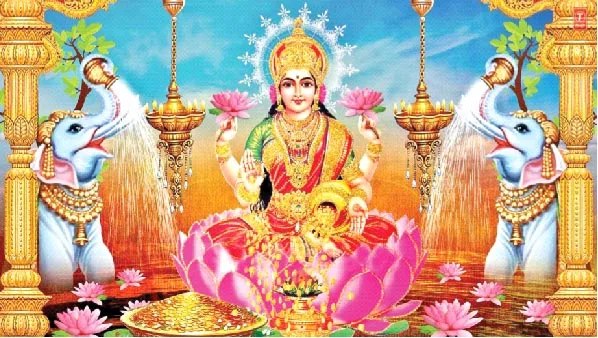
Maa Lakshmi finds her name originated from the word Lakshaya, which means the goal, the aim, the desired destination. Hence just having wealth or monetary prowess can’t be the only aim, can’t be the only goal, can’t be the only destination, though many think so.
Once Rishi or sage Durvasa visited Indra (the king of Heaven or symbolically our Indriyan or Senses, that rule everything) and gifted him a lotus garland, that represents spiritual enlightenment, beauty, fertility, purity, prosperity and eternity or all that Goddess Lakshmi represents. Indra put the garland around the neck of elephant Airavat, the favourite elephant of Indra.
In ignorance, the elephant turned his head and the garland fell on the ground and the same was stomped by it, destroying the wellness of heaven. Slowly the entire heaven started to turn pale and prosperity started to vanish. Weakness amongst Gods gave a quick and immediate rise to demons. The Gods approached Shree Vishnu to find a solution. He suggested that Samudra Manthan or ocean should be churned so that elixir as well as prosperity can be restored.
Significance of Auspicious Deepawali
On the auspicious day of Deepawali, which falls on the darkest night of the year, Mata Lakshmi re-emerged from the Samudra Manthan bringing prosperity, wellness, righteousness, splendour, strength and spiritual growth back in the universe. Simple lesson from this narration is that wealth should be protected, respected and cared, whether it’s a wealth of knowledge, or wealth of health or wealth in monetary terms.
Wealth creation can quickly turn from Sree Lakshmi or Shubh Lakshmi (stable wealth, leading to wellness, prosperity, Dharma) to Alakshmi (money prowess that enhances the enemies, enhances the confrontation and conflict in the household, leads to ailments and illness, creates fear and anxiety of being lost or stolen, finally reducing the life span inadvertently.)
These lessons on wealth have been relevant and will remain relevant for many millennia. Like the above story of Goddess Lakshmi, Sanatan has wisdom framework for business and prosperity that has been pertinent millennia back and are relevant in today’s day and era as well –
Vidur Neeti for Business
Focused – Unbiased Actions –
“यस्य कृत्यं न विघ्नन्ति शीतमुष्णं भयं रतिः”
Meaning – If one wishes to succeed in life and work, one needs to be unbiased and cut all emotional attachments.
For a business to grow, the business needs to look at the entire activity dispassionately with objectivity away from love, hate, fear or affluence and focus on facts, numbers and reality.
Committed to Tasks and Time Management –
“निश्चित्वा यः प्रक्रमते नान्तर्वसति कर्मणः”
Meaning – A wise person, once committed, continues to pursue the task relentlessly and doesn’t change goalposts now and then.
He further doesn’t take long breaks in between and wastes time. Once a break is taken, the task slips and the mind seeks leisure over work.
Where there is commitment and focus, that aspect grows. Business has to be done in a manner where there is the right allocation of time, capital and resources. If any of it is too dispersed, all businesses suffer.
Essence of Success –
षडैव तु गुणाः पुंसा न हातव्या कदाचन । सत्यं दानं अनालस्यं अनसूया क्षमा धृतिः॥
Meaning – Six qualities should never be abandoned by a person, including a business person. Truthfulness, giving, not being lazy, not finding fault even if something is bad, forgiveness and determination or courage.
- The foundation of business can never be built on lies and falsehood
- When one gives around one’s ecosystem, the ecosystem supports the business
- Laziness is an aspect of Tamas or negative extreme attachment. Thus one should look at an equilibrium and a balanced approach in business. During extreme emotions, one should avoid making any specific business decisions *Finding faults only perpetuates negative thoughts in oneself. Hence, even if something is bad, one should avoid it and if it’s interfering with one’s business or growth, one should cut it rather than bitch about it.
- People change with circumstances. As circumstances change, people’s company changes, people’s ages change, the person completely changes. Thus, if one is regretful and apologetic, one should forgive the person, but not trust the person blindly again. Forgiveness removes the burden from the forgiver’s back, but trusting yet again should be thought through deeply.
Courage and determination to face all odds should always be there with business. The environment is meant to change and thus non-acceptance of it or running away from it can only worsen the situation rather than improve it.
Chanakya Neeti for Entrepreneurs Chanakya Neeti 4.18 – The Correct Approach –
कः कालः कानि मित्राणि को देशः कौ व्ययागमौ । कश्चाहं का च मे शक्तिरिति चिन्त्यं मुहुर्मुहुः ॥
Meaning – One should consider again and again the following: the right time, the right friends, the right place, the right means of income, the right ways of spending, and from whom you are derive your power.
For entrepreneurs, one should have the right business model, the right set of suppliers, distributors, employees and the right partners for success. Consider again and again with whom you are about to start your partnership venture with.
Chanakya Neeti 2.13 – Learning Everyday
अबन्ध्यं दिवसं कुर्याद्दानाध्ययनकर्मभिः
Meaning – Not a single day should pass without your learning a verse, half a verse, or a fourth of it, or even one letter of it; nor without attending to charity, study and other pious activity.
In an entrepreneur’s life, every day is a new learning, a new lesson, a new initiative and no day should go wasted when an entrepreneur has not taken a new action or improvised the previous one.
Chanakya Neeti 16 -06 – Actions matter, not position
गुणैरुत्तमतां याति नोच्चैरासनसंस्थितः। प्रासादशिखरस्थोऽपि काकः किं गरुडायते॥
Meaning – Greatness comes from good qualities and not from a high position. A crow doesn’t become a Garuda (the chief of the feathered race) just by sitting on the top of a palace. In the same way, an entrepreneur should never mind doing any job, not thinking that one is the CEO or COO and hence can’t do certain things. Ego and Ahankar should never touch the minds of entrepreneurs.
















Comments