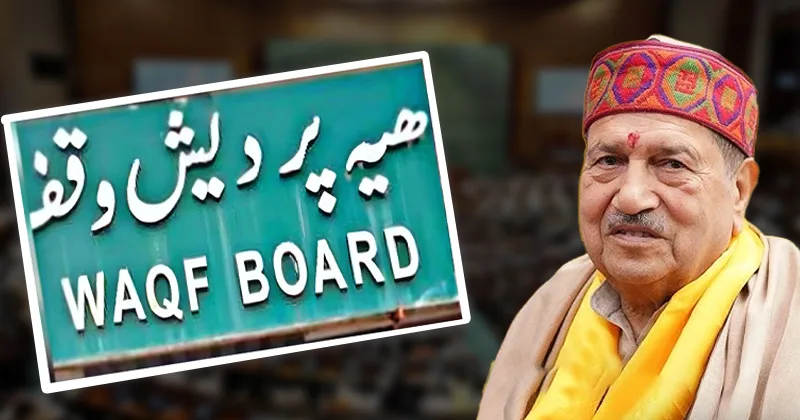
NEW DELHI: Dr Indresh Kumar, Patron of the Muslim Rashtriya Manch has defended the Waqf Amendment Bill and said that there is a growing perception in the Muslim community that the Waqf Boards in the country “operate like a mafia” and have become a “hub of corruption”.
He said this in an interview with The Indian Express. He also underlined that the Waqf Amendment Bill is aimed at ensuring transparency and accountability in the functioning of the Waqf Boards.
“In this country, any dispute pertaining to land is decided by the courts, but when it comes to disputes involving Waqf properties, the (Waqf) Board is the sole arbiter. If the Board decides against your case, that is the final word, and many properties have been inappropriately occupied as a result. So, there is an increasing opinion within the Muslim community that Waqf Board is operating more like a mafia and becoming a hub of corruption”.
On the concerns over the proposal to have non-Muslim members on Waqf Boards, he said, “It’s not just Muslims who donate, but even members of other religions donate to these Boards, then why should there not be representation of other religions on them?”
“There should be more awareness about these objectives, and people should be encouraged to provide their feedback to the Parliamentary committee on this. Anyone attempting to spin a false narrative that the government is trying to use this Bill as a backdoor entry into the workings of the Board should be strongly countered,” he said.
“There are people who try to instigate everyone (against the Bill)… Their lies should be exposed and people should be told that their objective is to enslave you to vote bank politics,” Kumar said.
It is to be noted that the bill was tabled by the Narendra Modi-led NDA Government in the Lok Sabha during the Budget Session. The Muslim Rashtriya Manch has supported the Bill before the Parliament committee.
Key changes proposed in enhancing transparency, accountability and inclusivity
The bill, which includes around 40 amendments to the existing Waqf Act of 1995, seeks to address concerns over the misuse of Waqf properties and the arbitrary powers held by Waqf Boards, while ensuring greater representation for women and non-Muslim members in Waqf institutions.
One of the central amendments in the bill is the introduction of mandatory verification for all Waqf property claims. This process, which involves the district magistrate, aims to prevent the misuse of properties and ensure that only legitimate properties are designated as Waqf. The bill stipulates that all Waqf properties must be registered with the District Collector’s Office, thereby ensuring an independent and transparent evaluation process.
The bill also clarifies what constitutes Waqf property. Government properties that were identified or declared as Waqf properties, either before or after the Act’s commencement, will no longer be recognised as Waqf properties. The District Collector will have the final say in determining whether a property is Waqf or government land, and their decision will be reflected in the revenue records and reported to the state government. This change shifts the authority from the Waqf Tribunal, which previously had exclusive power over such decisions, to the district administration, thus enhancing government oversight.
Another significant amendment is the removal of provisions allowing properties to be considered Waqf based on oral declarations. Properties without a valid waqfnama (Waqf deed) will be treated as suspect or disputed until the District Collector makes a final determination. This measure aims to reduce disputes and enhance the legitimacy of Waqf properties.
The Waqf (Amendment) Bill, 2024, introduces enhanced dispute resolution mechanisms. Disputes regarding Waqf Board decisions can now be appealed to high courts, providing a more robust legal framework for resolving conflicts. Furthermore, the bill grants the Union Government the authority to order audits of Waqf properties at any time. These audits will be conducted by auditors appointed by the Comptroller and Auditor-General of India or designated officers, ensuring thorough and impartial oversight.
A key focus of the bill is on increasing representation and inclusivity within Waqf institutions. The bill mandates the inclusion of at least two women and two non-Muslim members on the Central Waqf Council and state Waqf Boards. The Chief Executive Officer (CEO) of a Waqf Board, who was previously required to be Muslim, can now be a non-Muslim, provided they hold a rank not below that of a Joint Secretary to the State Government.
The Central Waqf Council, under the new bill, will consist of a Union Minister, three Members of Parliament, three representatives of Muslim organisations, and three Muslim law experts. Additionally, two former judges from either the Supreme Court or High Courts, four individuals of national repute, and senior union government officials will be part of the Council, further diversifying its composition.