





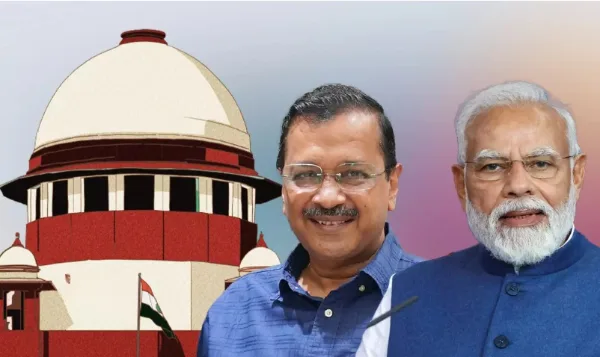
AHMEDABAD: A Gujarat trial court on Monday rejected a plea by Aam Aadmi Party (AAP) leader Arvind Kejriwal, who sought to quash the summons issued in a defamation case related to his comments on Prime Minister Narendra Modi’s academic qualifications. The defamation case was filed by Gujarat University, which claimed that Kejriwal’s remarks about PM Modi’s degree were defamatory and had damaged the university’s reputation. The Court’s decision came after a similar plea filed by AAP Minister Sanjay Singh had already been dismissed.
The defamation case revolves around Kejriwal’s public remarks, made during press conferences and public forums, where he questioned the validity of PM Modi’s degree from Gujarat University. These comments were perceived by Gujarat University as derogatory and damaging, prompting its registrar, Piyush Patel, to file a criminal defamation suit against both Kejriwal and Sanjay Singh.
The controversy initially arose in 2016 when Kejriwal, advocating for transparency, urged the Central Information Commission (CIC) to order the disclosure of details regarding PM Modi’s academic qualifications. In response, the CIC directed Delhi University and Gujarat University to release the information. However, the Gujarat High Court intervened, staying the CIC’s order and preventing the release of Modi’s degree details. Kejriwal’s remarks, which continued to question the legitimacy of the degree, eventually led to a defamation case by Gujarat University, which viewed his comments as an insult to the institution and an attack on its credibility.
When the Gujarat court considered Kejriwal’s plea, it refused to interfere, citing the consistency in its approach, as Sanjay Singh’s similar plea had already been rejected. The court maintained the position it had taken in Singh’s case, stating, “Having regard to that view, we would not like to entertain the present plea. The same is dismissed.” This decision affirmed the lower court’s right to proceed with the defamation proceedings against Kejriwal.
The crux of the defamation complaint lies in the accusation that both Kejriwal and Singh made defamatory remarks that not only insulted the prime minister but also disrespected the judiciary and Gujarat University. By questioning the authenticity of PM Modi’s degree, they were seen as attacking not just an individual but also an educational institution’s integrity. The university argued that such remarks led to disrespect and defamation, further fueling the controversy.
Kejriwal’s defense, led by Senior Advocate Dr. Abhishek Manu Singhvi, centered on the argument that Kejriwal had merely raised a question about why the university had not published PM Modi’s degree. Singhvi suggested that the remarks were not intended to defame but to seek transparency. He further argued that, if any defamation had occurred, it would be for PM Modi himself to file a criminal defamation case rather than the registrar of Gujarat University. Singhvi asserted that the involvement of the university was unwarranted, as the comments were directed toward the prime minister and not the institution itself.
During the hearing, Singhvi expressed Kejriwal’s willingness to offer a word of regret for his comments, seemingly in an attempt to resolve the matter. However, this was strongly opposed by the Solicitor General, who accused Kejriwal of repeatedly making reckless statements and then attempting to apologize after causing damage. He referenced past incidents, such as Kejriwal’s remarks against the late BJP leader Arun Jaitley, to illustrate a pattern of behavior. The Solicitor General emphasized that Kejriwal must exercise more caution in his public statements.
In the end, Singhvi conceded, and the Gujarat court dismissed the matter, aligning its decision with the previous ruling in Sanjay Singh’s case. The court did not engage with the merits of the defamation allegations, instead focusing on maintaining judicial consistency.
The case highlights issues of defamation, disrespect toward public institutions, and the indirect insult of a sitting prime minister. Kejriwal’s remarks were seen not only as a direct challenge to the prime minister’s credibility but also as a broader attack on the educational and legal systems tasked with upholding the legitimacy of academic degrees and protecting the dignity of individuals in public office.















Comments