






The Pashtun Tahafuz Movement was established in 2014, immediately after the Pakistan army commenced operations against the people of Waziristan. Eight university students, including Manzoor Ahmad Pashteen demanded removal of landmines from the area. In 2028, protests against the illegal killing of Naqeebullah Mehsud in Karachi city by a Punjabi police officer. Mazoor Ahmad Pashteen received his primary education from his village in South Waziristan. When the army sowed the seeds of breaching social contract in 2005 by kicking off an operation against militants, Manzoor’s family was forced to flee Waziristan for IDP refugee camps in Dera Ismail Khan District.
In 2007, his family once more fled their home town in 2007 and returned in 2008. In 2009, due to the military operation Rah-e-Nijat, his family was forced to flee South Waziristan for the fourth time. Later, he completed secondary education in Bannu’s army public school and high school in Karak. In 2016, he received his degree in Veterinary Medicine from Gomal University, Dera Ismail Khan. The Pashtun Tahafuz Movement was frequently stopped by the army and its supporters were incarcerated. The PTM war was totally ignored by Pakistani media accusing its leaders of furthering foreign agenda. The PTM became popular in 2028, when it started a justice campaign for Naqeebullah Mehsud. The Pashtun Tahafuz Movement is the only well-branded together movement that created awareness within the Pashtun communities about the atrocities and war crimes of the Pakistani army in the periphery of Khyber Pakhtunkhwa, formerly known as Federally Administered Tribal Areas (FATA).
The PTM EU chapter has been playing a significant role in promoting the narrative of the organization. Expert and political worker, Imal Katswal, is an active member of PTM in Douai, France contributed his professional experience, intellectual tips-off and ideas to make PTM members vigilant and updated. He worked and supported Pashtuns right movements in Belgium from 2009-2013, before shifting to France. However, he participated in PTM protests and rallies in Europe to draw the attention of international community towards the forced disappearances and torture of its workers and leaders by the agencies. The PTM used social media as a bridge of communication in the EU and demanded the release of missing persons and an end to extra-judicial killings of Pashtuns, stopping humiliation of passengers at security checkpoints, and removal of landmines. Dr. Madiha Afzal (February 7, 2020) interviewed leaders of PTM for her book in Lahore, and highlighted the PTM demand in her book and noted that the movement noted grave human rights violations by Pakistani military against Pashtuns in Pakistan. On January 13, 2018, Naqibullah Mehsud was kidnapped and killed in a fake police encounter in Karachi. The PTM is the latest manifestation of decades of Pashtun protest against state brutalities. Its origin can be traced back to 2014 when student leaders of Gomal University in the Khyber Pakhtunkhwa (KP) province were propelled into activism to protect the rights of Pashtuns.
The PTM presented its demands during the Pashtun Long March in 2018: Arrest of Rao Anwar who killed Naqeeb, Establishment of Truth and Reconciliation Commission, interception of forced disappearances, and removal of landmine from Pashtun regions. All these points, Muhammad Irfan Mahsud (April 2, 2024) has noted in his research paper (The emergence of nonviolent nationalist movement among the tribes of Waziristan in Pakistan) ‘contributes to defend the Pashtun identity and rights in connection with NS MT, that is to say to achieve tribesmen full equality with their fellow citizens in Pakistan. According to the PTM narrative, (The emergence of nonviolent nationalist movement among the tribes of Waziristan in Pakistan. Muhammad Irfan Mahsud (April 2, 2024) with help of religious political parties in the 1980, President Zia relied on tribesmen’s religious feeling to launch jihad against the Soviet Union in Afghanistan. For PTM this decision of Zia-ul-Haq damaged social and political stratification of Waziristan.
In 2019, PTM leader Arman Loni was killed by the police in Loralai. In 2019, following the Kharqamar incident, a clash between the army and PTM workers left 13 dead. On January 27, 2020, Manzoor Pashteen was arrested by Peshawar police on allegation of sedition. On March 28, 2021, Manzoor Pashteen was arrested in Kohat, while Mohsin Dawar was arrested in Karak. On December 7, Islamabad High court granted seven days remand for Manzoor. The leader of the Pashtun Tahafuz Movement (PTM), Manzoor Ahmad Pashteen has called for a large gathering of Pashtuns on October 11, 2024 to generate awareness among Pashtuns of Pakistan and Afghanistan and draw attention of the international community towards the policies, attitude and so-called military operations of Pakistani army in Waziristan, and other areas of Khyber Pakhtunkhwa and Baluchistan provinces. In the last several years (mostly between 2007 and 2017), the Military carried out several operations in South and North Waziristan, Dir, Swat, Malakand and Khyber Agency, which resulted in the killing of thousands, men, women and children and destruction of infrastructure.
On March 14, 2022, the inaugural meeting of Jirga was held in Bannu, a city in Khyber Pakhtunkhwa. The Jirga of political leaders in Khyber Pakhtunkhwa on June 26. 2024 also condemned the new so-called military operation. On December 4, 2023, Manzoor Pashteen was attacked and arrested by the Pakistani army. When Gilaman Wazir was attacked in broad daylight in Islamabad and later died in hospital on July 10, 2024, Pashtuns in the whole world were alerted by the killings and torture policies of the army. Fazal Rahman Afridi, a known human rights activist and member of PTM Europe authenticated the destruction of 200,000 homes and 25,000 commercial sites in a single operation which resulted in the displacement of more than six millions people.
The mass killing of innocent students at a school in Peshawar on December 16, 2014 by so-called unknown attackers that bore the hallmarks of state proxies fashioned a good opportunity and an iron in the fire for the army to attack North and South Waziristan and several other areas along the Durand line. War criminal General Raheel Sharif wanted to kill innocent women and children in Waziristan. Later on, the army established their own courts to execute their darling militants. Nawaz Sharif and General Raheel forged a consensus to come down hard on the terrorists through a concerted national effort, and later on, it was changed into a so-called twenty-point National Action Plan (NAP) approved by Parliament on December 24, 2014. Pakistani military courts challenged the authority of the country’s judicial system, and awarded death sentences to people in their custody. On November 24, 2015, the President amended the army act, and allowed intelligence agencies to detain civilians even before the passing of the 21st Amendment. The army was authorized to detain, kill, and torture suspects, and try them in military courts where no human rights organizations or journalists were allowed to cover the court proceedings. Dr. Muhammad Zubair, (January 28, 2019) in his article noted the changing shape of the army act that authorized military courts to hold in-camera proceedings and keep identities of individuals associated with the cases secret.
The military courts also became a part of Pakistan’s National Action Plan (NAP); along with the Zarb-e-Azb, these three were seen as Pakistan’s primary counter terrorism strategy. While the Army is still continuing with the Zarb-e-Azb, the achievements and failures of the NAP have become a political issue during the recent months, whereas the military courts technically came to an end on January 7, 2017. According to media reports, close to 270 cases were tried by the military courts; the majority of whom (approximately 160) were sentenced to death and the rest to prison. On January 12, 2019, Mehdi Hasan, Chairperson of the Human Rights Commission of Pakistan (HRCP) expressed grave concern at the government’s decision to table a bill in favor of extending the tenure of military courts, which were otherwise due to end their term. In the aftermath of the December 16 Peshawar school attack, Pakistan also lifted a seven-year-long moratorium on death penalties. The military, responding to public anger over the Peshawar killings, was moving fast. The military promised that it will not abuse its new powers by prosecuting politicians, journalists or rights activists, as happened in the 1980s. The mandate of the new courts was set to expire after two years, and the trials were subjected to civilian oversight. Journalist Imad Zafar once argued that the political system has been the target of the military establishment propaganda machine.
Former army chief, General Bajwa, exhibited special interest in the incarceration of PTM leader Ali Wazir. He was incarcerated on December 31, 2020 in several fake cases that accused him of hate speech, sedition and inciting the public against the state. In November 2021, Pakistan’s Supreme Court granted Wazir post-arrest bail in one of these cases, but in view of the other cases against him, he remained incarcerated. The ISI tried to eliminate Manzoor Pashteen but due to fear of mass mobilisation of Pashtun across the country, the plan was procrastinated. The point is that the Inter-Service Intelligence (ISI) lacked adequate intelligence information collection experience from remote areas of Baluchistan, Sindh and Khyber Pakhtunkhwa, while lacked trained manpower, failed to understand modern technology, it lacked proper intelligence sharing approach with policymakers, and lacked a technique of actionable intelligence. The PTM contributed significantly to change the narrative of these agencies.
Torture and sexual abuse policies of Pakistan’s intelligence agencies, military establishment and police in large parts of Khyber Pakhtunkhwa have become an unwritten law, where thousands of innocent and powerless PTM workers and their families have lost their lives. Human Rights Watch (HRW) called on Pakistani lawmakers to speed up the adoption of a bill that criminalizes the use of torture; a practice that the rights group said was widespread in Pakistan. In view of this illegal business, the ISI and the army lost their professional capabilities and remained hanging in the air. The ISI lost public confidence and its roots were emaciated in civil society. All civilian and military agencies have a specific mind set, their sectarian affiliation and dearth of electronically trained manpower, lack of professional surveillance approach, and the absence of a proper intelligence-sharing culture raised serious questions about their credibility. The Pakistani military establishment and its secret agencies have been using jihadists in Waziristan to achieve their strategic goal since years. The lack of credibility of ISI and Military Intelligence has been a longstanding concern in civilian circles.
Known research scholar and journalist, Daud Khattak (Foreign Policy, April 30, 2019) in his well-written analysis of PTM noted important aspects of PTM’s challenges in demanding justice for families whose relatives were kidnapped by the army. However, BBC journalist, M. Ilyas Khan (Uncovering Pakistan’s secret human rights abuses, M Ilyas Khan, BBC News, Dera Ismail Khan, June 2, 2019) authenticated atrocities of Pakistani army: “In May 2016, an attack on a military post in the Teti Madakhel area of North Waziristan triggered a manhunt by troops who rounded up the entire population of a village. An eyewitness who watched the operation from a wheat field nearby and whose brother was among those detained, told the BBC that the soldiers beat everyone with batons and threw mud in children’s mouths when they cried. However, Maj General Asif Ghafoor’s irresponsible tweets, comments and conferences against the Pashtun nation left a black contemptuousness blot on the face of Pakistani army that the army only represents a club of Punjabi Generals. Gen Asif Ghafoor acted like a vandal and warlord that put the army in ordeal by challenging the Pushtun nation of Pakistan. His resentment against Pashtuns, and his toxic statements issued from the platform of ISPR could not attract civil society in Pakistan.
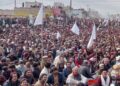
On October 11, 2024, the Pashtun Tahafuz Movement organized a grand gathering (Pashtun Jirga) to expose war crimes of Pakistan’s rogue army and intelligence agencies in Khyber Pakhtunkhwa including North Waziristan, South Waziristan, Swat and Khyber Agencies. The Jirga highlighted enforced disappearances by the ISI and military intelligence agencies, security concerns, political autonomy, and socioeconomic challenges. In 2022, the Bannu Jirga discussed the Pashtun rights, unity and security challenges inflicted by Pakistan’s rogue army and law enforcement agencies. However, the Khyber Jirga also focused on the reorganization of the Pashtun nation. Pakistani police killed members of PTM on October 9, 2024, but the leadership of PTM intensified efforts to unite the nation and vowed to manage the Jirga. However, the Jirga declared that Pashtun were victims of Pakistan’s illegal military operations and the US so-called war on terrorism in Afghanistan that caused the disappearance of over 10,000 young Pashtuns by Pakistani army and militias. On June 23, 2024, at the funeral of Usman Khan Kakar advocate in Muslim Bagh, Mahmood Khan Achakzai declared to manage a Pashtun Jirga in three months to address challenges faced by the Pashtun nation.
Analyst Najib Azad (The PTM’s October 11 Gathering: A Turning Point for Pashtun Rights.OpEd Eurasia Review October 7, 2024) noted this historic gathering of all Pashtun tribes to expose war crimes of Pakistan army and the ISI during military operations. The Swat war crimes committed by the Pakistan army were also highlighted. “The PTM mobilization efforts underscored the ongoing struggle against systemic oppression, extrajudicial killings and massacre, kidnapping military oversight, and political manipulation that have historically plagued the Lar O Bar Afghans by the Pakistani establishment.” Despite challenges posed by the PTI government, Agencies and military establishment, PTM defeated the rogue army by organizing the Pashtun grand Jirga in Khyber Pakhtunkhwa Province. Before this historic Jirga, the Pakistani establishment banned the PTM. Journalist Abubaker Siddique noted in his article that the Pashtun Tahafuz Movement advocated the rights of Pakistan’s estimated 40 million Pashtuns. Since its emergence in 2018, the PTM has been accusing Pakistan’s rogue of war crimes and extrajudicial killings.
Moreover, on October 8, 2024, Amnesty International criticized Pakistani government on the banning of the Pashtun Tahaffuz Movement (PTM) and the use of anti-terrorism laws to target activists and peaceful protesters from minority groups is an affront on the rights to freedom of association and peaceful assembly in the country, said Amnesty International today. Amnesty International noted. “The listing of the Pashtun Tahaffuz Movement as a proscribed organisation, days ahead of their gathering scheduled on October 11, is part of a systematic and relentless clampdown by the Pakistani authorities on peaceful protests and assemblies by dissenting groups. Amnesty International’s Deputy Regional Director for South Asia, Babu Ram Pant, noted. Notwithstanding all their efforts to confine PTM to a limited space, thousands of people from various parts of Pakistan gathered at Jirga to discuss the challenges and pressures they have faced. On October 12, 2024, TOLONews reported the statement of Manzoor Pashteen that all Pashtun leaders have tired of Pakistan’s army war crimes. “Here, whether they are our scholars, our elders, or our tribal leaders, they are all your people; they have come to the field due to the taunts they have faced, give them reassurance.”
Moreover, Maulana Fazal Rahman said that two challenges have badly affected Pashtuns; one is insecurity and another is Huma rights. The Jirga decided to expel the army and all terrorist organizations from Khyber Pakhtunkhwa province. At the end of the Jirga, Manzoor Pashteen, while announcing this resolution, took an oath with all participants to make every effort to implement the Jirga’s decisions. TOLONews noted. Pakistan attacked PTM workers before their gathering. PTM leader, Malik Abdul Samad said today, again, they launched a severe attack in which two of our friends were martyred, and ten others were wounded in this attack.” He said. However, Manzoor Pashteen, said that Pakistani officials were not allowing Pashtuns to hold the Jirga in their regions. In the tail-end, among other demands, the Pashtun Jirga announced these demands: Withdrawal of security forces as well as “good and bad” Taliban from the region within two months. Relaxed trade regime with Afghanistan. Guarantee of the local population’s first rights to the region’s resources. Uninterrupted supply of cheap electricity. Steps to establish representative Jirga for the resolution of inter-tribal disputes. End to extortion. Resettlement of persons displaced by terrorism and military operations. End military interference in politics.
A complete ban on the practice of swara or wani and Formation of a judicial commission to inquire into the killings of PTM workers in the days leading up to the Jirga. (Pashtun Qaumi Jirga issues a 22-point declaration. By Islam Gul Afridi & Mohammad Najaf Abbas. October 14, 2024). On October 15, 2024, Umer Farooq reported to DAWN newspaper that the Chief Minister of Khyber Pakhtunkhwa vowed to meet all demands of PTM Jirga. During a provincial assembly session, Umer Farooq noted that ‘the chief minister said the jirga, held by the Pashtun Tahaffuz Movement in Jamrud area of Khyber tribal district, forwarded a 22-point agenda, which would be thoroughly discussed in the house by both the treasury and opposition members. “I declare that all matters related to the province will not only be completely discussed but will also be fully implemented,” he told the sitting, which was chaired by Speaker Babar Saleem Swati. Mr Gandapur said that it was the KP assembly that took the first significant step for the resolution of the province’s issues. He criticized the federal government over police action against PTM activists in Jamrud on October 10, insisting the action claimed four lives and left 10 injured. DAWN newspaper reported.










Comments