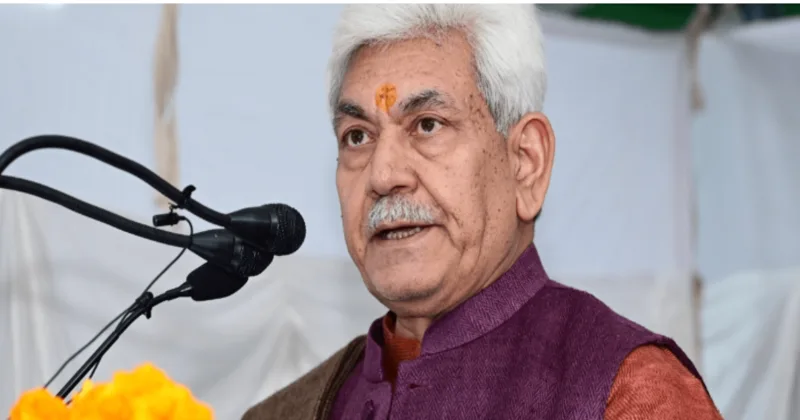
Senior Congress leader Ravinder Sharma, a lawyer by training, and a politician by choice, has strongly criticised the powers given to Lieutenant Governor Manoj Sinha to nominate five MLAs in Jammu & Kashmir. This will effectively raise the numbers in the legislature to 95 as elections to 90 single-member territorial assembly segments were concluded on October 1 evening. These nominated MLAs will have all legislative powers, including the right to vote, in all proceedings of the House.
What this means is that for an absolute majority in the Legislative Assembly, a party or any coalition of parties will need the support of 48 members. Since 90 is the number of elected members in the assembly, it was erroneously calculated that 46 will constitute an absolute majority. Mr Sharma, as also some National Conference (NC) leaders have termed the nomination of MLAs as “undemocratic and unethical’’, and a violation of the spirit of democracy.
Sharma says that this is an unfair advantage being conferred on the BJP as it virtually has five MLAs before the first vote has been counted. Incidentally, the counting is scheduled to be held o October 8 (Tuesday) and all results are expected to be out by 2 pm. It needs to be mentioned here that no single party is expected to get a clear majority. However, a pre-poll coalition of the NC-Congress parties is being viewed as a favourite. The BJP, on the other hand, is claiming that it will form the government and win over 35 seats.
What is the factual position regarding the nomination of MLAs in the legislature of a Union Territory (UT)? What are the rights given to nominated MLAs elsewhere outside Jammu & Kashmir? We will need to delve a bit deeper into the past to understand all this. For a beginning, we will need to see the birth of a legislature in a UT and when we start doing so, our attention is drawn to Puducherry which was the first UT to have a legislature.
The provision to create a legislature in a UT was made into a law by The Government of Union Territories Act, 1963. Therefore, at first glance, we can say that J&K LG Manoj Sinha is not the first person to exercise such powers which have existed in the Constitution for over six decades. There is nothing new in this law which was a constitutional amendment done by the Congress government. Under the Government of Union Territories Act, 1963, it was specified that the Puducherry legislature was to have 30 elected MLAs and three nominated MLAs. The UT Act, 1963, was moved in Parliament by then Union Home Minister Lal Bahadur Shastri and it was to create a legislature for the UT of Puducherry, he added.
Incidentally, the initial proposal of the Congress government of the time was to have a fully nominated legislature, with no provision for carving out single member territorial assembly segments. When the government of the day faced strong opposition, it was forced to have 30 elected and three (03) nominated MLAs.
In this manner, instead of having a 100 per cent nominated assembly which it had proposed, the Congress decided to have 10 per cent nominated legislators in a UT legislature. If the present Central government had followed the pattern established by the Congress government, it could have given Mr Sinha powers to nominate nine (09) MLAs as elections were held for 90 assembly segments in Jammu & Kashmir.
It is thus clear that the powers of the LG to nominate MLAs in a UT assembly are derived on a firm precedent set by the Congress in 1963. In July 2023, the Reorganisation Act, 2019, as a consequence of which J&K became a UT, was amended and powers to nominate five MLAs were given to LG, 60 years after the original law was passed. The Union Home Ministry led by Amit Shah was only following the Puducherry UT model at that time. The relevant provisions regarding nominated MLAs in UT legislature can be found in Article 239A of the Constitution.
BJP spokesperson Arun Gupta said this unnecessary noise and din being created by the Congress means is that its action is akin to cutting nose to spite the face. The Congress had introduced the provision of nominated MLAs in UT legislature and this provision has been there for over six decades now. However, the Congress is trying to mislead the masses by terming this due process of law as undemocratic and unethical, he pointed out.
Under Article 239A of the Constitution which was inserted in the Constitution by a Congress government in 1963, the legislature of a UT can be based partly on elected members and some of its members can be nominated. A legislature that is part elected, part nominated is an established norm and the Congress never uttered a word seeking any change in this existing law, Mr Gupta said. It has suddenly woken up now and is trying to mislead everyone by virtually disowning what it had done, he pointed out.
Quoting a similar provision in respect of Parliament, Mr Gupta said the President can appoint 12 members to the Rajya Sabha. These members enjoy the same voting rights as elected members, except that they can’t vote in the election of the President, he concluded.
If we go back further into the constitutional history, we find that after Independence in August 1947, Constitution was made and the states were categorised into those in Parts A, B, C, and D. A decade later, there was reorganisation of states and Parts C and D states were merged into Union Territories (UTs). These UTs were administered directly by the Central government then headed by the Congress. Subsequently, a committee was appointed under then Law Minister Asoke Kumar Sen to devolve more powers to the UTs and making recommendations regarding this.
The new article, Article 239A, gave Parliament power to create a legislature for Union Territories. The government’s proposal was similar to Article 240 of the Constitution, which had governed the administration of Part C states. This article also gave the central government the option to create a legislature that was fully nominated.
The proposal faced resistance in Lok Sabha and the members opposed the proposal of a wholly nominated legislature in the UTs. It was then that Shastri accepted his suggestion, and Article 239A provided that the legislature created for Union Territories could be either fully elected, or part nominated and part elected.
In 2018, the nomination of the three Puducherry MLAs was challenged before the Madras High Court. It was contended that the Central government did not consult the Puducherry government before nominating them to the Legislative Assembly. After the High Court upheld the nominations of the three BJP members, the case went in appeal to the Supreme Court.
In December 2018, a three-judge Bench of the apex court held that no consultation with the Puducherry government was required before nominating members. (K Lakshminarayanan v. Union of India and Anr, 2018)
The Court also considered whether the nominated members had the power to vote on the Budget and on the no-confidence motion against the government. It held that the 1963 law did not distinguish between elected and nominated MLAs – so, they enjoyed voting powers at par with elected MLAs, and were empowered to vote in no-confidence motions.