One Nation One Election to become a reality soon, Union Cabinet clears landmark proposal bill
July 13, 2026
  • Read Ecopy
  • Circulation
  • Advertise
  • Careers
  • About Us
  • Contact Us
Android AppiPhone AppArattai
Organiser
  • ‌
  • Bharat
    • Assam
    • Bihar
    • Chhattisgarh
    • Jharkhand
    • Maharashtra
    • View All States
  • World
    • Asia
    • Europe
    • North America
    • South America
    • Africa
    • Australia
  • Editorial
  • International
  • Opinion
  • RSS @ 100
  • More
    • Op Sindoor
    • Analysis
    • Sports
    • Defence
    • Politics
    • Business
    • Economy
    • Culture
    • Special Report
    • Sci & Tech
    • Entertainment
    • G20
    • Azadi Ka Amrit Mahotsav
    • Vocal4Local
    • Web Stories
    • Education
    • Employment
    • Books
    • Interviews
    • Travel
    • Law
    • Health
    • Obituary
  • Subscribe
    • Subscribe Print Edition
    • Subscribe Ecopy
    • Read Ecopy
  • ‌
  • Bharat
    • Assam
    • Bihar
    • Chhattisgarh
    • Jharkhand
    • Maharashtra
    • View All States
  • World
    • Asia
    • Europe
    • North America
    • South America
    • Africa
    • Australia
  • Editorial
  • International
  • Opinion
  • RSS @ 100
  • More
    • Op Sindoor
    • Analysis
    • Sports
    • Defence
    • Politics
    • Business
    • Economy
    • Culture
    • Special Report
    • Sci & Tech
    • Entertainment
    • G20
    • Azadi Ka Amrit Mahotsav
    • Vocal4Local
    • Web Stories
    • Education
    • Employment
    • Books
    • Interviews
    • Travel
    • Law
    • Health
    • Obituary
  • Subscribe
    • Subscribe Print Edition
    • Subscribe Ecopy
    • Read Ecopy
Organiser
  • Home
  • Bharat
  • World
  • Operation Sindoor
  • Editorial
  • Analysis
  • Opinion
  • Culture
  • Defence
  • International Edition
  • RSS @ 100
  • Magazine
  • Read Ecopy
Home Bharat

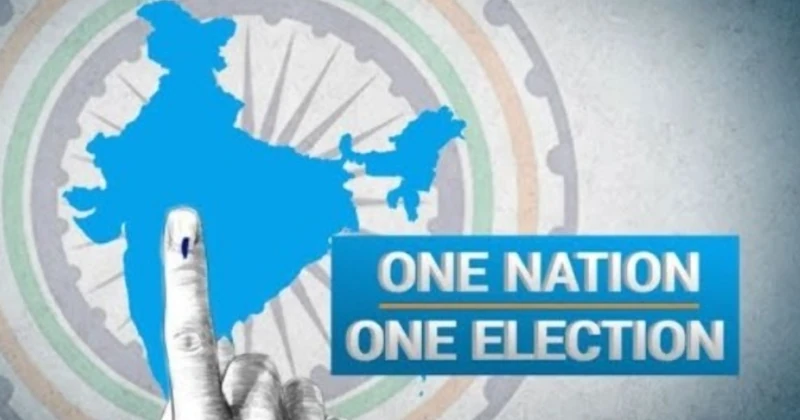
One Nation One Election to become a reality soon, Union Cabinet clears landmark proposal bill

The Union Cabinet has approved the 'One Nation, One Election' proposal to synchronise Lok Sabha and state assembly polls into a single schedule. The bill for this initiative, expected to be introduced in the upcoming winter session, follows a report by a high-level committee led by former President Ram Nath Kovind

WEBDESKWEBDESK
Sep 18, 2024, 03:45 pm IST
in Bharat
Follow on Google News
FacebookTwitterWhatsAppTelegramEmail

The Union Cabinet on September 18, in a landmark move approved the proposal for simultaneous elections across the country, referred to as ‘One Nation, One Election.’ The bill is expected to be introduced in the upcoming winter session of Parliament, marking a significant step towards synchronising Lok Sabha and state assembly elections under a single schedule.

This move comes after a high-level committee, headed by former President Ram Nath Kovind, submitted its report to the Cabinet, examining the feasibility and implications of holding simultaneous polls. The committee’s recommendations are expected to guide the legislative framework for the proposed electoral overhaul.

The idea of holding simultaneous elections—where voters across the country cast their ballots for national and state-level legislatures on the same day—has been discussed for decades. The system was prevalent in India during the early years of its democracy, with Lok Sabha and state assembly elections being held together in 1951-52, 1957, 1962, and 1967. However, this synchronisation was disrupted by the premature dissolution of several state assemblies and the Lok Sabha in 1970. Since then, elections have been staggered, with some held nearly every year, putting immense pressure on government resources.

The Modi government has advocated for the return of simultaneous polls since it came to power in 2014. In his Independence Day speech this year, Prime Minister Narendra Modi reaffirmed his commitment to the cause, calling frequent elections a hindrance to governance and progress. According to Modi, the Model Code of Conduct, enforced during elections, stalls development projects and impedes decision-making.

Frequent elections also burden the exchequer, requiring vast financial resources, and draw heavily on human resources, including deploying security forces and election officials. Advocates of ‘One Nation, One Election’ argue that synchronising elections will address these concerns, enabling better planning, governance, and implementation of policies.

The Kovind Committee Report: Key Recommendations

In 2023, the Modi Government constituted a high-level committee led by former President Ram Nath Kovind to explore the practicality of holding simultaneous elections. The committee submitted its report to President Droupadi Murmu in March 2024, and the report was later presented to the Union Cabinet for consideration. The committee’s findings and recommendations form the backbone of the legislative proposal expected to be introduced in Parliament.

The Kovind Committee made several key recommendations, including:

  1. Simultaneous Elections for National and State Legislatures: The committee proposed that elections to the Lok Sabha and state legislative assemblies should be held simultaneously to streamline the electoral process and reduce the costs associated with frequent elections.
  2. Common Electoral Roll and Voter ID: The committee recommended creating a unified electoral roll and voter ID card system, which would apply to national and state elections. This would eliminate discrepancies and improve the efficiency of the electoral process. The Election Commission of India (ECI), in collaboration with state election authorities, would oversee the implementation of this system.
  3. 18 Constitutional Amendments: The report outlined 18 necessary constitutional amendments to facilitate the transition to simultaneous elections. These amendments would address issues like the tenure of assemblies, early dissolution, and synchronisation of election cycles. While most amendments will only require parliamentary approval, a few will need ratification by at least half of India’s state assemblies.
  4. Two-Phase Election Proposal: In states where elections are held at vastly different times, the committee suggested a phased approach, with elections held in two stages to manage the transition smoothly.
  5. Implementation Group: To ensure that the recommendations are carried out efficiently, the committee suggested the formation of an Implementation Group tasked with overseeing the execution of the ‘One Nation, One Election’ policy. This group would coordinate with various stakeholders, including political parties, state governments, and the ECI.
  6. Governance Continuity: To prevent disruptions in governance, the committee proposed provisions for handling situations like a no-confidence motion or a hung parliament. It suggested exploring the concept of a “constructive vote of no-confidence,” where a government can only be ousted if the opposition has an alternative government ready to take over, ensuring continuity.
  7. Cost Savings and Governance Efficiency: One of the primary arguments favouring simultaneous elections is the significant reduction in election-related expenditure. The committee pointed out that holding frequent elections puts a strain on public finances and diverts essential resources. Simultaneous elections, it argued, would streamline these processes, saving time and money while allowing uninterrupted governance and development work.

In addition to the Kovind Committee’s report, the Law Commission of India is expected to release its findings on the subject. According to sources, the Law Commission will likely recommend a comprehensive approach that extends simultaneous polls to local bodies, including municipalities and panchayats. This would mean that starting in 2029, India could witness elections at all three levels of government—national, state, and local—being held simultaneously.

The Law Commission is also expected to propose mechanisms to ensure stability in cases where state assemblies or the Lok Sabha are prematurely dissolved. This would include provisions for a “unity government” to avoid the need for mid-term elections and ensure governance continuity.

Topics: Narendra ModiRam Nath KovindPM ModiModi governmentOne Nation One ElectionOne Nation One Election bill
ShareTweetSendShareSend
✮ Subscribe Organiser YouTube Channel. ✮
✮ Join Organiser's WhatsApp channel for Nationalist views beyond the news. ✮
Previous News

Myanmar border fencing; Government of India is fencing the root cause of year-long Manipur Conflict

Next News

Kerala: Hindus outraged over the Eid-Milad-un-Nabi celebrations in Pulamnthol Paloor Subramanian Swami temple 

Related News

UP CM Yogi Adityanath inaugurates 'Vriksharopan Mahayagya-2026' in Gorakhpur

‘Ek Ped Maa Ke Naam’: Uttar Pradesh creates green history by planting 40 crore saplings, CM Yogi hails achievement

As India expands its global partnerships, China grapples with growing political, military and economic challenges

Coup Fears in China? Why President Xi staying home while PM Modi expands India’s global diplomatic footprint?

PM Modi announces UPI integration with New Zealand’s payment network during historic visit

Bharat's timeless civilisation continues to transcend borders through its enduring culture, values, and soft power

Beyond Borders: Why Bharat’s ancient civilisational legacy still influences nations across Asia and beyond

New Zealand MP Parmjeet Kaur Parmar

New Zealand MP Parmjeet Kaur Parmar hails proposed FTA as ‘historic achievement’ ahead of PM visit

Why India needs a dedicated national award system to honour foreign heads of state and global leaders

Load More

Latest News

Great Nicobar is emerging as a strategic gateway that strengthens India's maritime reach while increasing pressure on China's Malacca Dilemma

Great Nicobar Project to boost India’s Indo-Pacific leverage, deepen China’s Malacca Dilemma: Report

PM POSHAN

PM POSHAN Scheme: Yogi government launches massive drive to recruit 3.53 lakh cooks in Uttar Pradesh

Uttar Pradesh: US national claiming special forces past held near Indo-Nepal border without passport

Rajaprasad Bije Ritual: Servitors Convey Mahaprabhu's Recovery Message to Gajapati Maharaja Divya Singh Dev

Odisha: Rajaprasad Bije ritual held at Puri Jagannath Temple; Gajapati Maharaja informed of Mahaprabhu’s recovery

Mukhyamantri Majhi Ladki Bahin Yojana

Maharashtra: Kirit Somaiya exposes 92 lakh ‘Bogus’ Ladki Bahin beneficiaries after verification

KPSC Chief Shivashankarappa Sahukar suspended as Governor orders inquiry

Karnataka Governor suspends KPSC Chief Shivashankarappa Sahukar over recruitment scam allegations, seeks SC probe

Rs 100 Crore Palani Temple land registered in private names, probe demanded

Tamil Nadu: Palani temple land worth Rs 100 crore illegally registered in names of two individuals, sparks outrage

UP CM Yogi Adityanath inaugurates 'Vriksharopan Mahayagya-2026' in Gorakhpur

‘Ek Ped Maa Ke Naam’: Uttar Pradesh creates green history by planting 40 crore saplings, CM Yogi hails achievement

Uttarakhand govt ends grants for 456 madrasas after abolishing Madrasa board

Uttarakhand govt ends grants to 456 Madrasas after abolishing Madrasa board; U-DISE benefits stay

Supreme Court (Left), Ayodhya Ram Mandir (Right)

Ayodhya Ram Mandir Donation Row: Union, UP, Temple trust get notice as SC seeks SIT status report

Load More
  • Privacy
  • Terms
  • Cookie Policy
  • Refund and Cancellation
  • Delivery and Shipping

© Bharat Prakashan (Delhi) Limited.
Tech-enabled by Ananthapuri Technologies

  • Home
  • Search Organiser
  • Bharat
    • Assam
    • Bihar
    • Chhattisgarh
    • Jharkhand
    • Maharashtra
    • View All States
  • World
    • Asia
    • Africa
    • North America
    • South America
    • Europe
    • Australia
  • Editorial
  • Operation Sindoor
  • Opinion
  • Analysis
  • Defence
  • Culture
  • Sports
  • Business
  • RSS @ 100
  • Entertainment
  • More ..
    • Sci & Tech
    • Vocal4Local
    • Special Report
    • Education
    • Employment
    • Books
    • Interviews
    • Travel
    • Health
    • Politics
    • Law
    • Economy
    • Obituary
  • Subscribe Magazine
  • Read Ecopy
  • Advertise
  • Circulation
  • Careers
  • About Us
  • Contact Us
  • Policies & Terms
    • Privacy Policy
    • Cookie Policy
    • Refund and Cancellation
    • Terms of Use

© Bharat Prakashan (Delhi) Limited.
Tech-enabled by Ananthapuri Technologies