





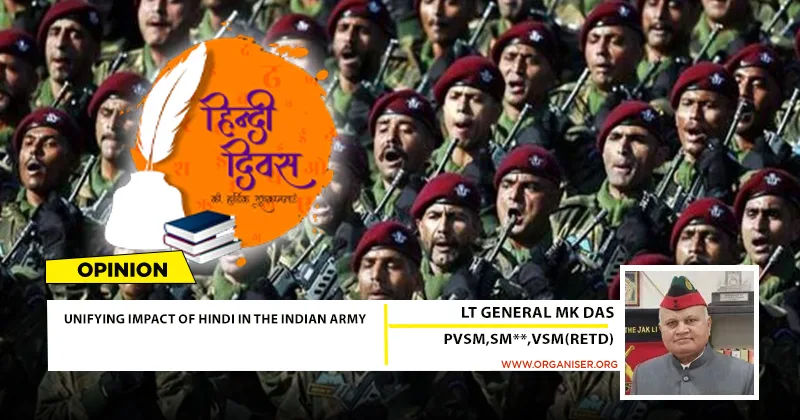
Greetings on Hindi Diwas to one and all. Indian Army has pan-India representation, and soldiers and officers from all states are part of this proud organisation. It may not be common knowledge that Hindi is the working language of the Indian Army. Knowing how Hindi is used in pure and modified forms to connect and communicate may be interesting.
It is important to note that most of the soldiers in the Indian Army have rural background. Even the education qualification for the intake used to eighth standard. The minimum qualification is the 10th standard, and most soldiers are ten plus 2. However, the training foundation is based on the premise that a young recruit may not be educated. Of course, the Army is getting better-qualified talent now through the Agnipath Scheme, including those with ITI Diplomas. As far as the officer cadre is concerned, they come from any part of the country. There is no reservation system in the Indian Army, be it soldiers or officers.
There are two types of units in the Indian Army. One is the controlled units, like Garhwal Rifles, Jammu & Kashmir Light Infantry (to whom I belong), Sikh, Punjab, Assam, etc., which are Infantry. Controlled units are in the Armoured Corps, Mechanised Infantry, Artillery, Corps of Engineers, etc. In the controlled units, troops belong to a particular state or a region. For example, my Jammu & Kashmir Light Infantry has troops hailing from the states of Jammu & Kasmir, including the Ladakh region. In Punjab regiment, soldiers are from Punjab, Himachal and J&K. In the controlled units, the regional language is predominantly used in verbal communication. In the Madras regiment, the troops speak Tamil, Telugu, Malayalam, and Kannada. But when it comes to matters of the military, the working language is Hindi.
The second type of unit in the Army is the All India All Class composition. In these units, troops hail from Kashmir to Kanyakumari, i.e. from anywhere in the country with no fixed quota for any state. In these units, soldiers in their capacity can use regional language, but all official functioning is in Hindi. Right from their training during the recruitment days, they are exposed to Hindi and those who lack knowledge of Hindi are encouraged to learn it. My experience has been that the soldiers from non-Hindi speaking areas say South India, pick up Hindi very fast once they join the Army.
The present organisation and functioning of the Indian Army are largely influenced by the British way of functioning from the pre-Independence era. Post-independence, the Army indianised slowly and steadily. We continued with colonial traditions for a long time, but now we have shed most of them. One of the fallouts of our British connection was that we inherited our training material, books and pamphlets written in English. Very little material was available in Hindi Devnagari script. During British times, a way out was found by using Roman Hindi.
In the Army, our troops use Roman Hindi, which is a language that uses Hindi words written in the English alphabet. For example, war is Yudh, the enemy is Dushman, the bullet is Goli, water is Paani, practice is Abhyas, etc. This was acceptable as the British officers could understand and command the troops in their native language. In the last two decades, Hindi has been written in the Devanagari script, and our troops from non-Hindi-speaking areas are getting adept at it.
I recall that some of my friends, particularly from the South, were not good at Hindi during our training days at the Academy. But the pull of Hindi was so strong that they quickly picked up the language. When some of them joined infantry regiments with troops hailing from Northern India, for example, Jat or Rajput Regiment, they changed personalities when we met for the Young Officers Course. I could see them speaking fluent Hindi. Similar was the case with officers joining the non-regimented units. Such is the influence of Hindi and the way binds people from all over the country and all walks of life. Hindi alone can have a unifying impact regarding soldiering, word of command, easy-to-understand directions and the feeling of being Indian.
It would be incorrect to say that we have eliminated English from our official correspondence. But the Indian Army is making steady progress here. Also, most of the text and terminology related to war, warfighting, warfare, technology and cyberspace are in English. The literal translation of such terms in Hindi is very difficult. For example, Hindi translation of All Round Defence is Sarvaangeen Raksha. Now, that may be a mouthful for a jawan from Arunachal Pradesh. Fortunately, such terms are explained to our jawans in English, and they can read, write, and explain them to their subordinates similarly. But a time has come to simplify some of the complex military terms in Hindi. It would not only help the soldiers but also help the common citizen understand the troops’ lingo.
The ability of the Hindi script in computers, smartphones and tablets has also helped the cause of Hindi. Indian troops watch a lot of Hindi content. Indian Army has promoted the use of Hindi in official correspondence. More and more books and texts are available in Hindi. The unit libraries are full of Hindi literature. The troops are fluently briefing tactical plans in Hindi. I have seen good use of Hindi in our troops’ social media and WhatsApp groups. A stage has come when all ranks of the Indian Army utilise Hindi voluntarily to communicate with others most effectively.
The next step would be to improve Hindi writing skills amongst all ranks and take it to the next level. A lot of official work trafficker has to do in English can be delegated to particularly the ses once they, master off, have mastered correspondence in Hindi. More and more texts in Hindi would encourage our troops to think and innovate in the common Hindi language. A time is not far for the software to be scripted by our jawans in Hindi.
Indian Army reflects India, showcasing unity and diversity in the truest sense. Hindi and encouragement to Hindi have undoubtedly played a key role in unifying all ranks of Indian Army in thought and action. Those who still oppose Hindi can learn and emulate from the example set by the Indian Army. As long as we all Indians start thinking in our mother tongue, followed by Hindi, the day is not very far when the opposition to Hindi will disappear. I believe Hindi will be the battle-winning factor in peacetime, in war and pursuit of Viksit Bharat @2047. Jai Hind. Jai Bharat.











Comments