





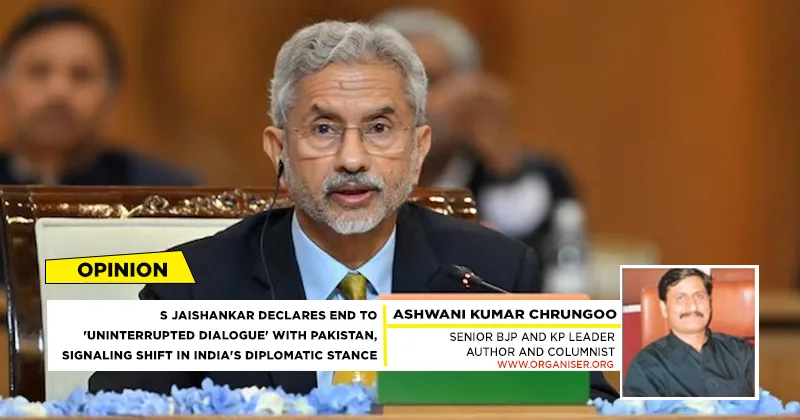
On the occasion of a book launch in New Delhi, the Minister for External Affairs of India, Dr S Jaishankar, made a very loaded public statement regarding the ongoing relationship with Pakistan. He said that the “era of uninterrupted dialogue with Pakistan is over”. About the comment made by the author, Rajiv Sikri (a former bureaucrat) in his book, that perhaps India is content to continue at the current level of relationship (with Pakistan), Jaishankar remarked, “Maybe yes, maybe no…we are not passive. And whether events take a positive or a negative direction, either way, we will react to it”. In this context, he also added that “Article 370 is done”.
What Jaishankar said on the occasion has surely, over the last some days, manufactured a lot of interest, news, comments and explanations in India, Pakistan and around the globe. There are several people who view these comments as positive or as a realistic approach to India’s establishment towards Pakistan, while some others call them pessimistic. However, to arrive at a more realistic and convincing position, the whole issue of Indo-Pak relations over the last decade needs to be seen from a historical perspective.
When BJP won the parliamentary elections in 2014 and went ahead to form the government at the Centre, the Government led by the newly designated PM Narendra Modi decided to send invitations to various heads of government in the neighbourhood for the oath-taking ceremony to be held in the Rashtrapati Bhawan, New Delhi on May 26 2014. Accordingly, the invitations were sent to Sri Lanka, Singapore, Bangladesh, Bhutan, Pakistan, Nepal, Maldives, Mauritius, and the Tibetan government in exile. It was the new government’s first show of its “Neighbourhood First” policy. Representatives from all the countries duly attended the oath-taking ceremony of Prime Minister Narendra Modi and his council of ministers, followed by a one-to-one meeting with Prime Minister Modi the following day. The then Pakistan PM, Nawaz Sharif, also attended the oath-taking ceremony and participated in the following meeting with PM Modi.
About Pakistan, PM Modi went a step ahead despite what was done by Pakistan in Mumbai on 26/11 in 2008 and in other parts of India before and after it. There was terrible anger among the Indians after the 2008 Mumbai terror attack organised and executed by the Pak-sponsored terror groups. Due to the unfortunate development, the relations between the two countries started deteriorating and impacted every field of activity, concern, influence, and operation. However, PM Modi made efforts to rewrite history afresh. He initially showed interest in reviving SAARC but eventually retraced his steps mainly due to the developing situation with the western neighbour.
The government of India consistently followed the policy that “terror and talks won’t go together”. It impressed upon Pakistan to realise the assurance given by that ‘the land under its control won’t be used for terrorism’. Pakistan, as usual, showcased its obsession of double talk and didn’t bring any change in its approach towards India so far as cross-border terrorism was concerned. But India had made up its mind to make Pakistan realise that terrorism from its soil directed towards India would cease to be a ‘low-cost affair for Pakistan now’.
In November 2015, after a chill of several months, Modi met with Nawaz Sharif on the sidelines of the UN Climate Summit CoP21 in Paris which was appreciated by one and all. This was followed by an unscheduled surprise visit of Narendra Modi to Lahore in December 2015 while returning home from Afghanistan, where he had gone after concluding a two-day visit to Russia. The Indian Prime Minister was given a red-carpet welcome in Pakistan, and Modi used the visit to congratulate the Nawaz Sharif family on Nawaz Sharif’s birthday and his daughter’s ensuing wedding. PM Modi successfully created a platform for bonhomie between the two nations through his initiative, which was applauded at a global level.
The National Security Advisers of India and Pakistan also met in December 2015 in Bangkok. This was followed by the visit of the then EAM Sushma Swaraj to Islamabad where the declaration came forth that said, “it was decided to engage in a comprehensive dialogue with each other”. These diplomatic advances by India raised high hopes, and these initiatives were expected to be taken to the next level soon.
The terror attacks sponsored by Pakistan in the army camps in Uri (Jammu & Kashmir) and Pathankot (Punjab) in the year 2016 derailed the whole process of “comprehensive dialogue”. India was compelled to react and retaliate in an unprecedented manner, paving the way for a strong surgical strike within PoJK, destroying terror infrastructure and terrorists operating therein. This shook the Pakistan establishment from top to bottom and the dialogue process was thus severely hit.
However, in June 2017, after a gap of 17 months after Prime Minister Modi had met Pakistan’s PM Nawaz Sharif in Lahore, the two leaders again met in the leaders’ lounge at the Opera House in Astana, Kazakhstan on the occasion of the SCO meet there. They exchanged greetings, and Modi enquired about the welfare of Sharif’s mother and family, whom he had met in Lahore in 2015. He also enquired about the health of Sharif who had undergone surgery in London.
In 2019, when the power exchanged hands in Pakistan, and Imran Khan had taken over as the Prime Minister, a big terror blast took place in Pulwama, Kashmir, killing scores of Indian security forces. In the words of EAM Jaishankar, “…and whether events take a positive or a negative direction, either way, we will react to it”, the government of India reacted to it very forcefully. India straightway went for air strikes on terror camps in Balakot in Pakistan, destroying the whole camp and other infrastructure therein. This created a big diplomatic and political upheaval, virtually closing all leftover doors for dialogue between the neighbouring countries.
Immediately after the reelection of PM Modi as the Prime Minister of India in May 2019, the government of India went for the abrogation of Article 370 in the constitution. In this connection, the government got overwhelming support in both the houses of parliament and Article 370 was done away with in August 2019. In an undue reaction, Pakistan downgraded the diplomatic ties with India, which India duly reciprocated. These important actions and reactions had their bearings on several issues incidental to the relationship between the two countries. Consequently, India was not interested in having political or diplomatic meetings with Pakistan.
The government of India while organising the G20 events in India, during its presidency of the group, ignored Pakistan and didn’t invite it in any of the events while invitations were sent to Bangladesh, Singapore, UAE, etc. Even the 22nd SCO summit of the heads of governments chaired by India (scheduled to be held in New Delhi in July 2023) was converted to a virtual mode, thus not necessitating the Pakistan PM to come to Delhi in person. These were clear hints to Pakistan by India about its position regarding the neighbouring state.
On both the occasions in 2019 and 2024, while the other neighbouring states were sent invitations, Pakistan wasn’t invited by India in the oath taking ceremonies of the new governments as was done in 2014. Here, it is important to note what PM Modi said about Pakistan in one of his interviews with a TV channel during the election campaign 2024. He said that ‘his government has put a lock on the issue of Pakistan in the context of India’s onward march and would wish that Pakistan takes care of its Dal & Roti’. This established that India, under the leadership of PM Modi, wouldn’t waste its time in any serious and meaningful engagement with Pakistan.
The EAM S. Jaishankar’s statement in the book launch function is directly linked to PM’s public expressions in the interview above. Moreover, these sentiments have a greater support among the common Indian masses. People of India and, especially the younger generations in the country, don’t feel comfortable comparing India with Pakistan in any sphere. They realise India has emerged as a big global player with a robust fifth-largest economy supported by a positively evolving GDP. The interest has decreased even in sports, art, music and people-to-people contact.
Under Modi’s leadership, India is being recognised today as the leader of the global south, carrying forward the aspirations of billions of people. After assuming power in June of this year’s third term, PM Modi visited Italy, Russia, Austria, Poland, and Ukraine. He is scheduled to visit the US and address the UN General Assembly in September 2024. He is currently on a visit to Brunei and Singapore. Over the last two decades, his outreach has already covered almost 70 countries. While India is conscious of its responsibilities as a global leader, it has fixed its priorities on a global front. Pakistan has ceased to be on its global diplomatic radar due to Pakistan’s doings, and India desires Pakistan to know and realise the hard truth. This is what precisely S Jaishankar meant by saying, “era of uninterrupted dialogue with Pakistan is over”.











Comments