





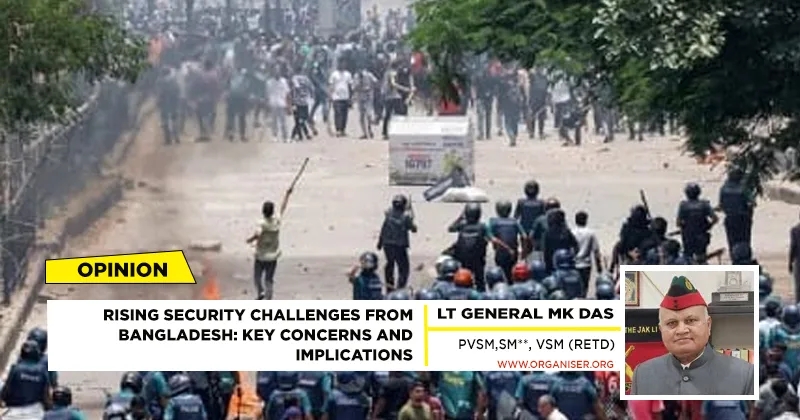
When Prime Minister Narendra Modi says that this is not an era of war, he also possibly conveys that this is not an era of new warlike situations emerging in the world, particularly in India’s neighbourhood. Post ouster of Sheikh Hasina Government in Bangladesh on August 5, 2024, we continue to see an unstable Bangladesh. Atrocities against the Hindu minority in Bangladesh continue, and Hindu Mandirs continue to get desecrated.
Bangladesh’s caretaker Government, under Nobel Laureate Muhammad Yunus, has made customary noises to protect the interests of the Hindu community in Bangladesh, but enough damage has already been done. Even when the situation normalises, Hindus in Bangladesh are likely to live in fear, no different from how they feel in Pakistan and Afghanistan. So, India has another major humanitarian crisis at hand. It is also emerging that the decisions of the caretaker government in Bangladesh are being dictated by international powers that are inimical to India’s rise.
The release of Jashimuddin Rahmani, the chief of the Ansarullah Bangla Team (ABT), a terror outfit affiliated with al-Qaida and Pakistan’s Lashkar-e-Toiba (LeT) is indeed alarming. ABT is known to have established a base in West Bengal and has been attempting to spread its influence in India’s North East. The intelligence inputs indicate that ABT operatives have been more successful in infiltrating the States of Assam and Tripura, possibly with the advantage of knowing the local language. The release of Rahmani appears to be part of a larger game plan which clearly has security implications for India.
The inputs of an increase in defence collaboration between Bangladesh and Pakistan are already evident. Bangladesh is to buy 40,000 rounds of long-range artillery ammunition, 2900 high-intensity projectiles and 40 tons of RDX explosives. Bangladesh buys most of the military hardware from China. The Bangladesh Army has Chinese tanks, anti-tank missiles and grenades. The Air Defence system is wholly Chinese. Bangladesh Navy has Chinese frigates and missile boats. Bangladesh Air Force uses Chinese fighter jets. The Bangladesh Armed Forces number roughly 2.5 lakh personnel on active duty, and the defence budget is the third largest in South Asia. In short, the Bangladesh Armed Forces are not a pushover.
India and Bangladesh have shared good relations between the militaries of both countries. Under PM Sheikh Hasina’s Government, defence cooperation reached great heights in the last 15 years. A large number of defence personnel, particularly officers undergo training in India and Bangladesh as part of mutual defence agreements. But even with such good relations, Bangladesh continued to import military hardware largely from China, the US, European nations, and even Pakistan, but very little was procured from India. During my visit to Bangladesh in 2015 as part of an Indian delegation, I noticed that India had gifted three patrol boats to the Bangladesh Coast Guard as part of military goodwill. But it was ironic to know that Bangladesh’s military treated India as an enemy in their strategic thinking, and their wargames portrayed India as an aggressor.
India and Bangladesh share a 4096 km long border, which is India’s longest border with any neighbouring country. The maximum border is shared with the State of West Bengal (2217 km), followed by Tripura (856 km), Meghalaya (443 km), Mizoram (318 km) and Assam (262 km). Having served along these borders in my military career, I can say that they continue to pose a challenge of major infiltration. The demography in the States neighbouring Bangladesh has undergone a huge change because of illegal immigration. In the past, many of the areas close to the borders provided shelter and refuge to insurgent groups like ULFA. It is feared that many of the insurgent groups and Islamist elements may be tempted to revive their foothold in border areas in the vicinity of India, with the active support of Bangladesh’s Jamaat-e-Islami.
Militarily, two threats from the Bangladesh side are imminent in the near future. One is a revival of insurgency in India’s North East, with the aim of embroiling the Indian Army into counter-insurgency operations. In the last decade, the Indian Army has slowly withdrawn from an active role in counter-insurgency operations in the North East. The focus of the Indian Army is to strengthen its presence on the Indo-Chinese border and to develop infrastructure. China will be keen to develop a crisis situation in India’s North East and compel the Indian leadership to employ the Indian Army back into fighting insurgency. Early indicators of such a Chinese strategy are visible, and the security establishment in India has to remain proactive to address the problem.
The second threat is to the Siliguri Corridor. The Siliguri Corridor, located in North Bengal, connects India’s NE to the rest of mainland India. The Siliguri Corridor, also called Chicken’s Neck, is a narrow corridor of land, which measures roughly 170 km by 60 km, and its narrowest sections are just 20 km wide. The corridor is located between Bangladesh to the South West and Nepal to the North West and has Bhutan in close proximity through the city of Siliguri. From the Bhutan side, the threat to Siliguri Corridor through the Doklam plateau, which led to the famous India-China standoff in mid-June 2017, lasting more than two months, is still fresh in our minds. The gallant action of the Indian Army led to a retreat by China, but the event underscored the significance of the possible threat to the Siliguri corridor. With an unstable Bangladesh, China and its proxies have another opening that poses a threat to the Siliguri corridor. Uneasy Centre-State relations in West Bengal may exacerbate the challenge.
The issue of asylum to Sheikh Hasina, even if a temporary one, is likely to be exploited by the current dispensation in Bangladesh. It is a tricky situation for India, as it has rightly decided to look after a long-time friend of India in a crisis situation. Indian leadership may be weighing all the options on this issue. A decision on Sheikh Hasina, if it is not to the liking of the BNP and Jamaat-e-Islami-dominated dispensation in Bangladesh, is likely to shape the trajectory of Indo-Bangladesh relations.
So far, India has exercised a great amount of restraint on the sudden developments in Bangladesh. It has maintained dignity in respecting the change of power dynamics in Bangladesh and largely urged Bangladesh to ensure the safety and security of the Hindu minority. The continued violence and threats to Hindus in Bangladesh, even after a month, is a cause of distress. India may have to weigh the options per Bangladesh’s evolving dynamics and clearly articulate the concerns and redlines. India has to be prepared for all the contingencies of emerging security threats from Bangladesh in the short and long term so as to prevent a warlike situation and act when compelled. Such a response would govern our growing status as a responsible regional and international power.
















Comments