Evolution of Governance: Bharat's journey and the lessons for democracy
December 13, 2025
  • Read Ecopy
  • Circulation
  • Advertise
  • Careers
  • About Us
  • Contact Us
Android AppiPhone AppArattai
Organiser
  • ‌
  • Bharat
    • Assam
    • Bihar
    • Chhattisgarh
    • Jharkhand
    • Maharashtra
    • View All States
  • World
    • Asia
    • Europe
    • North America
    • South America
    • Africa
    • Australia
  • Editorial
  • International
  • Opinion
  • RSS @ 100
  • More
    • Op Sindoor
    • Analysis
    • Sports
    • Defence
    • Politics
    • Business
    • Economy
    • Culture
    • Special Report
    • Sci & Tech
    • Entertainment
    • G20
    • Azadi Ka Amrit Mahotsav
    • Vocal4Local
    • Web Stories
    • Education
    • Employment
    • Books
    • Interviews
    • Travel
    • Law
    • Health
    • Obituary
  • Subscribe
    • Subscribe Print Edition
    • Subscribe Ecopy
    • Read Ecopy
  • ‌
  • Bharat
    • Assam
    • Bihar
    • Chhattisgarh
    • Jharkhand
    • Maharashtra
    • View All States
  • World
    • Asia
    • Europe
    • North America
    • South America
    • Africa
    • Australia
  • Editorial
  • International
  • Opinion
  • RSS @ 100
  • More
    • Op Sindoor
    • Analysis
    • Sports
    • Defence
    • Politics
    • Business
    • Economy
    • Culture
    • Special Report
    • Sci & Tech
    • Entertainment
    • G20
    • Azadi Ka Amrit Mahotsav
    • Vocal4Local
    • Web Stories
    • Education
    • Employment
    • Books
    • Interviews
    • Travel
    • Law
    • Health
    • Obituary
  • Subscribe
    • Subscribe Print Edition
    • Subscribe Ecopy
    • Read Ecopy
Organiser
  • Home
  • Bharat
  • World
  • Operation Sindoor
  • Editorial
  • Analysis
  • Opinion
  • Culture
  • Defence
  • International Edition
  • RSS @ 100
  • Magazine
  • Read Ecopy
Home Politics

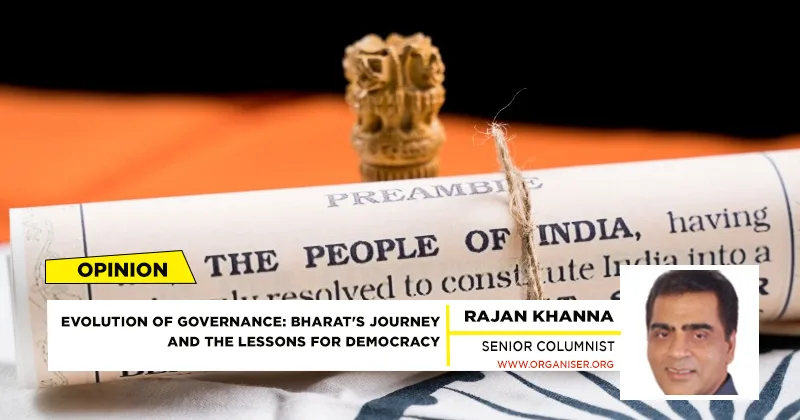
Evolution of Governance: Bharat’s journey and the lessons for democracy

As Bharat continues to evolve as a democracy, there is a need for the society to critically assess and fine-tune its democratic processes. It is essential to tailor the democratic model to the unique needs of Bharat, rather than viewing it through a Western lens

Rajan KhannaRajan Khanna
Aug 28, 2024, 06:10 pm IST
in Politics, Bharat, Opinion
Follow on Google News
FacebookTwitterWhatsAppTelegramEmail

For millennia humankind has been experimenting with various kinds of forms of government and if we closely observe, we discover that till the advent of the twentieth century, most of the world was either ruled by various monarchies or was colonised by the European powers. After the American and French revolutions, democracies started evolving in the Western world and as large parts of the remaining world was colonised by the Westerners, there was no question of self-rule in the enslaved countries. However, most of the countries freed by the European powers, with exception of Arabian countries, opted for democracy as a system of governance.

In context of Bharat, we were the first to introduce democratic system when we had Janpadas few centuries BC. People had the power to elect the kings and their governing councils. But later with the consecutive invasions of the Greeks, Shakas and Huns, the system collapsed and before Islamic invaders came to rule, various indigenous dynasties like Mauryas, Guptas, Cholas, Chalukyas, Shatvahanas ruled at various stages in Bharat.

When Bharat got independence from the British, it was a vivisected country; Pakistan was created to suit the designs of the Britishers. Both the countries, Bharat as well as Pakistan became democracies but we have become the largest democracy of the world whereas Pakistan remained under military rule most of the time and whenever civilian elected government came to power, it was not allowed by the army to last its full term. What is the reason? Though, both the countries have same ancient culture, Pakistan followed Islamic tenet of keeping Satta (Power) over Samaj ( Society) whereas we continued Sanatan tradition of keeping Samaj over Satta which is the first and foremost condition for any democracy to flourish.

Though remaining proud of our robust democracy, Bhartiya samaj has to do lot of brainstorming to fine tune it further and visualise it according to our own needs and not to view it from the westerner prism.

In recently held Lok Sabha elections, though the incumbent NDA regime had performed excellently on all fronts like economic, defence and foreign policy; one noteworthy achievement was, no scam was reported during the entire tenure, yet the main party BJP could not secure majority on its own. It leaves lot to be pondered over.

It has come to light that the ruling party could not communicate with the people about its achievements and opposition parties, both national as well as of state level, were successful in creating false narratives which influenced the voters. Normally from Panchayat to the parliament level, we have four tiers of elections in our country. All four legislatures have their scope of work properly demarcated. For example, Panchayyats administer rural areas and decide about developmental work and accordingly spend funds allocated to them by the state governments. Local bodies like municipal corporations have their jurisdiction on urban requirements like roads, water supply, health, education, public parks and regulation of construction work. State governments regulate law and order, allocate budgets to municipalities and rural bodies, build state level road infrastructure and irrigation plans, supervise education boards, create and maintain cultural bodies and facilitate implementation of central government schemes in the state.

Central government majorly takes care of national defence, foreign policy, fiscal policies and plans, communications, currency, science and technology, space programmes, culture, law, taxation and internal security.

Elections are held periodically for all the tiers, from Panchayat to the Loksabha. In absence of proper information and knowledge, it has been observed that the electorate mostly discusses municipal issues even during state assembly and Loksabha elections. Rightfully the issues which should come to the public domain for discussion with respective candidates should be pertinent to the specific elections. For example, in the recently held Loksabha elections in Bharat, hardly the subjects like foreign relations and defence were discussed in media as well as in the campaigns run by the candidates and by the opposition parties.

On the contrary, Congress party and the other regional political outfits created many of the issues which were false and misleading. Unfortunately, incumbent NDA alliance led by the BJP could not effectively counter the same. For example, when INDI alliance led by the Congress party announced cash transfers of Rs 8,500 to women if it wins the elections, was not effectively countered by the ruling party. The implementation of the scheme requires Lakhs of crore rupees and the unsuspecting electorate was not enlightened where the money is going to come from? In simplistic terms the whole central budget will be washed away if such schemes are implemented; and at cost of what? Infrastructure development, defence, health sector would have been biggest sufferers. Samajwadi party leader Akhilesh promised 30 lakh jobs if elected to power. Obviously he was talking about government jobs. Nobody discussed in media that the exercise demands again Lakhs of crores of rupees. In a country of 140 crores where youth constitute more than 65 percent of population, what effect 30 lakh jobs would have created?

Instead, if same amount is spent on education and skill training programmes for the youth, crores of them could have been beneficiaries.

Foreign powers who want Bharat to tow their line in the international diplomacy, resort to arm-twisting actions when the latter declines to do the needful. George Soros, an American

billionaire and controller of many NGOs which influence elections on foreign lands, had publicly announced that he wanted to see the exit of Narendra Modi government. Obviously, he was acting on behest of powers who were not comfortable with independent policy decisions of Bharat. Unfortunately, the agenda of detractors coincided with that of opposition parties of Bharat. There is no denying the fact that in democracies opposition parties use all the tactics to oust the incumbent governments; however, they should remain in the ambit of national interests only. Electorate should be vigilant about such agendas.

Ultimately, ball remains in the court of the electorate. It needs to understand real issues which determine the trajectory of the development and are instrumental in making Bharat so strong that none of the world powers can dictate terms to it. The political parties which have been fighting elections on caste lines for decades now have not done any deed of welfare for their voters; most of them have prospered their dynasties only. Media increasingly has the duty of bringing real and vital issues in the public domain. Bharat has to demonstrate to the rest of the world that it is not only the largest democracy of the world, it is mature one also.
Topics: NDANational Democratic AllianceI.N.D.I Alliance
ShareTweetSendShareSend
✮ Subscribe Organiser YouTube Channel. ✮
✮ Join Organiser's WhatsApp channel for Nationalist views beyond the news. ✮
Previous News

From research initiative to conversion activities, all about “Joshua Project” which is being linked to caste census

Next News

Congress-JMM government of Jharkhand engaged spy behind Champai Soren; 2 detained in Delhi: Himanta Biswa Sarma

Related News

Bihar Chief Minister Nitish Kumar with deputy CMs Samrat Choudhary and Vijay Kumar Sinha, Image courtesy- Prabhat Khabar

Bihar: Cabinet gives nod to creation of 3 additional departments to meet ‘1 crore jobs and employment’ target

A representative image- courtesy PTI

Bihar: Senior BJP leader Prem Kumar elected speaker of the State Legislative Assembly

Representative image

“Should intruders with Aadhaar be made voters?”: SC comes down heavily on I.N.D.I Alliance over vote bank politics

Prime Minister Narendra Modi on stage shares his joy with Chief Minister Nitish Kumar in Patna’s historic Gandhi Maidan

Bihar Election Results: After wave mandate, high tide of expectations

Image for representational purpose: Bihar CM Nitish Kumar with deputy CM Samrat Choudhary, Image via X

Bihar: CM Nitish Kumar allocates portfolio, deputy CM Samrat Choudhary gets Home Department

Nitish Kumar taking oath as Chief Minister of Bihar, Image- ANI

Bihar: Nitish Kumar takes oath as Chief Minister for record 10th time

Load More

Comments

The comments posted here/below/in the given space are not on behalf of Organiser. The person posting the comment will be in sole ownership of its responsibility. According to the central government's IT rules, obscene or offensive statement made against a person, religion, community or nation is a punishable offense, and legal action would be taken against people who indulge in such activities.

Latest News

House Democrats introduce a resolution seeking to roll back emergency-based tariffs on Indian imports, warning of economic fallout and strained US–India ties

US Congress members move to end President Trump’s unilateral tariff regime on India, calls move illegal and harmful

PM Modi pays tribute to security personnel killed in the 2001 Parliament attack

2001 Parliament Attack Anniversary: PM Modi and leaders pay tribute to brave security personnel

Representative image

Delhi: “Operation CyHawk phase 2 leads to arrest of 284 people, legal action against 2900,” says Joint CP IFSO

Image for representational purpose: IED blast in Bijapur

Chhattisgarh: 24-year-old woman injured in IED explosion in Bijapur

Representative image

Uttar Pradesh: Varanasi police undertake ‘Operation Torch’; 500 suspected illegal Bangladeshi & Rohingayas identified

Representative image

Tamil Nadu ISIS Radicalisation Case: NIA files supplementary chargesheet against 7 individuals and 1 registered society

Representative image

From Brahmavarta to Haryana: A 3,000-year journey through names, identity and civilisation

Representative image

Fact Check: The truth behind “BBC footage” of RSS dancing in 1942 — Video is from a 2015 Shiksha Varg celebration

Union Minister Sarbananda Sonowal visited the families of those who lost their lives in the tragic road accident in Arunachal Pradesh

Anjaw Road Accident: 21 workers from Assam killed; Sarbananda Sonowal visits bereaved families, reviews rescue efforts

Image for representational purpose only

Bihar government to setup ‘Prakrit and Pali’ language academies

Load More
  • Privacy
  • Terms
  • Cookie Policy
  • Refund and Cancellation
  • Delivery and Shipping

© Bharat Prakashan (Delhi) Limited.
Tech-enabled by Ananthapuri Technologies

  • Home
  • Search Organiser
  • Bharat
    • Assam
    • Bihar
    • Chhattisgarh
    • Jharkhand
    • Maharashtra
    • View All States
  • World
    • Asia
    • Africa
    • North America
    • South America
    • Europe
    • Australia
  • Editorial
  • Operation Sindoor
  • Opinion
  • Analysis
  • Defence
  • Culture
  • Sports
  • Business
  • RSS @ 100
  • Entertainment
  • More ..
    • Sci & Tech
    • Vocal4Local
    • Special Report
    • Education
    • Employment
    • Books
    • Interviews
    • Travel
    • Health
    • Politics
    • Law
    • Economy
    • Obituary
  • Subscribe Magazine
  • Read Ecopy
  • Advertise
  • Circulation
  • Careers
  • About Us
  • Contact Us
  • Policies & Terms
    • Privacy Policy
    • Cookie Policy
    • Refund and Cancellation
    • Terms of Use

© Bharat Prakashan (Delhi) Limited.
Tech-enabled by Ananthapuri Technologies