





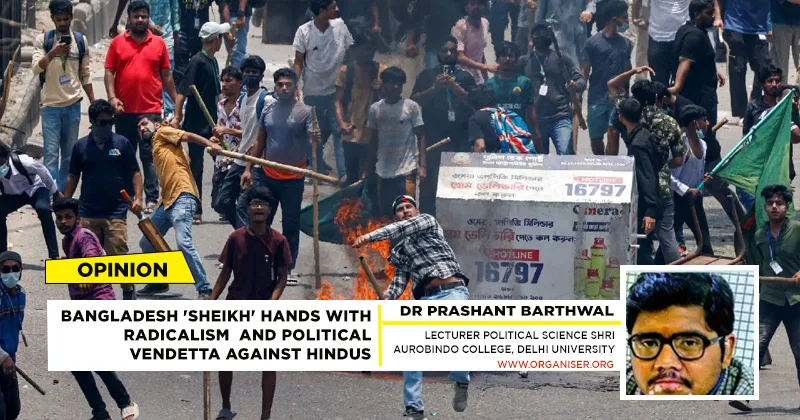
The issue of growing Islamic militancy in Bangladesh is undoubtedly critical because it harms the peace, stability, and security of the entire South Asian subcontinent. Some political observers and commentators felt the headquarters of Islamic terrorism are shifting from Afghanistan to Bangladesh, which is a soft state with an ineffective government and police force and which Islamist groups, with their organised and well-armed cadres, can easily dominate. Islamists are being systematically placed in key positions in Government, and an Islamist state within a state is being built for the ultimate takeover of Bangladesh as the base for Islamist operations in South and South East Asia. More importantly, as Islamic militancy rises in Bangladesh, India’s security and stability are adversely affected. The more Bangladesh has been moving towards Islamic militancy, the more it has been moving away from the possibility of a continued friendly and cordial relationship with India. This is so because as militant Islamic organisations like Jamaat-e-Islami and its fundamentalist allies get firmly entrenched in the vital governmental institutions of Bangladesh and spread their tentacles deep inside the Bangladeshi society, polity, and economy, they cultivate anti-India feelings throughout Bangladesh. Jamaat could never forget its defeat as a collaborator of the West Pakistani junta, installing the process of liberation of Bangladesh from Pakistan and also the fact that India was solely responsible for its defeat. Being the representative of the Pakistani face of Bangladeshi politics and as an act of revenge against India, Jamaat and its allies leave no stone unturned to humiliate India whenever they manage to assume power in league with some other political party in Bangladesh.
The alarming situation in Bangladesh has made this problem even more severe. Bangladesh has long been plagued by political instability. The power struggle between the Awami League and the Bangladesh Nationalist Party (BNP) has repeatedly pushed the country towards anarchy. This political instability has a direct impact on minority communities. The influence of Islamic fundamentalist groups in Bangladesh has increased in recent times. These groups often target Hindus and other religious minorities. Despite the economic development in Bangladesh, economic inequality persists among different sections of the society. This disparity also shows up on religious lines, leading to increased tensions. Since the partition of 1947, the situation of Hindus in East Bengal (which later became East Pakistan and then Bangladesh) has been challenging. The impact of this burden of history is still felt today and is perhaps the result of political tensions that have even taken the form of religious violence.
Along with this political instability, religious fanaticism has also increased in Bangladesh. The majority of the country’s population is Muslim, but there is also a large Hindu population. Attacks on Hindus have increased in the last few years, including vandalism of temples, possession of property, and personal violence. These incidents not only create fear among the minority community but also damage the secular image of the country. The growing influence of radical Islamist groups is another cause for concern. These groups target not only Hindus but also moderate Muslims. The killings of bloggers, writers, and intellectuals are evidence of how intolerance is on the rise. The Government has tried to curb these groups, but their influence has not diminished.
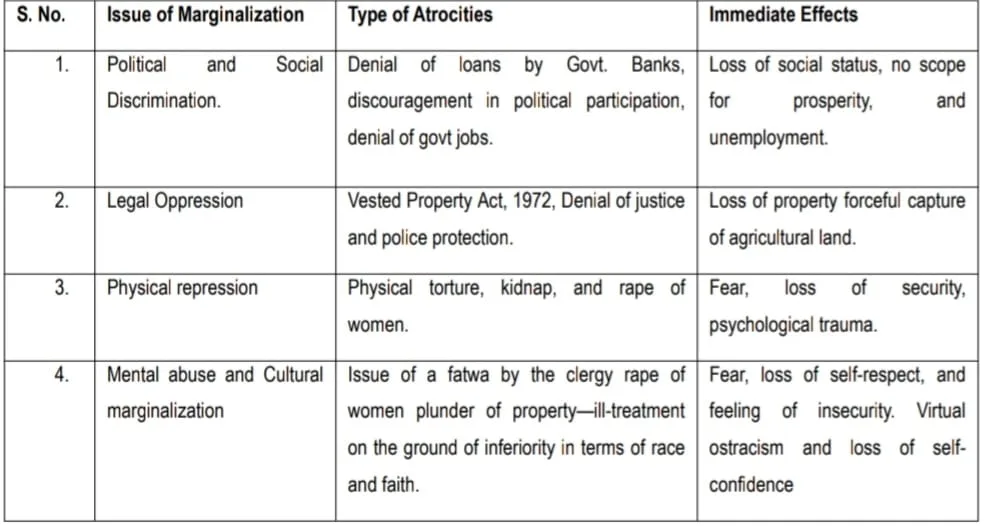
A significant question raised hereafter is whether the Hindu cleansing drives a clear manifestation of the return of Pakistan’s legacy of religion-based communal politics in Bangladesh. The planned attacks carried out on the Hindus had far-reaching implications. In a way, they implied a revival of the old Pakistani legacy of religion-based communal politics in the country. Now, the question is – what does the term cleansing denote? Ethnic cleansing is a euphemism referring to the persecution, through imprisonment, expulsion, killing, or raping the members of an ethnic minority by a local majority to achieve ethnic homogeneity in the majority-controlled territory. It is a process of systematic removal of a group of people from a specific area through killing and forced migration. The situation of Hindus in Bangladesh is particularly worrying. At the time of independence, the percentage of Hindus in the country’s population was about 22 per cent, which has now come down to less than 8 per cent. This decline is the result not only of the massive displacement that occurred during the partition between Pakistan and India but also of continued discrimination and persecution in the years that followed. Incidents like illegal occupation of Hindu property, rape, and kidnapping have become common. It is difficult to get justice for these crimes as law enforcement agencies and the judiciary often come under pressure from the majority community. Another aspect of violence against Hindus in Bangladesh is forced conversion. In many cases, Hindu girls and women are abducted and forced to convert to Islam. This is not only a violation of individual freedom but also creates an atmosphere of fear in the entire community.
The Government has enacted laws to prevent such incidents, but their implementation has often been weak. The following table will help to summarise and understand the way Hindus were mistreated and tortured and their immediate consequences in Bangladesh.
To understand this whole hatred politics against the Hindus in Bangladesh, there is a need to examine the intent and objective of Islamic radicalism in South Asian countries, specifically India and its neighbours. Popular Front of India (PFI) released its objective to transform India by 2047 and to expand its Islamic credentials by increasing the anarchy, political chaos, and unrest in the state. Even the CPI (Maoist) strategies state, sharing the exact outline of the PFI model of 2047, that “the specific characteristics of revolutionary war in India determine the military strategy to be one of protracted people’s war of establishing revolutionary base areas first in the countryside where the enemy is militarily weak and then to gradually surround and capture the cities which are the bastions of the enemy forces” (p. 8, Strategy and Tactics). Therefore, it is quite clear that their armed struggle and the movement in the rural areas will play the primary role, and the work in the cities will play a secondary role, complementary to the rural work. They believed that even Mao said, “the final objective of the revolution is the capture of the cities, the enemy’s main bases, and this objective cannot be achieved without adequate work in the cities” (Mao, Selected Works, Vol. II, p.317). These sorts of strategies spread political unrest even in Bangladesh with the assistance of its radical groups and brainwashing of the youth, and this time, it was not the classical Jihad agenda. Somewhat, the classical tactics were changed with modern warfare.
Even the Islamic radical forces, such as Jamaat-e-Islami, Hefazat-e-Islam, and Jamaat Shibir, in Bangladesh share the same outline as what the CPI (M) intends to plan in India by targeting the religious minorities after mobilising, manipulating, and misdirecting the Muslims and youths for the revolutionary movement and sending them as their cadre in urban and rural areas. They not only targeted the marginalised for the bloodshed revolutions, but they also stressed the White-Collar Employees who, for them, are the reliable allies of the working class and the revolution. For them, ‘it is essential to penetrate the military, para-military forces, police, and higher levels of the State’s administrative machinery. It is necessary to obtain information regarding the enemy, to build support for the revolution within these organs, and even to incite revolt when the time is ripe”.
The Fifth Generation Warfare (5GW) by PFI uses non-kinetic military operations, including social engineering, misinformation, cyber-attacks, and emerging technology like artificial intelligence and completely autonomous systems. 5GW is an information and perception war. The world is changing in many ways with evolving technology and fast globalisation. Warfare techniques are also shifting generationally. State players have decreased while non-state actors have increased in combat theatres since World War II. Now, with globalization, war can be fought without guns and bombs. Through tactical war styles, the enemies can achieve their goals. It can wage battle adaptably. We are seeing the growth of “Elastic wars,” where a pattern replaces a fixed chain of command. This design ensured that activities matched battle theatre conditions. It was conducted to defeat the enemy by considering different combat theatre dimensions. The US calls this warfare a ‘Hybrid War.’
Political upheaval in South Asian countries, particularly India and Bangladesh, is often caused by complex historical, social, and economic issues. Global market forces and essential figures like George Soros shape economic and political landscapes but rarely generate political turmoil. The complex interactions between global economic factors, local political dynamics, and domestic and foreign stakeholders affect South Asian politics. Understanding these dynamics needs detailed research of individual situations and recognition of each country’s unique background.
In April 2023, Hasina accused the US of seeking a regime change in Bangladesh, calling it an undemocratic action whereby “they (the US) are trying to eliminate democracy and introduce a Government that will not have a democratic existence.” Bangladesh officials hit back at the US, pointing to weakness in America’s democracy and calling America a bunch of hypocrites. The Awami League Government had indicated it was not inclined to get a lecture from the US on democracy.
Moreover, Pakistan and China’s involvement in this crisis adds a dangerous dimension to the violence. Both nations have a vested interest in destabilizing Bangladesh. By backing Islamist factions like Jamaat-e-Islami, Hefazat-e-Islam, and Jamaat Shibir, they are advancing their geopolitical agendas while exacerbating the humanitarian crisis. Pakistan, notorious for supporting Islamist extremism, has reportedly provided financial and logistical support to these extremist groups. China, leveraging its influence in the region, has further destabilised the situation, disregarding the atrocities committed against the Hindu population.
All these factors have fuelled the exodus of Hindus from Bangladesh. Thousands of Hindu families are forced to seek refuge in India every year. This not only reduces the cultural diversity of Bangladesh but also puts pressure on India, where settling these refugees and arranging for their resettlement is a significant challenge. The rise of Islamic fundamentalism in Bangladesh is a complex phenomenon with multiple causes. Economic inequality, lack of education, and political instability have created fertile ground for the spread of radical ideologies. The increasing number of seminaries financed by the Gulf countries has also contributed to spreading radical ideas. Moreover, some political parties have used religious sentiments for their benefit, leading to social polarization. This has profound implications for India. Bangladesh is an important neighbour of India, and the two countries share a long border.
Instability in Bangladesh not only affects bilateral relations but also poses a threat to India’s internal security. The rise of radical groups and the threat of cross-border terrorism is a matter of concern for India.
Finally, a long-term solution to this problem is only possible through Bangladesh’s internal political and social processes. External pressures and interventions may provide short-term relief, but real change will come from internal changes in Bangladesh’s society and polity. Therefore, India and the international community must support forces that promote democratic values, religious tolerance, and social justice in Bangladesh. It may be a long and challenging process, but it is essential for the future of Bangladesh and the entire South Asia region. A peaceful, prosperous, and inclusive Bangladesh will benefit the Hindus and the whole area. All parties need to work together to achieve this goal.












Comments