





1946, Direct Action Day
The Muslim League Council proclaimed August 16, 1946 as ‘Direct Action Day’ in order to accentuate their demand for a separate Muslim homeland after the British left the Indian subcontinent. Their main aim was to attain a different country with a Muslim majority.
Muslims chose August 16, 1946 as the day to accomplish their mission simply because the Battle of Badr occurred on this day and it resulted in the first decisive victory of Islam over the heathens and the subsequent conquest of Mecca.
The All-India Muslim League decided to take a “direct action” using violence to intimidate Hindus and their leadership for a separate Muslim homeland after the British exit from India. SN Usman, the Mayor of Calcutta and the Secretary of the Calcutta Muslim League circulated a leaflet in Bangla which read “Kafer! Toder dhongsher aar deri nei! Sarbik hotyakando ghotbe!” (“Infidels! Your end is not far off! There will be a massacre!”).
The black day began with a large public meeting of the Muslim League in the Calcutta Maidan. Muslim workers from Howrah’s Jute Mills began pouring into the city headed toward Ochterlony’s needle monument for the mammoth meeting to ‘celebrate’ Direct Action day”. No one from any non-Muslim press was present at the meeting. Suhrawardy who was then the Premier of Bengal said that he would see how the British could make Mr. Nehru rule Bengal. Direct Action day would prove to the first step towards the Muslim struggle for emancipation.
The crowd included a large number of Muslim goondahs (hoodlums) and that their ranks swelled as the meeting ended. They made for the shopping centres of the town where they at once set to loot Hindu shops and houses. They then spread out, howling their battle cries “Allaho Akbar, Pakistan Zindabad, Muslim League Zindabad, Lekar Rahenge Pakistan,
Ladke Lenge Pakistan”.
Then the torching began. Hindu-inhabited areas such as the southern part of Amherst Street, Bortola, Jorasanko were in flames in no time. The fires burnt right through the night, punctuated by the war-cries of “Allaho Akbar, Ladke Lenge Pakistan”.
Gopal Chandra Mukhopadhyay or fondly called Gopal ‘Patha’ is the symbol of Hindu resistance who shattered the dreams of Jinnah and his Muslim League Islamists of forcefully including a Hindu majority Calcutta and its surrounding districts in East Pakistan after draining out Hindus by unleashing a mass genocide during his infamous Direct Action call on 16 August 1946. Gopal single-handedly with his group of Hindu boys fought back the Islamist terrorists just two days later on 18 August saving thus millions of Bengali Hindu men, women and children from certain extinction.
Unfortunately, many of the children of poor and helpless Bengali Hindu women who Gopal saved in 1946 from the rapist murder Islamist gangs during Direct Action in Calcutta, have been drafted into communist politics and defame their own saviour as a ‘dacoit’ or a ‘goonda’. It is important thus to tell the true story of the unsung hero of Bengal and India. Gopal Patha saved Hindus from sure-shot annihilation by the Islamist terrorists of Suhrawardy and Jinnah during Direct Action in 1946.
American author Richard Benkin in his book A Quiet Case of Ethnic Cleansing: The Murder of Bangladesh’s Hindus has written that after 1947, 5 crore Hindus in Bangladesh were either killed or converted.
1946 Naokhali Genocide
Noakhali Genocide were a series of organised massacres, rapes and abductions, combined with looting and arson of Hindu properties, perpetrated by the Muslim community in the districts of Noakhali in the Chittagong Division of Bengal (now in Bangladesh) in October–November 1946, a year before India’s independence from British rule.
It affected the areas under the Ramganj, Begumganj, Raipur, Lakshmipur, Chhagalnaiya and Sandwip police stations in Noakhali district and the areas under the Hajiganj, Faridganj, Chandpur, Laksham and Chauddagram police stations in Tipperah district, a total area of more than 2,000 square miles.
The massacre of the Hindu population started on October 10, on the day of Kojagari Lakshmi Puja and continued unabated for about a week. Around 50,000 Hindus remained marooned in the affected areas under the strict surveillance of the Muslims, where the administration had no say. In some areas, Hindus had to obtain permits from the Muslim leaders in order to travel outside their villages.
The Partition of 1947
The Partition of India after the British left, bifurcated the land into three, with one being Bharat, East Pakistan and West Pakistan. Although the populations of both zones were almost equal, the political concentration and the decision-making bodies were concentrated in west Pakistan only.
Soon after the boundaries were drawn, two separate nations came into existence. Pakistan was having two geographically and culturally separate areas to the east and the west with India in between. The authorities of West Pakistan viewed the Bengali Muslims in the East as “too ‘Bengali’” and their application of Islam as “inferior and impure”, believing this made the Bengalis unreliable “co-religionists”. And the Bengali Hindus were always under their target. The authorities at the west started assimilating the Bengalis culturally. In March 1948, The founder of Pakistan, Jinnah declared in a civic reception in Dhaka that “Urdu and only Urdu will remain as the state language of Pakistan”. The students of Dhaka University instantly protested this declaration in front of Jinnah which led to army invation in East Pakistan.
1971 Genocide
’71’s genocide’ was the ethnic cleansing of Bengalis, especially Bengali Hindus, residing in East Pakistan (now Bangladesh) during the Bangladesh Liberation War, perpetrated by the Pakistan Armed Forces and the Razakars.
On December 16, 1971, Bangladesh won its independence after a brutal genocide and liberation war against the West Pakistan army. Hindus across Bangladesh were killed in large numbers, their mother and sisters were kidnapped and raped.
On March 25, 1971, the Pakistan military began a 10-month campaign of genocide against the ethnic Bengali and Hindu religious communities in East Pakistan, a clear example of the facets of genocide as defined the United Nations Genocide Convention. This spurred the 10-month Bangladesh Liberation War and later the 13 day Indo-Pakistan war. Both ended on December 16, 1971 with the surrender of Pakistan.
In the eyes of the Pakistani military, Hindu, Bengali, and Indian identities were one and the same. Although Hindus were a special target of the Pakistan military, Bengali Muslim, Christian, Buddhist, and other religious groups were also significantly affected. By the end of the first month in March 1971, 1.5 million Bengalis were displaced. By November 1971, 10 million Bengalis, the majority of whom were Hindu, had fled to India.
1992: Demolition of disputed structure led to
temple destruction in Bangladesh
1992 Bangladesh pogroms was a series of violence against the Bengali Hindus by Islamists against the demolition of disputed structure (Babri Masjid), driven out of hate and revenge mindset continuing from almost 1947. The incidents of violence began in December 1992 and continued till March 1993.
On 7 December, the Dhakeshwari temple was attacked. The Bholanath Giri Ashram in Dhaka was attacked and looted. Hindu owned jewellery shops were looted in old Dhaka. Hindu houses in Rayerbazar were set on fire. (Taslima Nasreen has also mentioned in her novel ‘Lajja’ how the Dhakeshwari temple was attacked in 1992. The main temple was burnt.)
The SAARC Quadrangular cricket tournament was affected
due to the riots
On 7 December, 5,000 Muslims armed with iron rods and bamboo sticks tried to storm into the Dhaka National Stadium, where the match between Bangladesh and India A was under progress. The police fired tear gas and rubber bullets to stave off the attackers, but the match was abandoned after 8.1 overs. The organizers rescheduled the match on 10 December and the final between India A and Pakistan A on 11 December, but both of them were eventually cancelled.
On 8 December, Hindus were attacked in Kutubdia Upazila in Cox’s Bazar District. Muslims attacked 14 Hindu temples, eight of them were burnt and six damaged. 51 Hindu houses in Ali Akbar Dale and another 30 in Choufaldandi. In Sylhet, one house was burnt in the heart of the town and 10 other temples were torched. In Chittagong District, the Fatikchari and Mireswari villages were burnt completely. Five Hindu temples including Panchanan Dham and Tulsi Dham were attacked and damaged.
Continuous Violence against Hindu
Community in Bangaldesh
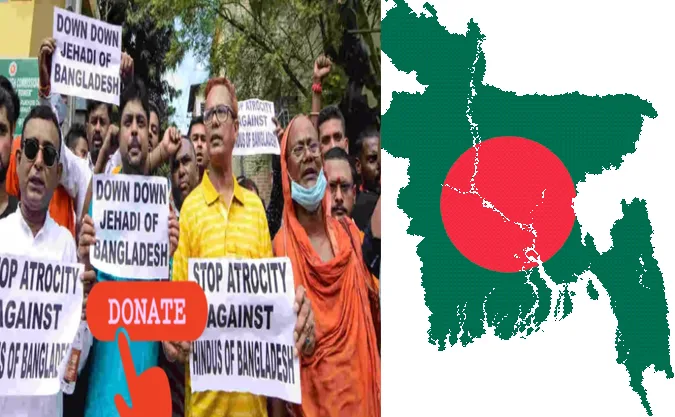
Ahead of the Bangladesh elections, the Hindu community was facing the wrath of political violence. Several Hindu families were forced to vacate their houses in Shailkupa upazila in the Khulna division of Bangladesh and sell them at giveaway prices to avoid religious persecution.
As per a report by Kalbela News, the minority community was facing threats from Islamists and hence many Hindu families are migrating to other parts of the country.
On an average more than 1000 temple and hindus homes were attacked, 1000’s of sexual assaults on Hindu women were reported in the
past few years.
Bangladesh Hindu Population
The Hindu population has undergone a steady attrition over the years, from 28 per cent in 1940 to 8.96 per cent in 2011 and (7.53 per cent today), with especially two periods of sharp decline—the first around the time of partition and the second during the 1971 Bangladesh War that resulted in the liberation of Bangladesh.
Over the past 50 years, the total population of the country has more than doubled, but not in the case of Hindus. The number of Hindu persons in the country had dropped by around 7.5 million (75 lakh). The number of Buddhists, Christian and persons of other religions has remained more or less constant.









Comments