





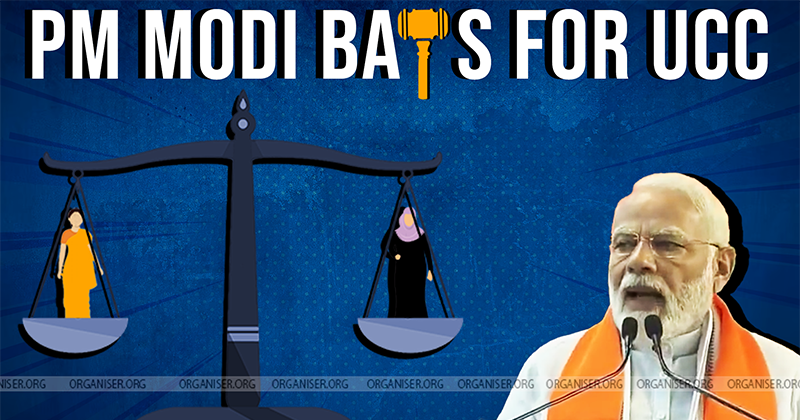
On August 15, 2024, during his Independence Day address from the Red Fort, Prime Minister Narendra Modi called for the implementation of a Uniform Civil Code (UCC) in India. Criticising the current civil code as “communal,” PM Modi emphasised the necessity of a “secular” code that guarantees equality for all citizens, regardless of their religion.
Since his speech, opposition parties, including the Congress, have accused the BJP of undermining the very essence of the Constitution, labelling the move as not only anti-constitutional but also anti-Ambedkarite.
However, these claims overlook the fact that Dr. B.R. Ambedkar, a principal architect of the Constitution, was a staunch supporter of the UCC and advocated for its enactment.
PM Modi’s speech
In his address, PM Modi pointed out the shortcomings of the existing civil code, stating, “The Civil Code that we are living with is actually a Communal Civil Code in a way. It is the need of the hour that there be a Secular Civil Code in the country… only then would we be free of discrimination on the basis of religion.”
He further stressed the importance of moving towards a UCC, adding, “The Supreme Court has repeatedly discussed the Uniform Civil Code and has issued directives on multiple occasions. A large section of the country believes— and it is true— that the Civil Code that we are living with is actually a Communal Civil Code in a way.”
PM Modi also called for broad-based discussions on the issue, stating, “There must be widespread discussions; everyone should come forward with their opinions, and laws that divide the country on religious lines must be done away with. They have no place in a modern society. Time demands a secular civil code. And then we will be free of religious discrimination.”
Congress opposition
In response, the Congress criticised PM’s remarks, particularly his characterisation of the existing civil code as “communal” and “discriminatory.” The party called it “a gross insult” to Dr Ambedkar.
Congress communications chief Jairam Ramesh wrote on X, “The non-biological PM’s capacity for malice, mischief, and maligning of history knows no bounds. It was on full display today in his Red Fort speech. To say that we have had a ‘communal civil code’ till now is a gross insult to Dr Ambedkar, who was the greatest champion of reforms in Hindu personal laws that became a reality by the mid-1950s. These reforms had been bitterly opposed by the RSS and the Jana Sangh.”
Ramesh also cited the 21st Law Commission’s Consultation Paper on Reform of Family Law, dated August 31, 2018, which stated that a UCC “is neither necessary nor desirable at this stage.”
What did the constituent assembly opine?
During the Constituent Assembly debates, what is now Article 44 of the Indian Constitution was initially drafted as Article 35 (The State shall endeavour to secure for the citizens a uniform civil code throughout the territory of India). Several members, including Mohamed Ismail Sahib, Naziruddin Ahmad, Mahboob Ali Beg, and Pocker Sahib Bahadur, proposed amendments to this draft article. They were concerned about the impact of a UCC on personal laws.
Here are some key points from their proposed amendments:
Mohamed Ismail Sahib suggested adding a clause to protect personal laws, arguing, “If anything is done affecting the personal laws, it will interfere with the way of life of those who have observed these laws for generations.”
Naziruddin Ahmad proposed that changes to personal laws should require the approval of the affected community. He noted, “The goal should be towards a uniform civil code, but it should be gradual and with the consent of the people concerned.”
Mahboob Ali Beg argued that the term “Civil Code” should not cover personal laws, emphasising, “The law as observed by a particular religious community is not covered by article 35.”
Shri K.M. Munshi emphasised that the proposal for a UCC was not new, arguing against claims that it would violate minority rights or infringe on Article 19. He pointed out that the Constitution already allows Parliament to legislate on secular activities even if associated with religious practices. Munshi argued, “When you want to consolidate a community, you have to take into consideration the benefit which may accrue to the whole community.” He further noted that many advanced countries do not allow personal laws for minorities, suggesting that a uniform code would unify India without infringing on religious practices.
Shri Alladi Krishnaswami Ayyar supported Munshi’s view, stating that even during British rule, Muslims accepted a common criminal law. He argued that a UCC would not endanger religious practices and asked, “Why should you distrust much more a national indigenous Government than a foreign Government?” Ayyar concluded that the article should be unanimously passed, as it was well-considered and aimed at unifying the nation.
Before the amendments were put to a vote, Dr. B.R. Ambedkar made the following remarks:
Dr. Ambedkar stated, “I cannot accept the amendments to this article. I do not intend to discuss whether India should have a Uniform Civil Code or not, as this has already been addressed by my colleagues Mr Munshi and Shri Alladi Krishnaswami Ayyar. However, I was surprised by Mr Hussain Imam’s question on whether it is possible or desirable to have a uniform code of laws for such a vast country. We already have a uniform code covering almost every aspect of human relationships.”
He then challenged the claim that Muslim personal law was uniform and unchangeable across India, saying, “Up until 1935, the North-West Frontier Province was governed by Hindu law in matters of succession, not Shariat law. It was only in 1939 that the Central Legislature applied Shariat law to Muslims in that region. Similarly, in other parts of India, like the United Provinces and Bombay, Muslims were also governed by Hindu law in succession matters until the Legislature intervened in 1937 to apply Shariat law uniformly.”
Dr. Ambedkar further noted, “In North Malabar, the Marumakkathayam law, a matriarchal system, was followed by both Hindus and Muslims. Therefore, it’s incorrect to claim that Muslim law has always been immutable and uniformly applied across India.”
Dr BR Ambedkar: A staunch supporter of UCC
Babasaheb was a great votary of UCC. He saw it as a fundamental edifice of our constitutional scheme. Deliberations of the Constituent Assembly, particularly those held on November 23, 1948, documenting Babasaheb’s strong espousal of UCC, are a great testimony to his unflinching commitment for unity and integrity of the nation through the constitutional instrument of UCC.
Dr Ambedkar articulated his support for a UCC during the debates in the Constituent Assembly. His statements emphasised the importance of national unity, equality, and the separation of religion from personal laws. Below are detailed quotes from Ambedkar on the subject:
1. “It is no part of religion to enter into civil matters such as inheritance, marriage, and divorce. I personally do not understand why religion should be given this vast, expansive jurisdiction so as to cover the whole of life and to prevent the legislature from encroaching upon that field.”
Context: Ambedkar argued that while religious freedom is important, it should not extend to civil matters like marriage, inheritance, and divorce. He believed that these areas should be governed by laws that apply equally to all citizens, rather than being dictated by religious practices. This perspective was foundational to his support for a Uniform Civil Code.
2. “We must all remember— including Members of the Muslim community— that if the law is to be static and uniform, it is possible for all to live under that system.”
Context: Ambedkar emphasised that a UCC would provide a stable and uniform legal framework for all citizens, regardless of their religious affiliations. He believed that such a code would help prevent divisions and ensure that everyone is treated equally under the law.
3. “The sovereignty of the Parliament and the unity of the Nation should be supreme, and no community should be allowed to come in the way of this.”
Context: Ambedkar underscored the supremacy of the Parliament and the importance of national unity. He argued that no community, religious or otherwise, should be allowed to obstruct the implementation of laws that are in the national interest, including the adoption of a UCC.
4. “There is nothing extraordinary in saying that the personal law of the Mohammedans should be changed. The personal law of the Hindus has been changed… I am utterly surprised at the opposition.”
Context: Ambedkar pointed out that personal laws, including those of Hindus, had already been subject to change and reform. He expressed surprise at the opposition to reforming Muslim personal laws, arguing that all communities should be open to change, especially in the interest of justice and equality.
5. “We are not merely laying down a mechanism to enable people to settle their disputes. What we are doing is laying down a code which will promote social justice and advance the welfare of the people as a whole.”
Context: Ambedkar highlighted that the objective of a UCC was not just to resolve disputes but to promote social justice and improve the welfare of all citizens. He saw the UCC as a tool for achieving greater equality and fairness in Indian society.
These quotes illustrate Ambedkar’s strong support for a Uniform Civil Code as a means of ensuring equality, promoting social justice, and reinforcing national unity. His views continue to be a significant part of the discourse on the UCC in India.















Comments