




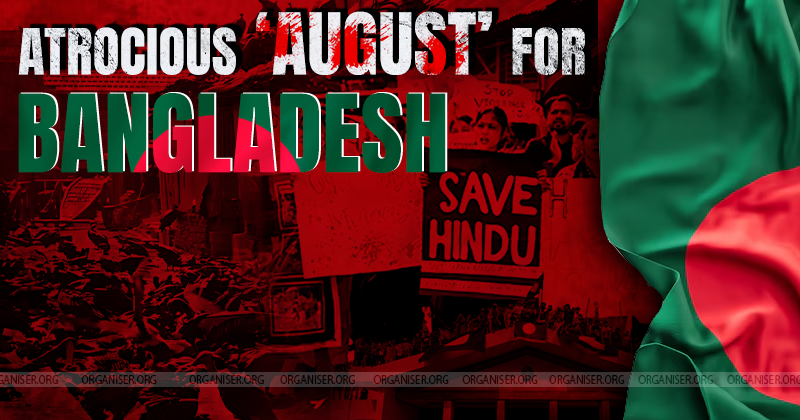
August has been a month marked by horrific violence against the Hindu community in Bangladesh. From the Direct Action Day in August 1946 to Partition in 1947 to assassination of Sheikh Mujibur Rahman in 1975, and the recent August 2024 genocide, Hindus have faced relentless persecution.
These events have resulted in massacres, rapes, abductions, and the systematic destruction of Hindu properties, leading to a significant decline in the Hindu population from 28 percent in 1940 to 7.53 percent today.
The history of atrocities against Hindus in Bangladesh underscores a pattern of systemic violence and persecution spanning decades. This persecution of Hindus highlights their ongoing struggle for safety and rights from the very first day.
Direct Action Day, August 1946,
The Muslim League Council proclaimed August 16, 1946 as ‘Direct Action Day’ in order to accentuate their demand for a separate Muslim homeland after the British left the Indian subcontinent. Their main aim was to attain a different country with a Muslim majority.
Muslims chose August 16, 1946 as the day to accomplish their mission simply because the Battle of Badr occurred on this day and it resulted in the first decisive victory of Islam over the heathens and the subsequent conquest of Mecca.
The All-India Muslim League decided to take a “direct action” using violence to intimidate Hindus and their leadership for a separate Muslim homeland after the British exit from India. SN Usman, the Mayor of Calcutta and the Secretary of the Calcutta Muslim League circulated a leaflet in Bangla which read “Kafer! Toder dhongsher aar deri nei! Sarbik hotyakando ghotbe!” (“Infidels! Your end is not far off! There will be a massacre!”).
The black day began with a large public meeting of the Muslim League in the Calcutta Maidan. Muslim workers from Howrah’s Jute Mills began pouring into the city headed toward Ochterlony’s needle monument for the mammoth meeting to ‘celebrate’ Direct Action day”. No one from any non-Muslim press was present at the meeting. Suhrawardy who was then the Premier of Bengal said that he would see how the British could make Mr. Nehru rule Bengal. Direct Action day would prove to the first step towards the Muslim struggle for emancipation.
The crowd included a large number of Muslim goondahs (hoodlums) and that their ranks swelled as the meeting ended. They made for the shopping centres of the town where they at once set to loot Hindu shops and houses. They then spread out, howling their battle cries “Allaho Akbar, Pakistan Zindabad, Muslim League Zindabad, Lekar Rahenge Pakistan, Ladke Lenge Pakistan”.
Then the torching began. Hindu-inhabited areas such as the southern part of Amherst Street, Bortola, Jorasanko were in flames in no time. The fires burnt right through the night, punctuated by the war-cries of “Allaho Akbar, Ladke Lenge Pakistan”. The process continued unabated the next day. An Additional Judge of Alipore Court was killed while trying to save a little boy who was fleeing for his life from the goondahs. Until midmorning of this day, that is the 17th there was no sign of any policemen anywhere.
A mob of violent Islamists attacked on Victoria college. All girls were raped in classroom, then killed and hung naked on windows. Hindu girls’ naked bodies were hung from hooks at Raja Bazar beef shops. Large number of the participants were reported to have been armed with iron bars and lathis.
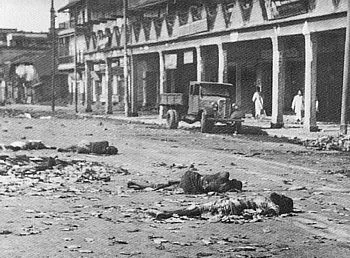
The bestiality of Razakars affected Hindus of Kolkata across sections, castes, class, professions. For example, Rajab Ali was the leader of the Muslim mob from Kasai bustee (slum) which set fire in two Hindu slums of Sasthitala mostly inhabited by Dalits i.e. so-called lower castes. Suhrawardy personally visited the slum and areas around Narkeldanaga main road and Maniktala main road to organise groups of Hindu hunters in order to ensure a flood by the blood of Hindu corpses.
In another shocking incident in Metiaburuz, around seven hundred Bihari and Odiya labourers were butchered by a Muslim mob which was led by local communist party leader Sayed Abdulla Farooqui. On August 17, Farooqui, the President of Garden Reach Textile Workers’ Union, along with Elian Mistry, a hardline Muslim League hooligan, led a huge armed mob into the mill compound of Kesoram Cotton Mills in the Lichubagan area. Hindu labourers were also part of the same union of Communist Party of India. They even showed their union cards to the bloodthirsty mobs whom they used to know as ‘comrade-in-arms’ only to get laughed away and murdered!! Their bodies were chopped and thrown into the river. In the early hours of August 17 morning, a Hindu household at 25, Budhu Ostragar Lane was ransacked by a Muslim mob. 25 members out of 37 were murdered. House was looted and set on fire.
American author Richard Benkin in his book A Quiet Case of Ethnic Cleansing: The Murder of Bangladesh’s Hindus has written that after 1947, 5 crore Hindus in Bangladesh were either killed or converted.
The Partition of August 1947
The Partition of India after the British left, bifurcated the land into three, with one being Bharat, East Pakistan and West Pakistan. Although the populations of both zones were almost equal, the political concentration and the decision-making bodies were concentrated in west Pakistan only.
When the partition of India and Pakistan was in papers only, a request for an independent and united Bengal was mooted by the then-Prime Minister of Bengal in British India (1946-1947). However, his demands were never met and partition was done as per Mountbatten’s plan.
Soon after the boundaries were drawn, two separate nations came into existence. Pakistan was having two geographically and culturally separate areas to the east and the west with India in between.
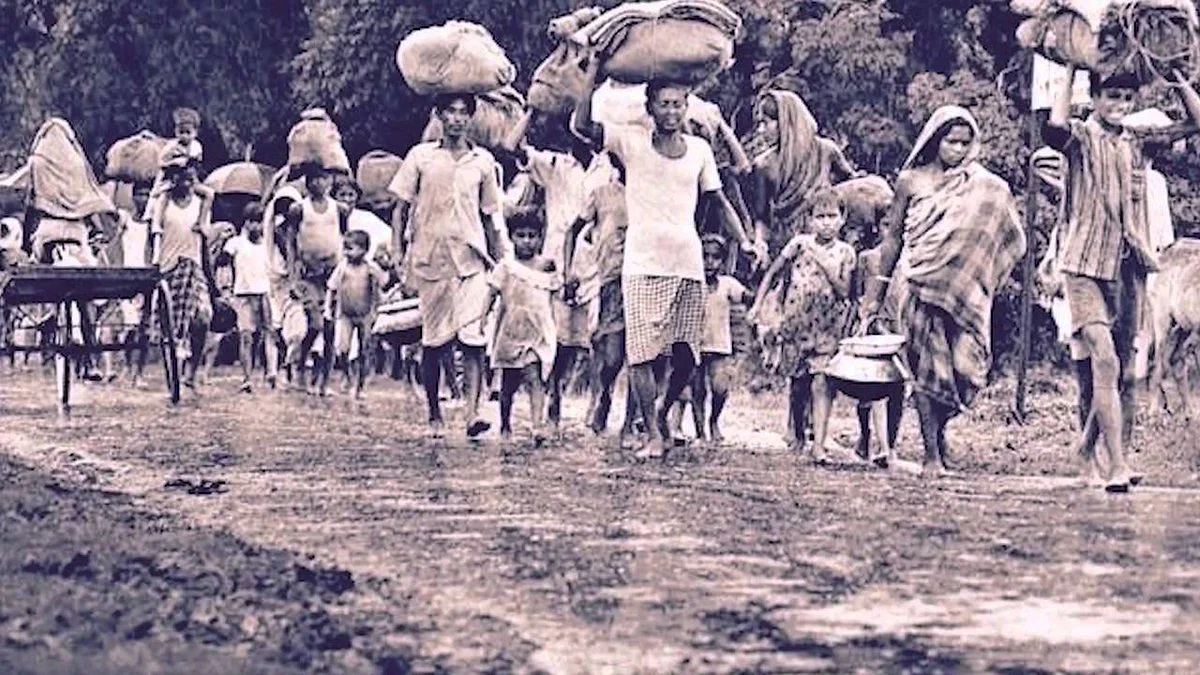
The authorities of West Pakistan viewed the Bengali Muslims in the East as “too ‘Bengali’” and their application of Islam as “inferior and impure”, believing this made the Bengalis unreliable “co-religionists”. And the Bengali Hindus were always under their target. The authorities at the west started assimilating the Bengalis culturally.
In March 1948, The founder of Pakistan, Jinnah declared in a civic reception in Dhaka that “Urdu and only Urdu will remain as the state language of Pakistan”. The students of Dhaka University instantly protested this declaration in front of Jinnah which led to army invation in East Pakistan.
Army units entered villages asking where Hindus live; it was “common pattern” to kill Hindu males. Hindus were identified because they were not circumcised. There were barely any areas where no Hindu was killed. Sometimes the military also massacred Hindu women.
Mass murder of Hindus, August 1971
It was only the month of August when Pakistan army ruthlessly killed lakhs of Bengali Hindus in Bangladesh. The Pakistan army eastern command headquarters officials in Dhaka made clear the Government’s policy on East Bengal that After the elimination of Hindus, their property was going to be shared among Muslims and Pak army.
Moreover, at the international level, the United States of America and the People’s Republic of China considered the crisis as an internal affair of Pakistan. On the other hand, India, Soviet Union and her allies, and general masses in Japan, and Western countries stood solidly behind Bangladesh. In order to gain strategic advantage vis-a-vis Sino-US-Pakistan axis, Indo-Soviet Friendship Treaty was signed on 9 August 1971. It provided a new dimension to the Liberation of Bangladesh.
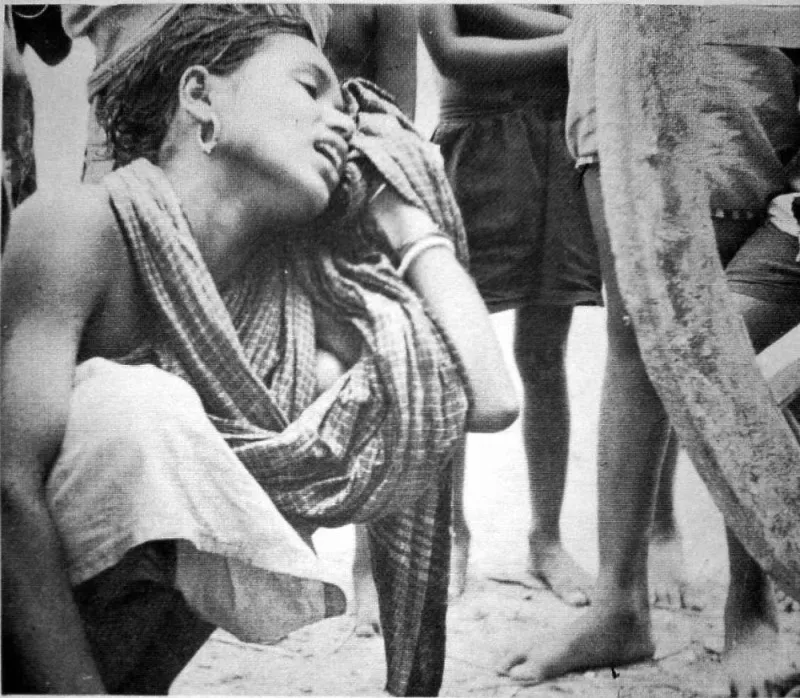
Assassination of Sheikh Mujibur Rahman, August 15, 1975
Sheikh Mujibur Rahman (Bangabandhu), the father of the Nation (Bangladesh) was assassinated along with most of his family in his personal residence on August 15, 1975 during a military coup by renegade army officers. His wife, brother, three sons, two daughters-in-law, and hosts of other relatives, personal staff, police officers, a brigadier general of the Bangladesh Army and many others were killed during the coup. More than 40 people got injured. The army chief KM Shafiullah was caught unaware and failed to stop the coup. Mujib was shot on the staircase of his house. Mujib was warned by many including the Indian intelligence about a possible coup. Mujib shrugged off these warnings by saying his own people would never hurt him.

Bangladesh Hindu Genocide and Sheikh Hasina’s exit, August 5, 2024
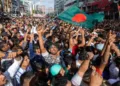
Hundreds of people have died and most of them are hindus in violent protests rooted in quota protests. Anti-government protestors marched to Dhaka and stormed into the PM Sheikh Hasina’s palace following a weekend of violence left dozens of people dead as the military imposed a curfew for an indefinite period and authorities cut off internet access in an attempt to stem the unrest.
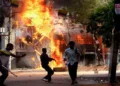
The Muslim mob in Bangladesh has created an havoc on minority Hindu as in 52 districts, instances of attacks of Hindu homes burnt, shops looted, temples vandalised have been reported.
The protests, which have drawn hundreds of thousands, began in July with students demonstrating against a controversial quota system that allocated government jobs. It turned violent on July 16 as student protesters clashed with security officials and pro-government activists, until the Supreme Court stepped in to roll back the decision. A renewed wave of anti-government demonstrations carried over into the weekend, and violent clashes reignited.
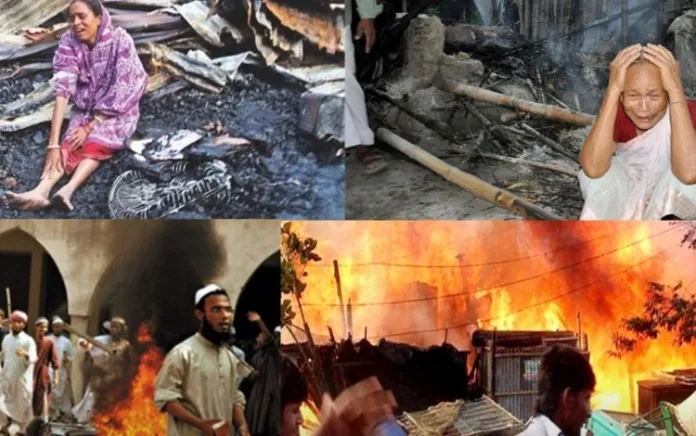
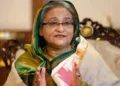
The protests, which show no signs of abating, turned into a major crisis for Hasina, whose 15-year-long dominance over the country ended. Prime Minister Sheikh Hasina has fled the country on an Air Force 1 on August 5 afternoon fearing a possible life threat and is currently residing in India.
Following this, on August 6, Separate Dhaka Metropolitan Magistrate Courts granted bail to 2200 members of the Bangladesh Nationalist Party (BNP) and banned outfit Jamaat-e-Islami. They had been lodged in jail over recent turmoil across the country centring quota reform movement.
The accused who have been granted bail include BNP standing committee members Amir Khasru Mahmud Chowdhury, Nazrul Islam Khan, Senior Joint Secretary General Ruhul Kabir Rizvi, Shamsur Rahman alias Shimul Biswas, Saiful Alam Nirob, Rafikul Alam Maznu, Jamaat Secretary General Mia Golam Parwar and Bangladesh Jatiya Party Chairman Andaleev Rahman Partho.
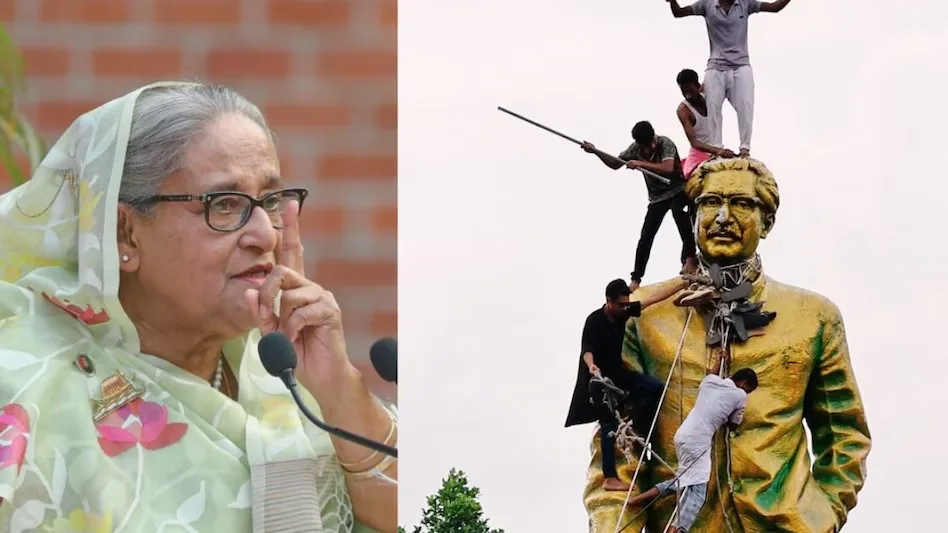
Several other inmates who have been released on bail belong to the Pakistan-linked Jamaat-e-Islami (JeI) Bangladesh, the Islamist radical banned group, that has been running havoc on the streets of Bangladesh after the violent ouster of Sheikh Hasina and terrorising minority communities, particularly, Hindus.
Jamaat-e-Islami members have been making a list of Hindu businesses and Hindu houses since the fall of Sheikh Hasina. The Hindus, on the condition of anonymity due to security concerns also said that many are unable to move to safer locations because the Jamaat-e-Islami groups and others Islamists are roaming the streets with guns, making it impossible for them to move to safer locations.












Comments