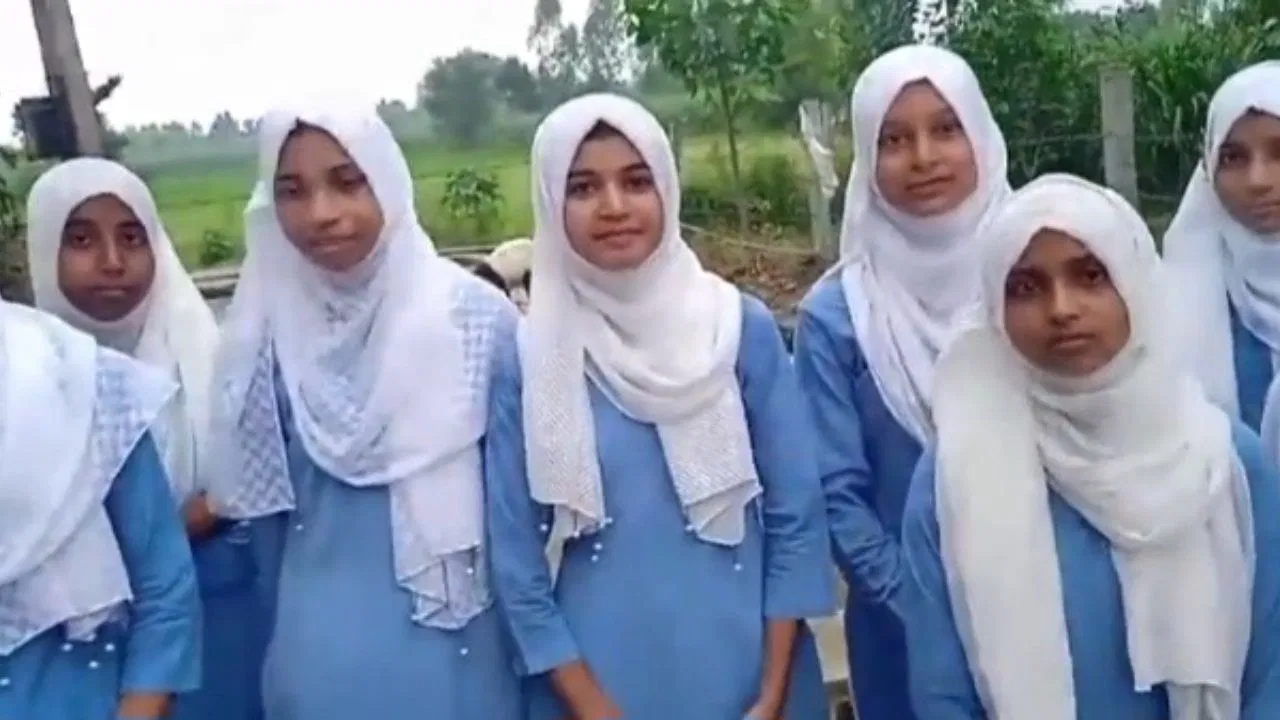
On August 12, a video surfaced online showing hijab-clad girls in school uniforms, accusing their principal of unfairly punishing them for wearing the hijab (a head scarf). This incident, from the Nahtaur area in Bijnor district, Uttar Pradesh, quickly gained widespread attention. The video was shared by various media outlets and intellectuals, who highlighted the alleged threat to “Islam” and “religious freedom” as a result of this situation. Yet, a deeper investigation by Organiser unveils a more nuanced and emotional backdrop to the controversy.
The viral video depicts students arriving at their college wearing hijabs only to be sent home by the principal after the morning assembly. This led to protests by parents and locals, which attracted police intervention and a visit from Circle Officer Rakesh Vashistha and Inspector Rajesh Kumar to restore order.
District Inspector of Schools Jai Karan Yadav clarified, “The incident occurred at Mahua village. The principal simply asked the students to adhere to the established dress code. Our team has spoken with the parents, who have agreed to comply with the dress code. It appears to have been a misunderstanding between the parents and the school staff.”
What the Principal Told Organiser?
To understand the principal’s decision, Organiser reached out to Principal Shivendra Pal Singh on August 13.
Singh explained that his school, located in a village with 600-700 students, including around 100 Muslim students, has strict uniform requirements. This includes wearing clean clothes, dupattas, and adhering to specific hairstyles. Given the school’s rural setting, the staff, including Singh, must enforce these rules strictly to ensure uniformity.
Since joining the school in August 2022, Singh has worked diligently to improve the student’s adherence to the uniform code. He noticed that many students were not following the dress code and made efforts to provide uniforms and shoes to those in need, utilising both government schemes and NGO support. His efforts have significantly increased compliance among students.
Singh shared, “Recently, I have observed that some students, particularly from higher grades, have been disregarding the uniform code, including girls wearing hijabs. They were even encouraging younger students to ignore the rules, saying, ‘No matter what the principal says, we won’t follow his directives.’”
He explained, “I spoke with the students and told them that we should maintain a uniform appearance at school to prevent our religious or other identities from being emphasised. Wearing hijabs makes it easier to identify the students as Muslim, which goes against the principle of uniformity and equality we aim to uphold.”
“I have repeatedly reminded students to adhere to the standard dress code, and some have complied, with Muslim girls removing their hijabs and following the prescribed uniform. However, recently, the emphasis on wearing hijabs has intensified. Just a few days ago, after prayer time, I instructed all students who were not adhering to the dress code—including 20-25 boys without shoes, girls with improperly fixed dupattas, and 12-15 girls in hijabs—to comply.”
He noted that as Muslim girls began flouting the dress code, Hindu students also started disregarding it. They wore dupattas as shawls, and boys stopped wearing shoes. When confronted, they replied, “You allow them to wear hijabs but have issues with us when we don’t follow the rules.”
Sensing growing unrest, the principal called the girls wearing hijabs to his office. They reported that junior students had been pressured by seniors to wear hijabs, insisting they would not comply with his directives and that their parents supported their stance. The principal then requested that the parents come to school the next day.
The same day, only two guardians arrived with around 150-200 villagers. The parents argued, “This is a matter of our religion, and our children will come to school in hijabs. Do not impose uniformity on our children. If you have a problem with this, we will withdraw our girls from school.”
He advised the parents to instruct their children that while they were permitted to wear hijabs, they should not pressure other students to do the same. Although the parents agreed, the situation took a turn as students began encouraging their peers with statements like, “If the principal allows us to wear hijabs, why can’t you? We’re fighting for our religion, and this is what you’re doing to us.”
The parents also began rallying other Muslim families, persuading them to send their children to school in hijabs, fearing repercussions within their community if they did not comply. Consequently, the number of girls wearing hijabs increased to 12-15.
When the principal inquired about this sudden shift, the students explained that they and their families felt pressured to adhere to Islamic practices, and non-compliance could result in community backlash. Following this, the principal called the students’ parents to the school.
He added, “On the day I requested the parents come to school the next day, one of our staff members, Waseem Siddiqui, manipulated the students by urging them to bring their parents immediately. Despite normally not allowing students to leave during school hours, I made an exception that day.”
The students, accompanied by their parents and a crowd of 150-200 people, including political figures, arrived at the school. Among them was Shahbaz Khan, a local Samajwadi Party leader and the sarpanch of Baruki village, who recorded the video of the students. In the video, Khan can be heard directing the filming and asking, “Let’s make the video in front of the school; it doesn’t look good here.”
Khan questioned the principal, “Why did you expel them for wearing hijabs? Which constitution prohibits students from wearing hijabs to school?” The principal clarified that the policy was about maintaining uniformity, not religious discrimination. Khan responded, “Our daughters will come like this, and if this is what you want, your dreams will never come true.”
The video was later circulated on social media, escalating the issue.
The principal also noted that students are granted special leave for prayers, with the school day ending at 1:30 PM. During Eid and other festivals, students are given additional time off to attend prayers at the mosque or at home. Every Friday, 100-150 students receive special permission for prayers. The school management has accommodated these requests.
Refuting the allegations, the principal emphasised, “Rules should be applied equally to all students. It should not be turned into a religious issue.”
Similar cases from the past
Kanpur Hijab Issue
The District Magistrate of Kanpur, Rakesh Singh, launched a formal investigation into the incident involving three female students who appeared in hijabs at a government inter-college in Bilhaur, Kanpur, Uttar Pradesh. This raised concerns about the adherence to the institution’s dress code. Singh tasked Sub-District Magistrate (SDM) Rashmi Lamba with investigating the matter and submitting a report by August 17, 2024.
The situation emerged on August 3, 2024, when the students arrived at the college wearing hijabs, violating the dress code. Teacher Jyoti reprimanded them, but they refused to comply, insisting on their right to wear hijabs even if it meant expulsion. Principal Surjeet Singh Yadav then imposed a strict ban on non-uniform attire and contacted the student’s parents, who promised to ensure their daughters would follow the dress code moving forward.
Karnataka Hijab Debate
This incident echoes the hijab controversy that began in Karnataka in late 2021, when Muslim students were barred from classes for wearing hijabs, leading to protests and a statewide debate. The Karnataka High Court later upheld the state’s dress code enforcement, ruling that hijabs were not an essential religious practice and that institutions could mandate uniform policies.
Mumbai Hijab Issue
In a similar case from Mumbai, a Supreme Court bench of Justices Sanjiv Khanna and Sanjay Kumar scrutinised a college’s ban on hijabs, questioning why similar restrictions weren’t applied to other religious symbols like tilaks and bindis. They emphasised that students should have the freedom to choose their attire and criticised the college’s selective enforcement of dress codes. This review follows a petition challenging a Bombay High Court ruling that upheld the college’s ban.
The dispute originated on May 1, 2024, when Chembur Trombay Education Society’s NG Acharya & DK Marathe College enforced a dress code prohibiting hijabs, niqabs, and other religious attire. Nine female students, arguing that this restriction violated their fundamental rights, sought legal redress after their requests to lift the ban were ignored by the college administration.
Kerala Hijab Debate
A similar controversy also emerged at Paingottoor St Joseph Higher Secondary School in Kothamangalam, Kerala, in August 2024, regarding the demand for a designated space for namaz. The issue began when two Class XII students were found performing namaz in a classroom, contrary to school rules. Despite initial warnings, one student continued to pray, leading to a confrontation with the principal and their parents.
The principal denied the request for a separate namaz space, citing Kerala Education Rules that permit worship time only until 2 pm on Fridays. Tensions rose as parents threatened to escalate the matter if their children were not allowed to pray at school. Supporters of the principal, including the Catholic Congress and local church officials, backed the decision, citing concerns about disrupting school discipline.
This incident mirrors a similar controversy at Nirmala College in Muvattupuzha, where students requested a dedicated prayer space, sparking broader debates about religious practices in educational institutions.