





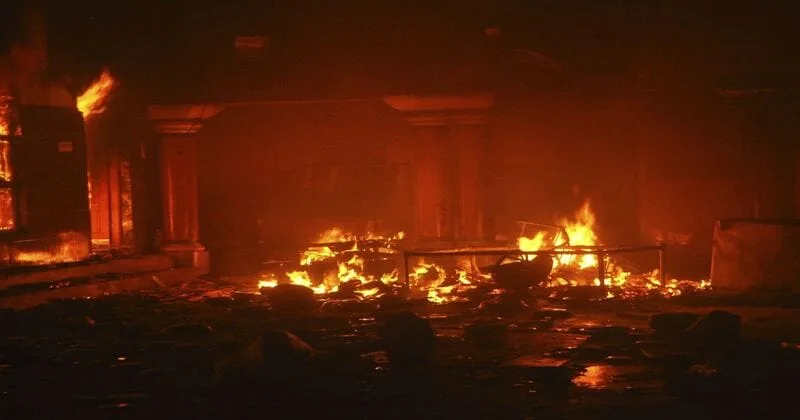
On August 5, former Prime Minister Sheikh Hasina of Bangladesh resigned and fled the country amid escalating protests. In her absence, the Bangladeshi Army took control, and an interim government led by Muhammed Yunus was swiftly established. During this period, Bangladeshi Hindus faced increased attacks from Islamist groups. Such incidents are unfortunately not rare; reports of violence against Hindus, including attacks on their temples and businesses, have been documented. As global awareness of these attacks grows, here is an overview of recent incidents targeting Hindus in Bangladesh.
2001: Bhola Violence
December 2019: During the parliamentary discussion on the Citizenship Amendment Bill, Home Minister Amit Shah highlighted the Bhola violence to emphasise the ongoing persecution of Hindus. The Bhola violence refers to a series of brutal attacks in 2001, shortly after the Bangladesh National Party (BNP), led by Begum Khalida Zia, assumed power. Following their election victory, the BNP and Jamat-e-Islami supporters launched coordinated assaults on Hindus across various districts, including Bagerhat, Barisal, Bogra, Brahmanbaria, Chitgaon, Fani, Ghazipur, Jesor, Khulna, Munshiganj, Bhola, Narayanganj, and Sirajganj.
In October 2001, the Lalmohan region of Bhola witnessed extreme violence. Hindu homes were raided, looted, and vandalised; trees were cut down, and crops were destroyed. In Char Fasson, BNP-affiliated Muslim mobs attacked and raped over 200 Hindu women, with victims ranging from an 8-year-old child to a 70-year-old woman. A subsequent Judicial Commission inquiry revealed that more than 25,000 leaders and local party workers from the BNP and Jamat-e-Islami were implicated in these attacks. This violence resulted in numerous deaths and injuries and forced many Hindus to flee to India.
2003: Tragic Arson Attack in Banshkhali
November 18, 2003: In Banshkhali Upazila, Chittagong district, Bangladesh, 11 members of a Hindu family were brutally burned alive by Islamists seeking to seize their land. The victims, led by Tejendra Lal Sheel, resided in Sheelapara, Sadhnopur village. Prior to the attack, the assailants had attempted to coerce Sheel into relinquishing his property. When he refused, the attackers set his house ablaze.
Under the orders of Mokhtar Ahmad, Mahbub Rashid sealed the house’s doors and windows, trapping the family inside. Rubel, another attacker, then set the house on fire, resulting in the deaths of 11 individuals, including six children. Initially, police labelled the incident as a robbery, but local residents, such as a hairdresser named Nepal, questioned this claim since eight nearby houses were untouched.
Following public outrage, police reopened the investigation. Mahbub Rashid confessed that 12 people were involved, with six entering the house and six acting as lookouts. According to Rashid, Rubel directed the arson after the family resisted with acid. The attack was orchestrated by Aminur Rahman Chowdhury, a leader of the ruling Bangladesh National Party (BNP) at the time, to illegally acquire Sheel’s land. The trial for this horrific crime is still ongoing.
2012: Jamaat-e-Islami’s Assault on Hindu Shops and Homes in Hathazari and Fatehpur
Between February and November 2012, and extending into early 2013, a series of violent attacks targeted minority communities across various locations in Bangladesh, including Hathazari, Bashkhali, Chittagong, Kaliganj in Satkhira, Chirirbandar in Dinajpur, Ramu in Cox’s Bazar, Sathia in Pabna, and Barisal.
The violence began on February 9-10, 2012, in Hathazari, where members of Islami Chhatra Shibir, the student wing of Jamaat-e-Islami Bangladesh, incited local Muslims to launch assaults on Hindu properties. This orchestrated violence resulted in the destruction of eight temples, twelve shops, and numerous homes.
Despite the arrest of the perpetrators by the police, they were soon released on bail with the aid of Hefajat-e-Islam leader Ahmed Shafi. Nearly a decade has passed since these events, yet justice remains elusive for the Hindu victims, who continue to suffer from the aftermath of the attacks.
The 2012 violence in Hathazari marked the beginning of a series of targeted attacks by Jamaat-e-Islami, a fundamentalist group in Bangladesh. Following the Hathazari incident, the violence spread to Fatehpur and Chakdaha in Satkhira in March and April 2012. During these attacks, several Hindu homes, along with a few belonging to Muslims who supported their Hindu neighbours, were destroyed. At least 12 houses were reduced to ashes, and two villages were heavily vandalized over a two-day period.
March 31, 2012: The Daily Drishtipat, a local newspaper with Islamist backing, falsely claimed that a school play had made offensive remarks about the Prophet Muhammad. The paper distributed copies widely, inciting Islamists to attack and loot Hindu properties. Despite the severity of the violence, the police largely ignored the situation, allowing nearly 10 Hindu families’ homes to be looted and burned.
Initially, the mainstream Bangladeshi media largely ignored the events. However, the situation gained attention after Hindu students from Jagannath Hall at Dhaka University protested against the persecution, prompting the media to cover the violence.
August 4, 2012: A coordinated attack was executed by local extremists on the Hindu community in Chirirbandar Upazila, Dinajpur District, Bangladesh. This premeditated assault resulted in the destruction of 50 Hindu households.
The violence was incited by an inflammatory speech delivered by Professor Hamida Khatun from Chittagong Metropolitan College, with the backing of Chirirbandar Upazila Parishad chairman and Jamaat-e-Islami leader Aftab Ali Molla. The speech was intended to incite local Muslims against the Hindu population. Following the provocative address, supporters of Jamaat-e-Islami took to the streets, leading to widespread support for the attacks. The result was the complete devastation of homes belonging to at least 50 Hindu families, leaving their properties reduced to ashes.
September 29, 2012: Islamic extremists targeted a predominantly Buddhist neighbourhood in Ramu, Cox’s Bazar, Bangladesh. The violence was sparked by a fake Facebook account purportedly belonging to Buddhist youth Uttam Kumar Barua, which allegedly featured a desecration of the Quran. Islamists, accusing Barua of insulting Islam, attacked Buddhist monasteries and Hindu temples in the area.
The violence soon spread to Ukhia Upazila in Cox’s Bazar and Patiya Upazila in Chittagong, where additional Buddhist and Hindu sites were destroyed. Reports indicate that the image was falsely attributed to Barua. The attacks involved an estimated 25,000 Muslims who targeted Buddhist communities in Ramu.
2013: Bangladesh Anti-Hindu Violence Following War Crimes Verdict
February 28, 2013: The International Crimes Tribunal sentenced Delwar Hossain Sayeedi, the vice president of Jamaat-e-Islami, to death for war crimes committed during the 1971 Bangladesh Liberation War. In retaliation, Jamaat-e-Islami and its student wing, Islami Chhatra Shibir, launched violent attacks against Hindus across Bangladesh.
The ensuing violence resulted in over 100 deaths, including police personnel, and led to widespread looting, property damage, and the burning of Hindu homes and temples. Reports from minority leaders estimate that more than 50 Hindu temples and 1,500 Hindu homes were destroyed across over 20 districts during the 2013 anti-Hindu violence.
2014: Retaliation Against Hindus Following Election Boycott
In 2014, violent clashes erupted across Bangladesh after Hindus chose to participate in the 10th general elections, defying a boycott call from the primary opposition, the Bangladesh Nationalist Party (BNP), and its ally Jamaat-e-Islami. Following the elections, BNP and Jamaat-e-Islami activists retaliated against the Hindu community, targeting them across various districts.
In the aftermath, Hindu homes were looted, vandalised, and set ablaze in several regions, including Thakurgaon, Dinajpur, Rangpur, Bogra, Lalmonirhat, Rajshahi, Chittagong, and Jessore. The violence left hundreds of Bengali Hindus homeless and resulted in the destruction of numerous Hindu temples. This period of unrest saw widespread property damage, with Hindu religious sites and homes severely impacted by the attacks.
2016 Nasirnagar and 2017 Rangpur Violence: Escalating Attacks on Hindus in Bangladesh
October 2016: Nasirnagar Upazila in Brahmanbaria, Bangladesh, witnessed a severe outbreak of violence when a Muslim mob attacked the Hindu community over an alleged Facebook post. The unrest, triggered by accusations that a Hindu fisherman had defamed Islam on social media, led to the looting of over 300 Hindu homes and the desecration of at least 19 temples. The violence left approximately 100 people injured, including several temple devotees.
The violence against Hindus continued into November 2017, when a similar incident unfolded in Thakurpara village, Rangpur Sadar Upazila. On November 10, 2017, a Muslim mob targeted 30 Hindu houses, looting, vandalising, and setting them on fire. The unrest was fueled by rumours that Titu Roy, originally from Thakurpara but living in Narayanganj, had posted derogatory content about Prophet Muhammad on Facebook.
The subsequent violence resulted in one death and several injuries, with protesters also burning Titu’s house. An investigation later revealed that the inflammatory posts were made by a different account with a similar name, not by Titu Roy. The attacks highlighted ongoing sectarian tensions and violence against Hindus in Bangladesh.
2019: Borhanuddin Violence
October 23, 2019: Borhanuddin, Bangladesh, was the scene of severe violence when rumours spread that Biplob Chandra Baidya, a local Hindu youth, had posted a blasphemous comment about Islam on Facebook. This led to clashes between police and local Muslims, who demanded Baidya’s punishment. The violence resulted in the deaths of four people and injuries to hundreds, including ten policemen. Hindu properties were targeted during the unrest, with 12 homes and one temple vandalised, one home set on fire, and a motorcycle torched. Subsequent investigations revealed that the blasphemous post was actually made by two Muslims, not Baidya.
2020: Surge in Attacks on Hindus Across Bangladesh
May 2020 was marked by a dramatic increase in violence against Hindus in Bangladesh, with at least 30 attacks reported in just one month. According to a press release by the World Hindu Federation, Bangladesh Chapter, the violence resulted in four murders, 12 cases of looting, the illegal occupation of 435 acres of Hindu land, and the displacement of 43 Hindu families, with 10 families forced into exile. The violence began with assaults on Hindu homes in various villages, leading to severe injuries and property damage. In Gopalganj, a Hindu family was attacked, and in Moulvibazar, a poultry farm owned by a Hindu was vandalised. False accusations of blasphemy led to the arrest of a Hindu student and subsequent looting and destruction of his home.
September 11, 2020: The Kali Mandir in Gazipur city, Bangladesh, was desecrated when unknown perpetrators vandalised the idols of Hindu deities. The attackers broke into the temple in the early hours and desecrated four idols, leaving their heads on the ground. Temple President Naresh Raya suspected that the attack might have been orchestrated by influential locals interested in acquiring the temple land. The incident drew widespread condemnation and highlighted ongoing tensions and threats faced by Hindu communities in the region.
2021: Attacks on Hindu Temples and murtis in Bangladesh
In March 2021, several attacks targeted Hindu sites in Bangladesh, reflecting escalating religious tensions.
March 18, 2021: In Uttargaon village, Thakurgaon’s Ranisankail Upazila, miscreants attacked and damaged an idol of the Hindu Maa Kali at a local temple. The attackers vandalised the temple and set the Kali murti on fire, causing significant damage.
Islamists targeted Hindu temples to protest Prime Minister Narendra Modi’s visit to Bangladesh. Hefazat-e-Islami members launched an assault on a train in Brahmanbaria district, injuring ten people and severely damaging the train’s engine room and coaches.
April 2021: In Futala village, Satkhira district, multiple Hindu homes and a local temple were attacked. The assailants looted homes, desecrated three temple idols, and injured at least ten community members. The violence stemmed from a dispute involving the harassment of a minor girl, which escalated into the ransacking of the village.
These incidents illustrate the ongoing vulnerability of Hindu communities in Bangladesh amidst rising sectarian violence.
October 2021: A wave of violence erupted in Bangladesh, targeting the Hindu community during the Durga Puja festival. The violence began with a staged incident in Cumilla, where a Quran was deliberately placed at a Durga temple, sparking false accusations against Hindus. This act triggered a nationwide spree of destruction, resulting in the vandalism of over 315 temples and 1,500 homes across 30 districts, including Chandpur, Chittagong, and Noakhali.
The coordinated attacks led to the deaths of at least 10 Hindus and several women being raped. In Noakhali, the ISKCON temple was severely damaged, and a devotee was killed. The violence included the burning of Hindu homes and the desecration of more than 20 temples in Rangpur. The attacks illustrated the ongoing dangers faced by Hindus in Bangladesh, especially during religious festivals.
2022 Violence Against Hindus in Bangladesh: Temple Attacks and Assaults
In 2022, violence against Hindus in Bangladesh surged with several horrific incidents:
March 17, 2022: An ISKCON temple on Lalmohan Saha Street in Dhaka was attacked by a mob of 150-200 under the direction of 62-year-old Haji Shafiullah. The attackers desecrated idols, vandalised the temple, and looted valuables, injuring devotees Sumantra Chandra Shravan, Nihar Haldar, and Rajiv Bhadra.
April 28, 2022: Controversy erupted when the Bangladesh Nationalist Party (BNP) served beef to Hindu members at an Iftar party in Sylhet. The Hindu invitees were served beef, which they could not eat, leading to accusations of communal insensitivity.
July 15, 2022: A Muslim mob vandalised a temple, grocery store, and multiple homes in Sahapara, Lohagara, Narail. The violence was sparked by a Facebook post allegedly offensive to Muslim sentiments. The mob targeted the grocery store of the family related to the accused.
July 25, 2022: Anuradha Sen, a Hindu girl from Nalitabari Upazila, Sherpur, was abducted and killed. Her kidnapper used her Facebook account to post a picture of her dead body with a message announcing her death. The suspect, Bari Mehdi, had previously threatened her family.
July 29, 2022: Apo Rani Roy, a Hindu woman from Bhervedi Union, Dinajpur, was gang-raped and murdered. Her disrobed body was discovered in a paddy field, and a 10-year-old girl was found nearby in an unconscious state. The victim was killed to prevent identification of the attackers.
August 8, 2022: Mongla Police detained three madrasa students for vandalising idols at Kainmari Temple. The attack followed a dispute over football being played on temple grounds, resulting in the destruction of Maa Kali and Bhagwan Ganesh idols.
September 2022: Ahead of Durga Puja, vandals damaged idols at Kashipur Sarbajanin Durga Temple in Mehendiganj Upazila, Barisal. The temple lacked CCTV, complicating investigations into the incident.
October 7, 2022: A Kali temple in Dautiya village, Jhenaidah, was destroyed. The Kali idol was found smashed, with its head discovered half a kilometre from the temple. This attack occurred shortly after the Durga Puja festival.
These incidents reflect a troubling trend of targeted violence against Hindus in Bangladesh, underscoring the precarious situation for religious minorities in the country.
2023 Attacks on Hindus and Hindu Temples in Bangladesh
January 5, 2023: A mob of Islamists attacked Hindus renovating a century-old Shiva temple in Radhaballabhchak village, East Medinipur, West Bengal. The attackers, who opposed the temple renovation, used bricks and iron rods, injuring many Hindus and damaging the temple. Relatives of the local Hindu Trinamul Panchayat chief were also targeted. Leaders of the Bangiya Hindu Sena called for unity among Hindus to defend their religious freedoms.
January 15, 2023: In Uttar Kandi village, Kotalipara upazila, Gopalganj, Bangladesh, an Islamist mob vandalised a Hindu family’s home over alleged blasphemy by a youth. The accused, who had been living in India for years, was not present, but his family faced the destruction of their property. Fortunately, no casualties were reported in this attack.
January 26, 2023: A group of 9-10 Islamists attacked the Saraswati Puja in Naraich village, Mohanganj upazila, Netrakona district. After being told not to take pictures, they vandalised the Saraswati idol. The attackers were identified as local juveniles from Hatnaiya village, disrupting the puja ceremony and causing distress in the community.
February 5, 2023: At least 14 Hindu temples were attacked and vandalised overnight in northwest Bangladesh. Temples in Sindurpindi, Collegepara, and Sahbajpur Nathpara were damaged, with idols broken and tossed into ponds. Police are investigating, with promises to uncover the truth behind these coordinated attacks.
October 13, 2023: In Comilla, Bangladesh, a protest march by Hindus against MP Bahauddin Bahar’s derogatory remarks about Durga Puja was attacked. The demonstration, organised by several Hindu organisations, faced violence in Nazrul Avenue, resulting in severe injuries to participants, including Aditya Das, Sunil Das, and Tanmoy Das.
November 6, 2023: A Hindu temple in Bijulia village, Shailkupa upazila, was desecrated. The incident follows a similar case from October 2022, where a Kali idol was vandalised. Local Hindus have expressed hope for peace amid upcoming elections, fearing further incidents.
December 15, 2023: In Alfadanga upazila, Faridpur district, Bangladesh, ten idols across three Hindu temples were vandalised. The affected temples included Kendriya Hari Mandir, Sri Sri Vishnu Pagal Mandir, and Sri Sri Damodar Akhara. The attack damaged several deities, prompting local Hindus to protest and demand justice.
These incidents illustrate a troubling pattern of targeted violence and religious intolerance impacting Hindu communities in Bangladesh and West Bengal throughout 2023.
















Comments