





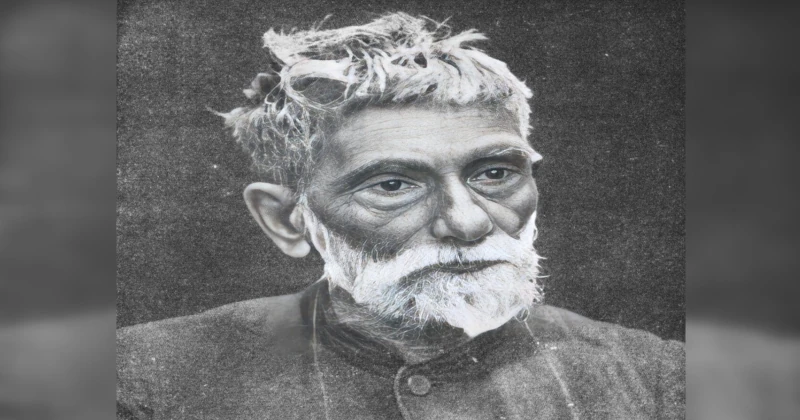
Bharat-centric studies have been the central theme of the National Education Policy. Chemistry has existed as a fundamental branch in the Bharatiya knowledge tradition from the Vedic period to modern times. Acharya Prafulla Chandra Ray is the Bharatiya scholar who is credited with systematically documenting and publishing the manufacture of various chemicals found in the Atharvaveda in the Vedic period.
Acharya Ray’s most important contribution is his book ‘The History of Hindu Chemistry’, the basic text of the Indian form of chemistry. Acharya PC Ray was born on 2nd August 1861. He was not only a chemist; apart from this, his achievement is also in the form of the foundation stone of the chemical industry. The process of reaching the modern form of chemistry is a phased process. In the first phase, there is Vedic era chemistry, under which he has described the chemicals mentioned in Rigveda to Atharvaveda in the first chapter of the introduction of his book titled ‘Alchemical Ideas in the Vedas’. In the next phase, he described the metaphysics of Vaisheshik Philosophy and the chemistry of the Shaiv Tantric era. After that, he described the chemistry used in the medical science of Charak and Sushruta, and later, he described the scientists of modern chemistry.
This idea of Acharya Ray does not deviate from the basic rules of chemistry anywhere. Chemistry started in the Rigvedic era; while showing much evidence in this statement, he has mentioned processes like medical science, metallurgical operations, and the Ashwini Kumars mentioned in the Rigveda. He has propounded the chemical interpretation of Vedic mantras by talking about the personification of chemicals in Rigvedic mantras. After that, to explain the chemistry of the Charak and Sushruta era to the general people, he quoted the Metaphysical ideas of Vaisheshik Philosophy, the science of its basic Pharmacology, in his book. By presenting the chemical analysis of the basic six substances, 24 attributes of Vaisheshik philosophy and establishing their relation with 6 Tastes, he has very seriously analyzed the medical chemical analysis of Charak and Sushruta.
Describing a subject like philosophy as the basic science of a subject like medicine is an achievement in itself. In the description of Ayurveda period, while enumerating the subtle and gross elements, the division of Tanmatra and Mahabhuta of Sankhya philosophy, the atomic theory of Vaisheshik philosophy, the description of Simple, Binary, Tertiary and Quaternary atoms, the description of the 24 attributes of Vaisheshik philosophy like Colour, Savour etc. and proving their utility in medical science is indicative of the mental maturity of Acharya Prafulla Chandra Ray.
Using the nomenclature of pure chemistry while explaining the chemistry of Acharya Charak and Sushruta is indicative of his eternal intellect. Keeping the ancient vocabulary of Kshatriya elements (Alkali), Parad (Mercury), Yashad (Copper), and Kajjali (Black Sulphide of Mercury) with modern terminology is indicative of his interdisciplinary talent. Mentioning the experiments of Indian chemists like Vrinda and Chakrapani with their actual references indicates the extraordinary talent of Acharya Ray. By equating mica and mercury with Har (Shiva) and Parvati (Gauri) and describing their mixture as Amrit, he has propounded the theory of personification of chemicals.
The combination of the two, O goddess, destroys death and Poverty.
Acharya Prafulla Chandra Ray not only propounded the principles of ancient chemistry but also mentioned many ancient instruments in his book, such as Dolayantra, Swedani Yantra, Adhaspatan Yantra, Dheki Yantra, and Valuka Yantra.
Through the above subjects, it can be estimated how extensive and deep Acharya Prafulla Chandra Ray’s study was. The study of Prafulla Chandra Ray is inevitable among the pioneer Acharyas of the Indian knowledge tradition.










Comments