






The intersection of religious conversion and politics has been a contentious issue throughout history and remains a source of socio-political tension in India. The politics of conversion refers to religious conversion as a tool for political power, social control, or demographic change. While religious conversion itself is a personal choice protected under freedom of religion in most democratic constitutions, it becomes problematic when state or non-state actors weaponise conversion for political ends. This can manifest in various forms, from aggressive proselytization campaigns backed by foreign funding to discriminatory laws that incentivize or penalise conversion. When such practices conflict with constitutional principles of secularism, religious neutrality, and equal treatment of all faiths, it can be viewed as a form of constitutional infidelity – a deviation from the spirit and intent of a nation’s founding legal framework.
Understanding the theoretical underpinnings of Conversion
The history of conversion is essential to understanding its current politics. Religious conversion has long been linked to political power and colonialism. Conversion and political discourse have become hotspots that test India’s constitutional values and secular ethos. This article examines how postmodern India’s politics of conversion has contributed to constitutional infidelity, a steady deterioration of allegiance to and respect for the nation’s constitutional values since independence. The historical context, legislative framework, and expressions of conversion politics are examined to illuminate the complicated relationship between religious identification, political manoeuvrings, and constitutional values in the world’s most populous democracy.
The postmodern era’s questioning of grand narratives and fracturing of conventional power structures has reshaped India’s secularism, religious freedom, and national identity disputes. India’s future is contested in the politics of conversion as globalisation and fast social change affect society. This investigation will examine how political parties, religious organisations, civil society groups, and individuals use religious conversion for political benefit, frequently at the price of constitutional ideals. Individuals have the right to convert, but today, governments and many religions are converting individuals by creating a conspiracy or phony narrative to preserve their false ideas.
Some analysts believe that some sects target young males, especially young ladies of other religions, to convert them to their faith after enticing them with love. They say the individual is ‘brainwashed’ with physical-mental assault, secluded from his family and community, and compelled to change his identity. It produces psychological pain, social and religious friction, and distrust. Why does an adult need to hide his identity in this love affair? Why are they sacrificing adult love for politics and religion? Does a pretender, maulana, or priest have the right to desecrate love if he doesn’t understand it?
Responsible for False Belief: Modernity or Madrasah?
Today, an emotive subject like conversion makes us wonder why today’s youth is engulfed in this horrible worldview. First, forcing secularism on the nation is the fundamental reason young people today are forgetting their culture and faith. The phrase secular does not recognise all national sects equally. Instead, it starts a never-ending rivalry among all sects, who will use all means to win. We must remember that India has always prioritised spiritual democratic thoughts and values like Sarva Dharma Sambhav and Ekam Sat Vipra Bahuda Vadanti.
Modernism was conceptually rejected. However, the theory’s application was not understood: modernity is the search for balance by harmonising antiquity and culture. Thirdly, few education systems are still alive in the nation, which has hampered development and progress since medieval times—the Madrasa education system. Even today, many madrasas educate students with extreme hatred for others, eager to do jihad every day in society, and pressuring non-Islamic people (kafir) to accept Islam through love, force, deceit, or economic temptation.
Today’s Jihad differs from the real Jihad mentioned in the Islamic principles. The jihad that the World has witnessed is the ‘Political jihad,’ not the religious Jihad, which prescribed that Muslims purify, clean, and work upon their souls and thoughts. Let me quote Maulana Abul Kalam Azad to justify my explanation of political vs. religious jihad. Dr Ambedkar himself quotes Azad’s statement in his book, Pakistan or the Partition of India, with a typical Pan-Islamic outlook: “Our big fight is with the 22 crores of our Hindu enemies, who constitute the majority… if they become powerful, then these Hindus will swallow Muslim India and gradually even Egypt, Turkey, Kabul, Mecca… So, it is the essential duty of every devout Muslim to fight on by joining the Muslim League so that the Hindus may not be established here. A Muslim rule may be established in India as soon as the English depart”.
Dr Ambedkar further explained the Muslim conditions under Islamic principles, stating that- “the Hindus have their social evils. However, there is one relieving feature about them: some are conscious of their existence, and a few are actively agitating for their removal. The Muslims, on the other hand, do not realise that they are evil and consequently do not agitate for their removal”.
One could claim that arguing against Madrasah education disrespects education. Many examples of ‘proselytisation’ of girls for marriage and love emerged in Uttar Pradesh, where many Muslims and Quranic believers committed severe crimes. Again, this is ‘political jihad’—cross-breeding with other religions and sect girls to increase the Muslim population. Many other students and research scholars at reputable universities and colleges suddenly chose this religiosity, or perhaps they opted for ‘Jihad’ when they met such people.
According to S. Irfan Habib, managing Madrasahs is not helpful for mainstream employment due to their narrow scope and curriculum. These schools are worse due to their religious focus and lack of empirical research. For instance, many students from these universities unwillingly accepted “the Earth is square.” Is it sarcastic? A decision like this renders people vulnerable to maulanas like Tauqeer Raza and religious and economic temptation.
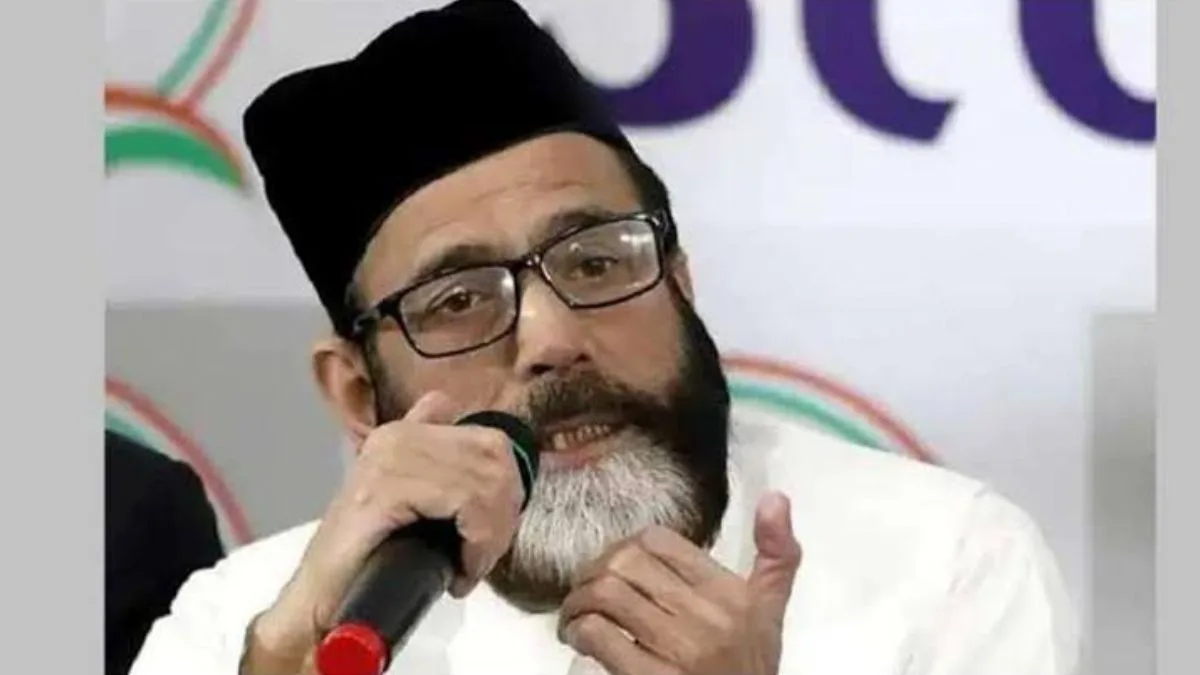
Maulana Tauqir Raza Khan : An Agent of communalistic chaos
On Monday, (July 15), radical preacher Maulana Tauqeer Raza announced that preparations were underway to publicly convert 5 Hindu women to Islam and conduct their nikkah (marriage) with their Muslim partners. He claimed to have received 23 applications, 5 from Hindu men and 15 women for converting to Islam. As part of his ulterior design, Tauqeer Raza has vowed to carry out the conversion of 5 Hindus and conduct nikkah with their Muslim partners in the first phase on July 21.
The mass conversion programme was scheduled to be held at the Khalil Higher Secondary School at 11 am on July 21, 2024. The educational institute is located in Bareilly district of Uttar Pradesh. Raza requested the district administration to give him the permission for organising the mass conversion programme. A letter to this effect was sent to the city Magistrate Rajiv Shukla by Raza’s aide and organisation in charge of Raza’s political party Ittehad-e-Millat Council (IMC), Nadeem Qureshi.
In a bid to divert attention from these deceitful conversions,this radical preacher Maulana Tauqeer Raza claimed that his organisation ‘Ittehad-e-Millat Council (IMC),’ had announced to not allow boys and girls to convert to Islam for the sake of love or greed. It is to be noted that when the cases of love jihad are on a rise in the present times, Maulana Tauqir Raza tried to whitewash this.
Tauqeer Raza had even gone to the extent to mainstream the conspiracy theory of the ‘Bhagwa Love trap’ which claims that a sinister ploy is supposedly underway to convert Muslim women to Hinduism by luring them to fall in love with Hindu men. If we go through the data the alone in Uttar Pradesh almost 100+ cases of love jihad had been found in the last year.
This is the same Tauqeer Raza on whom the Additional Session’s Judge Court in Uttar Pradesh has declared him as the mastermind behind the 2010 anti-Hindu Bareilly riots this year. Anti-Hindu riots rocked the Bareilly district in 2010 after a mob, which was part of a Muslim Barawafat procession, diverted from its decided route and attempted to forcefully pass through a Hindu area. Large-scale violence and arson by Islamists continued in parts bringing the city to a standstill owing to curfew for more than 10 days.
The founder of the All India Muslim Personal Law Board (Jadeed) and the Ittehad-e-Millat Council (IMC), Maulana Tauqeer Raza Khan has now been declared by a UP court as the mastermind of the Bareilly violence. The court in its order reportedly mentioned that the maulana had got a stage made in the Kohada Peer area and began addressing the procession with hate speech, inciting the mob. The court further cited the case diary which mentions that the Maulana, along with his party members, threatened the administration and the Hindus saying that if the procession is not allowed to pass through the Chahbai area then the result will not be good.
Way Forward
The politics of conversion threaten constitutional democracy and national spirituality. When conversion is used for political power or discrimination, it can be considered constitutional infidelity, weakening religious freedom and equality that many constitutions defend. The legacy of politically motivated conversion campaigns shapes global relations.
Political conversion has several motivations, including demographic engineering. Legal frameworks, economic incentives, and societal pressure are used. Religious minorities and social cohesiveness can be marginalised, confidence eroded, and human rights violated by conversion politics. These effects show that conversion politics affects more than religion. Indeed, a well-planned attitude like Love Jihad fosters friction and distrust in society and encourages divisive and separatist individuals to commit constitutionally forbidden crimes.
To develop a healthy and inclusive society, we must respect all faiths and cultures and defend human liberty, preferring pure heart change over distorted mindset reform. By sticking to key constitutional values, nations can only manage conversion politics and establish more inclusive, harmonious societies.
(Views expressed are personal)














Comments