
World Population Day: Demography, Democracy and Destiny
December 5, 2025
  • Read Ecopy
  • Circulation
  • Advertise
  • Careers
  • About Us
  • Contact Us
Android AppiPhone AppArattai
Organiser
  • ‌
  • Bharat
    • Assam
    • Bihar
    • Chhattisgarh
    • Jharkhand
    • Maharashtra
    • View All States
  • World
    • Asia
    • Europe
    • North America
    • South America
    • Africa
    • Australia
  • Editorial
  • International
  • Opinion
  • RSS @ 100
  • More
    • Op Sindoor
    • Analysis
    • Sports
    • Defence
    • Politics
    • Business
    • Economy
    • Culture
    • Special Report
    • Sci & Tech
    • Entertainment
    • G20
    • Azadi Ka Amrit Mahotsav
    • Vocal4Local
    • Web Stories
    • Education
    • Employment
    • Books
    • Interviews
    • Travel
    • Law
    • Health
    • Obituary
  • Subscribe
    • Subscribe Print Edition
    • Subscribe Ecopy
    • Read Ecopy
  • ‌
  • Bharat
    • Assam
    • Bihar
    • Chhattisgarh
    • Jharkhand
    • Maharashtra
    • View All States
  • World
    • Asia
    • Europe
    • North America
    • South America
    • Africa
    • Australia
  • Editorial
  • International
  • Opinion
  • RSS @ 100
  • More
    • Op Sindoor
    • Analysis
    • Sports
    • Defence
    • Politics
    • Business
    • Economy
    • Culture
    • Special Report
    • Sci & Tech
    • Entertainment
    • G20
    • Azadi Ka Amrit Mahotsav
    • Vocal4Local
    • Web Stories
    • Education
    • Employment
    • Books
    • Interviews
    • Travel
    • Law
    • Health
    • Obituary
  • Subscribe
    • Subscribe Print Edition
    • Subscribe Ecopy
    • Read Ecopy
Organiser
  • Home
  • Bharat
  • World
  • Operation Sindoor
  • Editorial
  • Analysis
  • Opinion
  • Culture
  • Defence
  • International Edition
  • RSS @ 100
  • Magazine
  • Read Ecopy
Home Bharat

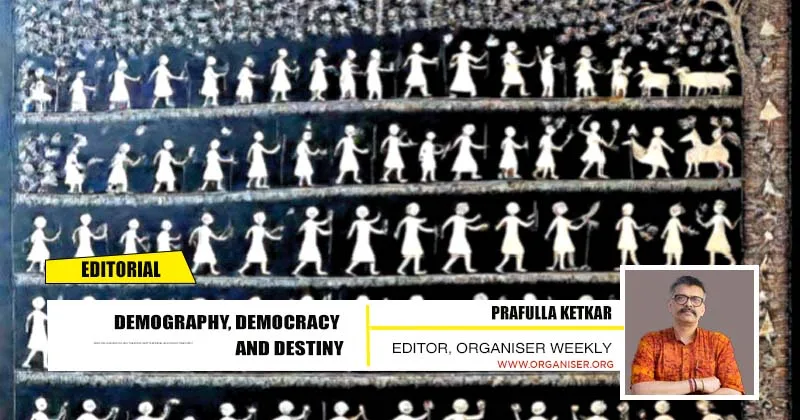
World Population Day: Demography, Democracy and Destiny

Prafulla KetkarPrafulla Ketkar
Jul 11, 2024, 08:00 am IST
in Bharat, Editorial
Follow on Google News
FacebookTwitterWhatsAppTelegramEmail

“Our country has a huge population–this is a reality. Nowadays there are two kinds of evaluation done on population. Population requires resources, if it keeps growing it becomes a big burden, perhaps an unbearable burden. Therefore, with the perspective of population control, plans are made. There is another dimension, in which population is considered an asset. Focus is on appropriate training and maximum usage. …. China has reversed its population control policy to population growth. Our national interest influences our thoughts on population matters. To beget, preserve and protect a populace apart from being relevant for national identity and security, is a subject that touches some other facets also. The number of children is linked with maternal health, education, financial status and individual wish. .. Population impacts the environment also. In summation, the population policy has to be formulated considering all these factors mindfully. It should be applicable to all; public awareness campaigns will be required to create a mindset of total observance of this policy. Only then rules pertaining to population control will yield results”. – Dr Mohan Bhagwat, Sarsanghchalak, Rashtriya Swayamsevak Sangh, in his Vijayadashmi Speech on October 5, 2022

The United Nations Development Programme (UNDP) designated July 11 as World Population Day in 1989, as the global population reached the five billion mark on the same day in 1987. Though the purpose of this annual event is to emphasise the urgency and importance of population issues and draw attention to the rapid growth of the global population and the adversities associated with it, there are different national connotations to the debate. For instance, countries like Japan have been facing a negative growth rate for decades, and China had to reverse the authoritative population control policy after implementing it for decades. That makes the population issue complex and nation-specific, with the core question of whether the population is a burden or an asset for the country. While discussing the population question in the Bharatiya context, we need a national discussion leading towards a comprehensive population policy.

Bharat is the world’s most populous country, and we should be concerned about it based on our national interest. There are three critical dimensions associated with it.

The population policy of 2000 has proved to be very effective in stabilising the population regarding the birth rate. Though we will continue to grow in absolute numbers as per the projections, the Total Fertility Rate (TFR) has declined from 3.2 in 2000 to 2.1 in 2023, which is considered as the replacement-level fertility, which is the average number of children needed per woman for each generation to replace itself without the need for international immigration. Similarly, the Infant Mortality Rate has declined from 68 to 26.13 in the corresponding period. The sex ratio is also addressed effectively in the process with schemes like Beti Bachao and Beti Padhao, which significantly improved the number of females for every 1000 males from 809 in 2001 to 929 in 2022.

The best part is that we achieved this without coercive policy and using educative and sensitisation programmes. We need to review whether the existing level of stabilisation is enough to convert the population into an asset rather than a burden.

Another dimension we need to focus on is the qualitative aspects of the existing and upcoming population. Different resource dimensions such as healthcare, education, employability and food security will depend on the planned utilisation of existing resources and the ability to distribute them equitably and inclusively to all sections of society. As a young country, we need a national perspective on the population policy to take advantage of the demographic dividend. With the growing challenge of environmental concerns, climate change, water scarcity and energy needs, which can potentially increase social strains and conflicts, balancing the aspirations of our population and resource mobilisation will be a critical decision. We need to review the entire process of mindless urbanisation and blind imitation of the Western development model based on consumerism. How we reinvent the Bharatiya model of sustainable development is vital for us and the global requirement.

Another critical dimension of population growth is the imbalance both in religious and regional terms. Despite stabilising the population at the national level, it is not the same in all religions and regions. There is a significant Muslim population growth in certain areas, especially bordering districts. The bordering States of West Bengal, Bihar, Assam and Uttarakhand are witnessing unnatural population growth due to illegal migration across the borders. In a democracy, when numbers are critical regarding representation and demography decides the destiny, we must be even more cautious of this trend. Politicians like Rahul Gandhi can afford to insult Hindu sentiments now and then, Mamata can play the blatant Muslim card even to accept the atrocities on women by the Islamists, and Dravidian parties can take pride in abusing the Sanatan Dharma only because of their confidence in the consolidation of so-called minority vote-bank developed with the population imbalance. Learning from the horrors of the Partition and what is happening with the politically correct but socially and culturally incorrect migration from West Asian and African countries, we have to address this issue urgently, as pointed out by various Rashtriya Swayamsevak Sangh resolutions and judicial pronouncements. Regional imbalance is another critical dimension that will impact the delimitation process of the Parliamentary Constituencies in the future. The States from the West and South are doing relatively better regarding population control measures and, therefore, fear losing a few seats in Parliament if the base population is changed after the census. Hence, we need policies to ensure that population growth does not disproportionately impact any single religious community or region, which can lead to socio-economic disparities and political conflicts.

Even before the commemoration of World Population Day, way back on December 10, 1974, the Henry Kissinger Report, which was titled ‘Implications of Worldwide Population Growth For U.S. Security and Overseas Interests’, talked about pushing for various means to control the population of countries like Bharat in all possible ways. Instead of getting carried away by the external agenda pushed through international organisations, research foundations and consultancy agencies, we should strive for a comprehensive National Population Policy, keeping in view the availability of resources in the country, future needs and the problem of demographic imbalance and apply the same uniformly to all.

Topics: Muslimdemographic imbalanceTotal Fertility RateWorld Population dayUNDPWorldwide Population GrowthBharatiya modelMuslim Population growth
Prafulla Ketkar
Prafulla Ketkar
Prafulla Ketkar, is the Editor, Organiser (Weekly) since 2013. He has a experience of over 20 years in the fields of research, media and academics. He is also Advisory Committee School of Journalism, Delhi University. He has been writing on issues related to International politics and foreign policy, with special reference to China and Democracy, Hindutva, and Bharatiya Civilisation. He was also a member of the Editorial team of the recently published Complete Works of Pt Deendayal Ji in 15 Volumes. He has 2 books, 29 academic articles, 2 entries in Encyclopedia of India and numerous articles to his credit. [Read more]
ShareTweetSendShareSend
✮ Subscribe Organiser YouTube Channel. ✮
✮ Join Organiser's WhatsApp channel for Nationalist views beyond the news. ✮
Previous News

MUDA Scam: Karnataka CM Siddaramaiah under fire, complaint filed against him with state election commission 

Next News

Karnataka: Neha Murder case in spotlight again; 483 page chargesheet rules out love jihad angle 

Related News

Attack on National Emblem at Hazratbal Shrine

Sunil Ambekar, Akhil Bharatiya Prachar Pramukh of Rashtriya Swayamsevak Sangh speaking at Tata Institute of Social Sciences in Mumbai where a documentary 'Demography is Destiny' was screened. The event commemorated Partition Horrors Remembrance Day

Changing demography of Bharat is a matter of concern and requires in-depth analysis

Karnataka: Protests erupt over Ishrath’s connection with Pakistan linked organisation MFI; Police launch probe

International Day of Population: Addressing global issues and demographic shifts

Representative Image

World Population Day: Youth of India hold key to ‘Viksit Bharat’

Book Review: Treatise by the warrior thinker

Load More

Comments

The comments posted here/below/in the given space are not on behalf of Organiser. The person posting the comment will be in sole ownership of its responsibility. According to the central government's IT rules, obscene or offensive statement made against a person, religion, community or nation is a punishable offense, and legal action would be taken against people who indulge in such activities.

Latest News

23rd India-Russia Annual Summit

India-Russia Summit heralds new chapter in time-tested ties: Inks MoUs in economic, defence, tourism & education

DGCA orders probe into IndiGo flight disruptions; Committee to report in 15 days

BJYM leader Shyamraj with Janaki

Kerala: Widow of BJP worker murdered in 1995 steps into electoral battle after three decades at Valancherry

Russian Sber bank has unveiled access to its retail investors to the Indian stock market by etching its mutual fund to Nifty50

Scripting economic bonhomie: Russian investors gain access to Indian stocks, Sber unveils Nifty50 pegged mutual funds

Petitioner S Vignesh Shishir speaking to the reporters about the Rahul Gandhi UK citizenship case outside the Raebareli court

Rahul Gandhi UK Citizenship Case: Congress supporters create ruckus in court; Foreign visit details shared with judge

(L) Kerala High Court (R) Bouncers in Trippoonithura temple

Kerala: HC slams CPM-controlled Kochi Devaswom Board for deploying bouncers for crowd management during festival

Fact Check: Rahul Gandhi false claim about govt blocking his meet with Russian President Putin exposed; MEA clears air

Union Minister for Road Transport and Highways Nitin Gadkari (Right)

India set for highway overhaul as Union Minister Nitin Gadkari unveils nationwide shift to MLFF electronic tolling

RSS Akhil Bharatiya Prachar Pramukh Shri Sunil Ambekar

When Narrative Wars result in bloodshed, countering them becomes imperative: Sunil Ambekar

Ministry of Civil Aviation mandates emergency action: IndiGo ordered to stabilise flight operations by midnight

Load More
  • Privacy
  • Terms
  • Cookie Policy
  • Refund and Cancellation
  • Delivery and Shipping

© Bharat Prakashan (Delhi) Limited.
Tech-enabled by Ananthapuri Technologies

  • Home
  • Search Organiser
  • Bharat
    • Assam
    • Bihar
    • Chhattisgarh
    • Jharkhand
    • Maharashtra
    • View All States
  • World
    • Asia
    • Africa
    • North America
    • South America
    • Europe
    • Australia
  • Editorial
  • Operation Sindoor
  • Opinion
  • Analysis
  • Defence
  • Culture
  • Sports
  • Business
  • RSS @ 100
  • Entertainment
  • More ..
    • Sci & Tech
    • Vocal4Local
    • Special Report
    • Education
    • Employment
    • Books
    • Interviews
    • Travel
    • Health
    • Politics
    • Law
    • Economy
    • Obituary
  • Subscribe Magazine
  • Read Ecopy
  • Advertise
  • Circulation
  • Careers
  • About Us
  • Contact Us
  • Policies & Terms
    • Privacy Policy
    • Cookie Policy
    • Refund and Cancellation
    • Terms of Use

© Bharat Prakashan (Delhi) Limited.
Tech-enabled by Ananthapuri Technologies