Tax Terrorism Under UPA Rule: A deep dive into harsh tax regime, GST and its impact on business
December 5, 2025
  • Read Ecopy
  • Circulation
  • Advertise
  • Careers
  • About Us
  • Contact Us
Android AppiPhone AppArattai
Organiser
  • ‌
  • Bharat
    • Assam
    • Bihar
    • Chhattisgarh
    • Jharkhand
    • Maharashtra
    • View All States
  • World
    • Asia
    • Europe
    • North America
    • South America
    • Africa
    • Australia
  • Editorial
  • International
  • Opinion
  • RSS @ 100
  • More
    • Op Sindoor
    • Analysis
    • Sports
    • Defence
    • Politics
    • Business
    • Economy
    • Culture
    • Special Report
    • Sci & Tech
    • Entertainment
    • G20
    • Azadi Ka Amrit Mahotsav
    • Vocal4Local
    • Web Stories
    • Education
    • Employment
    • Books
    • Interviews
    • Travel
    • Law
    • Health
    • Obituary
  • Subscribe
    • Subscribe Print Edition
    • Subscribe Ecopy
    • Read Ecopy
  • ‌
  • Bharat
    • Assam
    • Bihar
    • Chhattisgarh
    • Jharkhand
    • Maharashtra
    • View All States
  • World
    • Asia
    • Europe
    • North America
    • South America
    • Africa
    • Australia
  • Editorial
  • International
  • Opinion
  • RSS @ 100
  • More
    • Op Sindoor
    • Analysis
    • Sports
    • Defence
    • Politics
    • Business
    • Economy
    • Culture
    • Special Report
    • Sci & Tech
    • Entertainment
    • G20
    • Azadi Ka Amrit Mahotsav
    • Vocal4Local
    • Web Stories
    • Education
    • Employment
    • Books
    • Interviews
    • Travel
    • Law
    • Health
    • Obituary
  • Subscribe
    • Subscribe Print Edition
    • Subscribe Ecopy
    • Read Ecopy
Organiser
  • Home
  • Bharat
  • World
  • Operation Sindoor
  • Editorial
  • Analysis
  • Opinion
  • Culture
  • Defence
  • International Edition
  • RSS @ 100
  • Magazine
  • Read Ecopy
Home Bharat

Tax Terrorism Under UPA Rule: A deep dive into harsh tax regime, GST and its impact on business

The GST, introduced by the Modi government, has made India's tax system simpler by unifying tax rates across all states. This change has made it easier for businesses to operate and for people to understand their taxes. It has also lowered taxes on essential items, giving financial relief to everyday people and helping the economy grow by being more transparent and efficient

WEBDESKWEBDESK
Jul 10, 2024, 09:00 am IST
in Bharat, Economy
Follow on Google News
Representative Image

Representative Image

FacebookTwitterWhatsAppTelegramEmail

Before the implementation of GST, the tax structure in India was complicated and had multiple layers of taxation at both the central and state levels. Items were taxed differently across various states. This was the cause of lack of uniformity and increased compliance costs for businesses. The GST has harmonised the tax rates and brought consistency across the country. Due to this simplification, businesses can easily operate and it is easier for consumers to understand the taxes they are paying.

The Goods and Services Tax (GST) was implemented on July 1, 2017, under the leadership of Prime Minister Narendra Modi. It has been a transformative reform in India’s taxation system. One of the most significant impacts of GST has been the reduction in the tax burden on the common man, providing much-needed financial relief. This landmark tax reform replaced multiple indirect taxes with a unified tax system and simplified the tax structure and made it more transparent.

Tax Relief to the Common Man
Multiple daily use items before and after the implementation of GST:
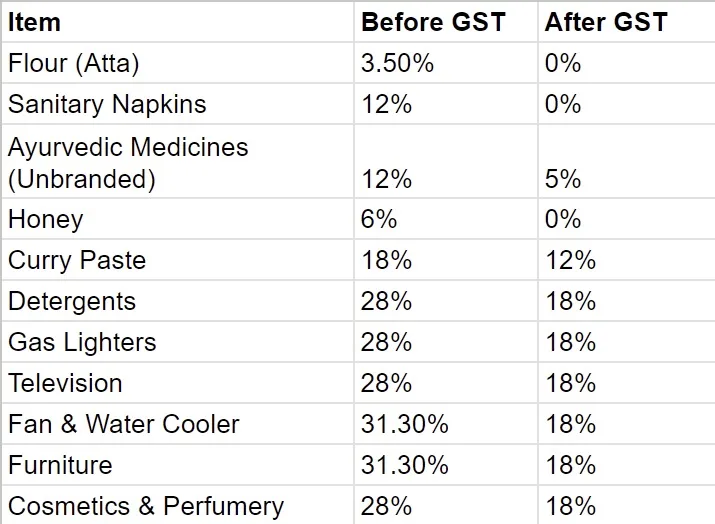
Items like flour (atta), sanitary napkins, and honey, which are essential for daily living, have seen their tax rates reduced to zero. Before GST, these items were taxed at rates ranging from 3.5 per cent to 12 per cent, making them less affordable for many households.

Reduced Tax Burden on Common Man
Prices of various daily use items before and after the implementation of GST:
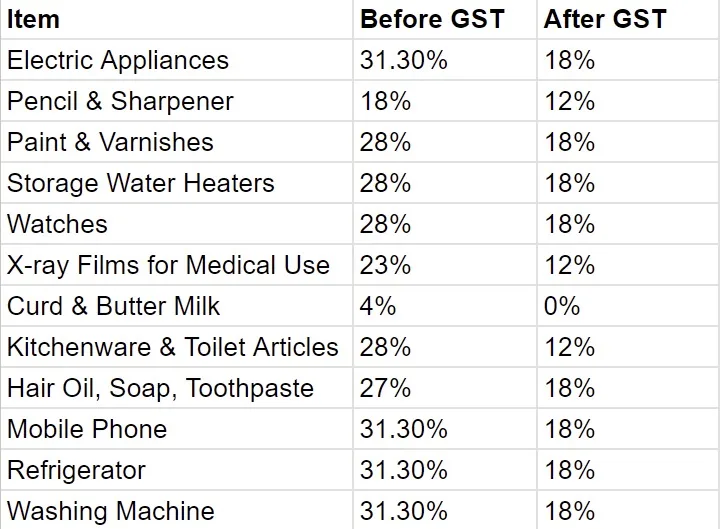
Additionally, products like detergents, gas lighters, and televisions, which previously attracted a tax rate of 28 per cent, are now taxed at 18 per cent. This reduction has made these items more affordable for the average household and has eased the cost of living.

Read More: Sengol Controversy: Sanctity of dharma danda

The tax relief extends to consumer durables as well. Items such as electric appliances, storage water heaters, and refrigerators, which were taxed at a high rate of 31.3 per cent, now have a more reasonable tax rate of 18%. This has reduced the overall cost of these goods, making them more accessible to a larger section of the population.

Sanitary napkins which were previously taxed at 12 per cent, are now exempt from GST, reflecting the government’s commitment to promoting women’s health and hygiene. This exemption is a significant step towards making sanitary products more affordable and accessible.

Furthermore, the tax rates on hair oil, soap, and toothpaste have been reduced from 27 per cent to 18 per cent, lowering the cost of these essential personal care items. This reduction ensures that basic hygiene products are within reach for more consumers, improving overall public health standards.

The GST reform has not only simplified the tax structure but also provided much-needed financial relief to millions of Indian households, underscoring the Modi government’s commitment to economic inclusivity and consumer welfare.

The Goods and Services Tax (GST) regime, implemented under the Modi government, has significantly bolstered the “Make in India” initiative by reducing the overall tax burden on manufacturing. This reform has played a pivotal role in making Indian goods more competitive in the global market.

By eliminating the cascading effect of multiple taxes, GST has lowered the cost of production. This reduction in production costs has made Indian products more attractive to both domestic and international buyers. As a result, foreign investment has surged, and domestic manufacturing has received a substantial boost, leading to job creation and economic development.

The introduction of GST has made tax administration more transparent. The online GST portal has simplified tax compliance for businesses, reducing the scope for corruption and tax evasion. This streamlined tax process has cut down the time and effort required for filing taxes, making it more efficient for businesses of all sizes.

Overall, the GST regime has not only supported the “Make in India” initiative but has also enhanced economic growth by fostering a more transparent and efficient tax system.

The implementation of the Goods and Services Tax (GST) under the Modi government has emerged as a transformative reform for the Indian economy. By reducing the tax burden on essential and daily use items, the government has provided substantial financial relief to the common man.

The GST regime has introduced a simplified tax structure, which has increased transparency and efficiency in the tax system. This landmark reform has not only made goods more affordable but also given a significant boost to domestic manufacturing. These achievements underscore the success of the GST implementation.

The reduction in tax rates on essential items has eased the cost of living for millions of consumers. Additionally, the streamlined tax process has facilitated ease of business, fostering a more conducive environment for economic activities.

Overall, the GST has set the stage for sustained economic growth and development, benefiting millions of consumers and businesses across India. The positive impact of this reform is evident in the increased affordability of goods and the enhanced transparency and efficiency in the tax administration.

Topics: GSTPM Narendra ModiUPAGoods and Services Tax
Share1TweetSendShareSend
✮ Subscribe Organiser YouTube Channel. ✮
✮ Join Organiser's WhatsApp channel for Nationalist views beyond the news. ✮
Previous News

Bharat has fully integrated all SDGs into its national strategy: Indian Envoy to UN Yojana Patel

Next News

Baloch National Gathering 2024: Community leaders, organisations in Pakistan to protest against CPEC, genocide

Related News

Former Mizoram governor Swaraj Kaushal passes away

Former Mizoram Governor Swaraj Kaushal passes away; PM Modi expresses condolences

(Left) PM Narendra Modi (Right) Russian President Vladimir Putin

Time-Tested Allies: Why Russian President Vladimir Putin’s visit to Bharat matters

Tamil Nadu: DMK government’s false GST narrative against central government falls flat against data

Representative Image

Rare Earth Elements: Importance, impact on international dynamics, and steps taken by Bharatiya Govt to support REE

Tamil Nadu: Governor Ravi slams DMK: “No chair for Bharati, but Karunanidhi honoured”—questions Tamil commitment

Ayodhya Ram Mandir Dhwajarohan 2025

Ayodhya Ram Mandir wave drives the trillion-dollar dream of Uttar Pradesh forward

Load More

Comments

The comments posted here/below/in the given space are not on behalf of Organiser. The person posting the comment will be in sole ownership of its responsibility. According to the central government's IT rules, obscene or offensive statement made against a person, religion, community or nation is a punishable offense, and legal action would be taken against people who indulge in such activities.

Latest News

Petitioner S Vignesh Shishir speaking to the reporters about the Rahul Gandhi UK citizenship case outside the Raebareli court

Rahul Gandhi UK Citizenship Case: Congress supporters create ruckus in court; Foreign visit details shared with judge

(L) Kerala High Court (R) Bouncers in Trippoonithura temple

Kerala: HC slams CPM-controlled Kochi Devaswom Board for deploying bouncers for crowd management during festival

Fact Check: Rahul Gandhi false claim about govt blocking his meet with Russian President Putin exposed; MEA clears air

Union Minister for Road Transport and Highways Nitin Gadkari (Right)

India set for highway overhaul as Union Minister Nitin Gadkari unveils nationwide shift to MLFF electronic tolling

RSS Akhil Bharatiya Prachar Pramukh Shri Sunil Ambekar

When Narrative Wars result in bloodshed, countering them becomes imperative: Sunil Ambekar

Ministry of Civil Aviation mandates emergency action: IndiGo ordered to stabilise flight operations by midnight

Chhattisgarh CM Vishnu Deo Sai at Panchjanya Conclave, Nava Raipur, Image Courtesy - Chhattisgarh govt

Panchjanya Conclave: Chhattisgarh CM Sai shares views on development projects in Maoist hotbed, women empowerment

Union Finance Minister Nirmala Sitharaman

‘TMC is holding Bengal back’: Sitharaman slams Mamata govt over industrial & healthcare setbacks

Karnataka: Muslim youth Mohammed Usman accused of sexual assault, blackmail & forced conversion in Bengaluru

Social Justice Is a cover; Anti-Sanatana dharma is the DMK’s real face at Thirupparankundram

Load More
  • Privacy
  • Terms
  • Cookie Policy
  • Refund and Cancellation
  • Delivery and Shipping

© Bharat Prakashan (Delhi) Limited.
Tech-enabled by Ananthapuri Technologies

  • Home
  • Search Organiser
  • Bharat
    • Assam
    • Bihar
    • Chhattisgarh
    • Jharkhand
    • Maharashtra
    • View All States
  • World
    • Asia
    • Africa
    • North America
    • South America
    • Europe
    • Australia
  • Editorial
  • Operation Sindoor
  • Opinion
  • Analysis
  • Defence
  • Culture
  • Sports
  • Business
  • RSS @ 100
  • Entertainment
  • More ..
    • Sci & Tech
    • Vocal4Local
    • Special Report
    • Education
    • Employment
    • Books
    • Interviews
    • Travel
    • Health
    • Politics
    • Law
    • Economy
    • Obituary
  • Subscribe Magazine
  • Read Ecopy
  • Advertise
  • Circulation
  • Careers
  • About Us
  • Contact Us
  • Policies & Terms
    • Privacy Policy
    • Cookie Policy
    • Refund and Cancellation
    • Terms of Use

© Bharat Prakashan (Delhi) Limited.
Tech-enabled by Ananthapuri Technologies