





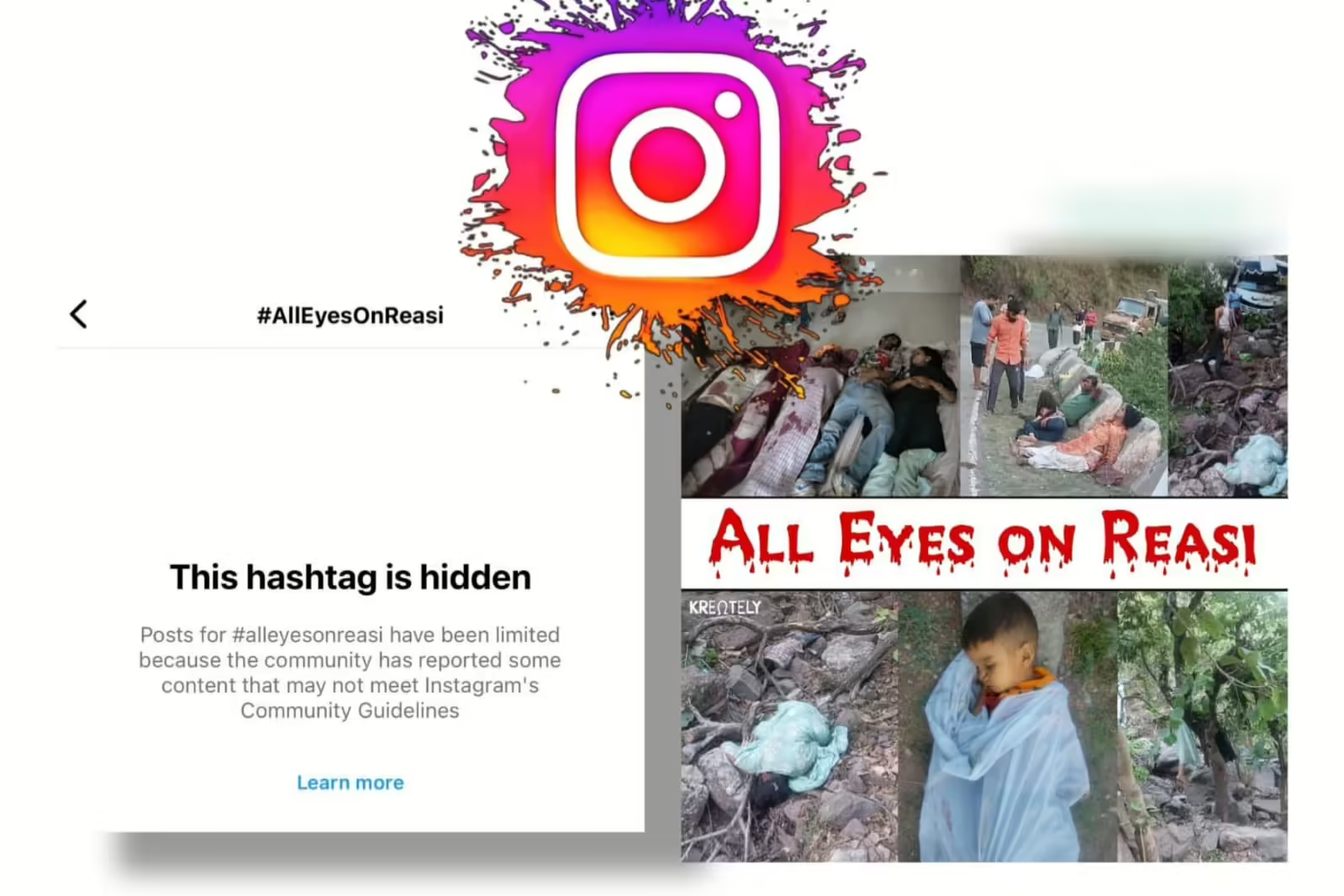
On June 9, terrorists in Jammu’s Reasi district opened fire on unarmed Hindu pilgrims returning from a temple visit, resulting in 9 deaths and over 40 injuries. The attack coincided with Prime Minister Narendra Modi’s National Democratic Alliance taking the oath for their third consecutive term in Delhi. Reports indicate that the attack was premeditated, with the timing chosen to undermine the government’s zero-tolerance stance on terrorism and its claims of having restored peace in the valley region with the abrogation of Article 370.
Notably, At least 9 pilgrims were killed and over 33 injured in the attack. The attackers opened fire at Hindus returning from Shiv Khori temple to Katra. The terrorists had planned this attack specifically for June 9, coinciding with the time when the PM Modi-led NDA government was sworn in for its third consecutive term. There were as many as four attackers.
In response to the attack, widespread outrage erupted on social media platforms such as X, Instagram, Facebook, and YouTube. A trend called “All Eyes on Reasi” gained traction, mirroring the earlier “All Eyes on Rafah” trend that emerged after Israel’s military operation in Gaza, which garnered support from over 33 million Indians, including various activists and celebrities. It was later revealed that many who supported the “All Eyes on Rafah” trend had received money in exchange.
Organiser’s report revealed that celebrities were offered different price tiers for posting specific content on social media platforms. Accounts with one to 100 thousand followers were offered USD 10, while those with over 50 million followers could receive up to USD 20,000. The report also highlighted a pattern of selective outrage among these celebrities: they vocally support victims from one community but fall silent when the victims are Hindu and the oppressors are Muslim.
However, as soon as “All Eyes on Reasi” began to gain momentum, Meta’s Instagram banned the trend from its platform. Posts under this hashtag were hidden, and users could not see the trend on Instagram. This move sparked criticism and accusations of bias against the platform.
Prominent voices spoke out against Instagram’s actions.
Lawyer Shashank Shekhar Jha wrote on X, “Shame on you, @instagram for banning #AllEyesOnReasi. Instagram allowed #AllEyesOnRafah but banned showing the sufferings of Hindus. Why is @Meta under @finkd so intolerant against Islamic terrorism? Alternatively, X under @elonmusk has proved to be a place to seek justice.”
Shame on you, @instagram for banning #AllEyesOnReasi.
Instagram allowed #AlleyesonRafah but banned showing the sufferings of Hindus.
Why is @Meta under @finkd so intolerant against Islamic terrorism?
Alternatively,
X under @elonmusk has proved to be a place to seek justice. pic.twitter.com/VHsvgiOcxq— Shashank Shekhar Jha (@shashank_ssj) June 10, 2024
Similarly, other activists criticised Instagram for promoting #AllEyesOnRafah while blocking #AllEyesOnReasi, accusing Meta of bias against India and Hindus and calling for the new government to take action.
Instagram was promoting #AlleyesonRafah but blocked #AllEyesOnReasi hashtag.@Meta @finkd is openly working on Left/IsIamic line against India & Hindus.
High time the new govt should grill them. They’ve been doing this for a long time.. They allow only anti Hindu contents. pic.twitter.com/ixw5S8ACc0
— Mr Sinha (Modi’s family) (@MrSinha_) June 10, 2024
Many users expressed their anger and demanded stringent actions from the Indian government against those responsible for the perceived censorship and partiality.
It is important to note that creators producing nationalist content have reported that YouTube India has been shadow-banning their content and intentionally demonetising it to limit its reach.
On June 3, Organiser reported that numerous YouTubers were experiencing shadow bans and demonetisation, preventing their content from reaching viewers. Notably, those affected had reported a landslide victory for the BJP and a significant defeat for Congress under Rahul Gandhi.
These creators have taken to social media to demand action against what they perceive as partial treatment by YouTube India and relevant ministries, but their appeals have gone unanswered. Prominent voices among them include senior journalist Ajeet Bharti, Editor of The New Indian Rohan Dua, TV journalist Sushant Sinha, Jaipur Dialogues, and YouTube creators AKTK and Ankur Arya, among others.
Highlighting the alleged bias affecting the free press on YouTube, Rohan Dua wrote on X, “I’m hearing India’s intelligence agencies have been supplied with recorded conversations of 17 @YouTubeIndia employees in India who explicitly wrote & spoke instructions on how to shadow ban any neutral coverage & promote anti-@narendramodi trash. It’s a criminal offence to influence polls & I have been told investigations have begun.”
The allegations suggest that whenever creators mention opposition leaders or anyone from the I.N.D.I Alliance, their videos are flagged for profanity and demonetised. The creators must then raise an issue, prompting a response from the team, which typically takes two to three days. During this time, the news becomes outdated, diminishing the video’s relevance and viewership.
Ajeet Bharti shared in a post, “In the last 45 days, YouTube demonetised 35 videos and re-monetised 32 of them upon appeal. It took them 2-5 days to re-monetise, meaning even if they did it after 12 hours, it resulted in zero revenue for creators. Just imagine—they were wrong 32 out of 35 times during the peak election period.”
In a related development, on June 1, OpenAI, the prominent artificial intelligence research organisation known for developing ChatGPT, reported on a covert influence operation allegedly designed to sway Indian electoral outcomes. The operation, reportedly orchestrated by an Israeli firm, STOIC, utilised AI models to generate and disseminate anti-BJP and pro-Congress content across various social media platforms.
OpenAI’s report claims that STOIC, a political campaign management firm, ran a network of accounts that posted AI-generated content critical of the ruling Bharatiya Janata Party (BJP) and supportive of the opposition Congress party. This network, active on platforms including X (formerly Twitter), Facebook, Instagram, websites, and YouTube, aimed to manipulate public opinion and influence the election results through deceptive means.
The operation, dubbed “Zero Zeno” by OpenAI, targeted audiences in India, Canada, the United States, and Israel, with content primarily in English and Hebrew. The Indian component of the operation began in early May, focusing on generating English-language content to influence Indian voters.
According to OpenAI, its defence mechanisms identified and disrupted these influence operations, suspending these actors’ use of its AI models before significant harm could be inflicted. This intervention is part of OpenAI’s broader efforts to counter deceptive and abusive activities using AI models over the past three months.
The report categorises the influence operation as part of a broader trend involving similar activities from Russia, China, and Iran.
This ongoing attempt by international forces to disrupt democracy in India underscores the urgent need for the government to take action to curb these agendas and expose the forces behind them.











Comments